Pros and Cons of Log Periodic Antenna in Field Measurements






2026-07-17 16:00:54
Modern field measurement tasks can't be done without Log Periodic Antennas (LPAs), which provide amazing wideband frequency coverage across multiple octaves without the need for antenna swaps. When bandwidth freedom is very important, like in EMC testing, spectrum tracking, and mobile messaging, these frequency-independent devices really shine. But because they are big, have moderate gain, and need to match impedance, they need to be carefully evaluated. When purchasing field measurement systems, procurement teams can make smart choices that balance measurement accuracy, operational efficiency, and budget constraints by knowing the pros and cons of LPAs.
Understanding Log Periodic Antennas in Field Measurements
What Defines a Log-Periodic Antenna?
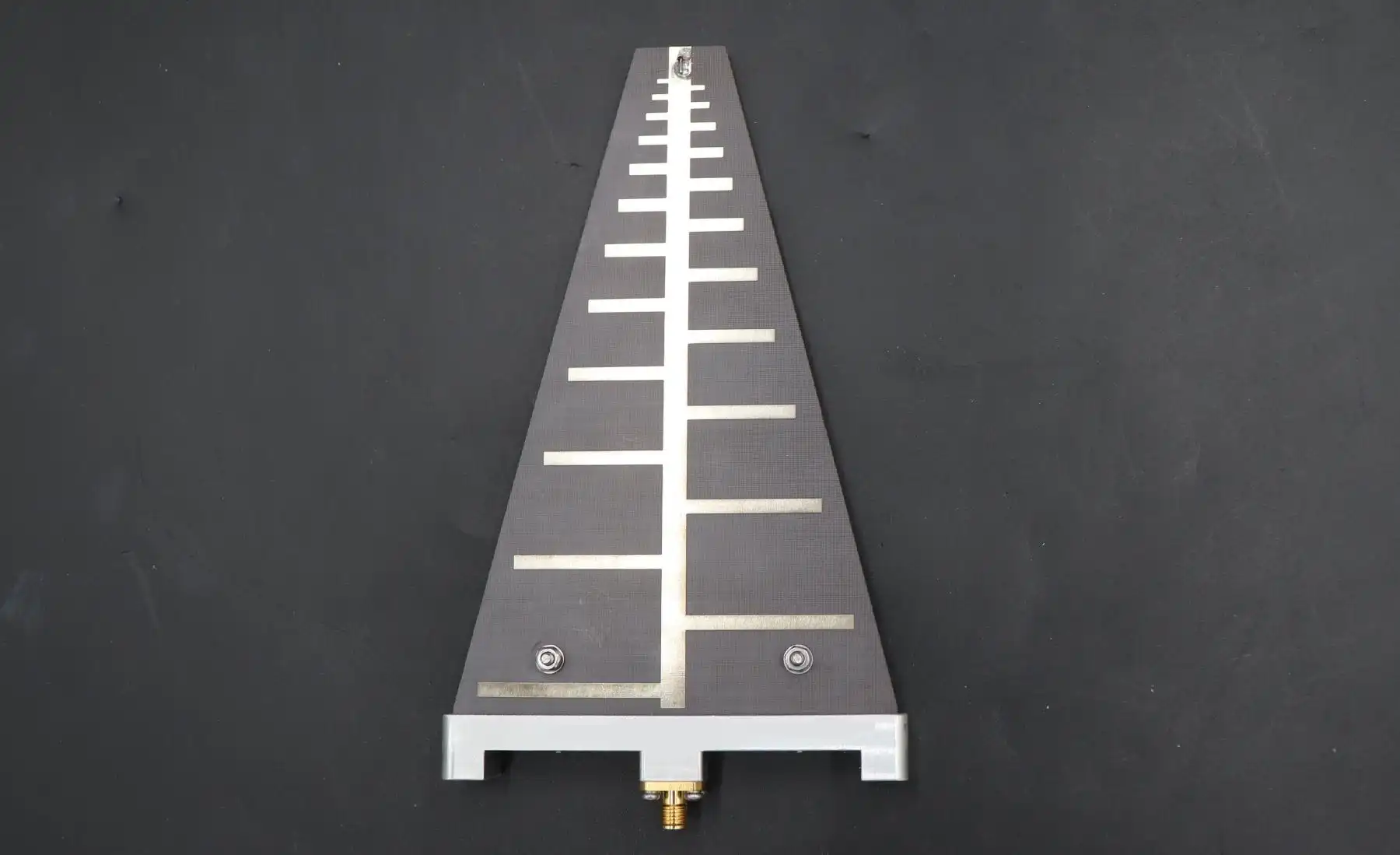
A log-periodic antenna, also called a log-periodic dipole array (LPDA), is a directional antenna that works the same way across very large bandwidths. Its performance is not affected by frequency. The log-periodic antenna is different from other narrowband antennas because it has dipole elements grouped in a logarithmic sequence along a center boom. Because of its unique shape, the antenna's active region can change dynamically as the frequency changes. Elements that are shorter respond to higher frequencies, while elements that are longer respond to lower frequencies. The antenna's bandwidth and gain are based on the mathematical relationship between element spacing (tau) and scaling factor (sigma). During the active band, the antenna should be able to keep VSWR below 2.0:1 and frequency ratios between 10:1 and 20:1.
Operational Theory and Design Principles
The building plan uses a self-scaling architecture, which means that each new part stays the same size in relation to the ones that came before it. This logarithmic pattern makes the resistance behave predictably across the frequency range, getting rid of the resonance spikes that are common in narrowband designs. A balanced gearbox line going through the boom is usually used for the feed system. This line acts as an endless balun to keep the pattern from distorting. In real-world measures, this means that the device will work reliably at 80 MHz or 3 GHz without needing to be recalibrated or physically changed. With front-to-back ratios of more than 20 dB, the radiation pattern stays one-directional, which does a great job of blocking out unwanted signals coming from behind the antenna.
Comparison with Alternative Antenna Technologies
When choosing a log-periodic antenna for field readings, comparing log-periodic antennas to other choices makes their unique value clear. Yagi-Uda antennas have a higher gain (12–15 dBi), but they can only work over a narrow range of frequencies, usually 10–15% of the center frequency. Omnidirectional antennas cover all directions over a wide range of bandwidths, but they give up all directional gain. Dipole antennas are easy to use and don't cost much, but they need to be tuned for each frequency band. Log-periodic antenna designs are in the middle, giving modest gain (6–8 dBi) and great frequency versatility. Log-periodic antennas are the best choice when measurement methods need to be able to change frequencies without losing accuracy in direction. This is important in a wide range of situations, from checking for electromagnetic interference (EMI) to setting up military radio links.
Advantages of Log Periodic Antennas in Field Measurements
Log-periodic antenna designs are always the first choice of field measurement professionals because they solve basic operational problems that plague narrowband alternatives. These antennas are very useful in tough settings because they cover a wide frequency range, are mechanically strong, and give accurate measurements.
Exceptional Wideband Frequency Coverage
Log-periodic antennas are popular because they can cover frequency ranges of more than one octave with a single device. Modern precision models can usually work from 30 MHz to 3 GHz, so they don't need to move, store, and switch out multiple antennas while they're working in the field. This feature directly fixes the problem of spectral splitting that comes up a lot in testing and tracking the spectrum for telecoms. When checking for regulatory compliance, going from VHF to UHF bands is necessary. A good log-periodic antenna keeps the antenna factor (AF) predictability constant the whole time, which makes sure that measurements are accurate and repeatable. The operational efficiency gains are big—automated test sequences run without stopping, which cuts lab rental costs and project timelines by 30–40% compared to setups with multiple antennas.
Stable Radiation Pattern and Gain Consistency
Log-periodic antennas have very stable radiation traits across their full frequency range, unlike resonant antennas whose performance drops quickly when they are not in resonance. The change in gain stays within ±2 dB most of the time, so testing results are always the same, no matter what the test frequency is. This stability is very helpful for testing EMC/EMI compliance according to IEC 61000-4-3, since accurate measurements of field strength depend on factors that are known about the antenna. The constant beamwidth and front-to-back ratio are also good for direction-finding tasks because they make it easy for operators to find signal sources across the monitored spectrum. Cross-polarization discrimination is more than 20 dB, so it's possible to accurately characterize both horizontal and vertical signal components during field surveys. Polarisation purity stays high throughout the band.
Environmental Durability and Mechanical Robustness
Quality log-periodic antennas made for field placement are made with strong materials and have weatherproofing features that are necessary for tough outdoor settings. Precision types are made with 6061-T6 aluminum parts and stainless steel gears, which makes them very resistant to rust, even in marine settings. Boom designs that are made to handle wind speeds of more than 160 km/h make sure that the machine stays stable while readings are being taken outside in bad weather. A lot of professional-grade log-periodic antennas have MIL-STD-810 certifications for shock and vibration, which means they can be used on temporary masts or vehicles that are moving around. The sealed coaxial feed systems keep out moisture, so the electrical performance and VSWR stay stable across temperature ranges from -40°C to +85°C. This meets the weather adaptability needs that are important for global application scenarios.
Versatile Application Across Multiple Industries
Log-periodic antenna designs can be used in a wide range of measurement situations and industries. Log-periodic antennas make it possible to do full 5G/6G site scans and measure both uplink and downlink bands without having to change any tools. Spectrum monitoring groups use rotatable log-periodic antennas to find frequency-hopping emitters and triple-check signals for interference. They do this by using the antennas' broad range to find interference. Defense uses military log-periodic antennas for over-the-horizon radar links and testing electronic countermeasures. Frequency agility gives them operating freedom against attempts to stop them. The flat antenna factor graph makes calibration easier and lowers measurement error, which is appreciated by research labs that measure antenna range. This ability to work with different types of industries makes the most of the return on investment, since a single antenna platform can meet the needs of many testing protocols and projects.
Table 1: Typical Log Periodic Antenna Performance Specifications
| Parameter | Specification Range | Application Impact |
|---|---|---|
| Frequency Coverage | 30 MHz – 3 GHz | Multi-band testing capability |
| VSWR | < 2.0:1 (typical < 1.5:1) | Efficient power transfer, minimal reflection loss |
| Gain | 6 – 8 dBi | Balanced sensitivity and beamwidth |
| Front-to-Back Ratio | > 20 dB | Excellent rear rejection, reduced interference |
| Impedance | 50 Ohm | Standard coaxial system compatibility |
| Power Handling | 50 – 100 W (up to kW for specialized models) | Suitable for transmission and reception testing |
These performance characteristics collectively address key customer needs for LPA-wide bandwidth coverage, low insertion loss, and reliable measurement accuracy across demanding field environments.
Limitations and Challenges of Using Log Periodic Antennas
Log-periodic antennas have many good points, but teams that are buying them need to take those pros and cons into account. That way, you can be sure that your goals are reasonable and that your application fits well.
Physical Size and Weight Considerations
Log-periodic antennas do work well with a lot of frequencies, but they work well with more frequencies than they need to. As a general rule, antennas need parts that are almost half the range of the lowest frequency they can work at in order to cover an octave. Most 30-500 MHz log-periodic antennas are 2 to 3 meters long, and the distance between their elements is more than 1.5 meters. They are hard to move and set up because of this. Most of the time, these types weigh more than 5 to 8 kilos as well. They are harder to move and need strong tools to mount because of this. This extra weight is a big problem when there isn't much room, like on an airplane or at a drone station. Less bandwidth may not be a bad thing if it means better results. Field teams that want to use log-periodic antennas should think about getting bigger trucks and better ways to help them.
Moderate Gain Compared to Specialized Designs
Because the design theory doesn't depend on frequency, peak gain performance has to be given up. A Yagi antenna that has been tuned might get 12 to 15 dBi gain at its design frequency. On the other hand, a log-periodic antenna in the same band will only get 6 to 8 dBi gain most of the time. The measurement range is cut in half if the difference is 4-6 dB, or you need four times as much send power to get the same field strength. Log-periodic antennas might not be the best choice if you need to be very sensitive to weak signals, like for long-distance point-to-point lines or conversations in deep space. When the frequency range is small, it is better to use parabolic mirrors and high-gain Yagi arrays instead of log-periodic antennas. When buying, managers think about how to measure things, they need to carefully consider whether the extra bandwidth is worth the loss. You need to do this if you want to try with set frequencies or small bands that work best with certain antennas.
Impedance Matching Complexities
It might not be easy to get the best impedance match across the whole operational bandwidth. This could make the measurements less accurate. Log-periodic antennas that work well keep their VSWR below 2.0:1 over the whole range. However, resistance changes still happen, especially near the ends of the bands. It is possible for measurements to be wrong if these differences aren't properly characterized through testing. The phase center shift effect makes it harder to measure in the near field because the radiation source moves along the boom as the frequency changes. The geometry of the test setup needs to be carefully planned to avoid this effect. When you put wires in the wrong place, they can mess up the radiation pattern and make the system work less well. This is why the feed line route is so important. There is a lot of work that test engineers have to do to make sure that the feed wires go behind the antenna and past the longer parts. They might also need support structures that aren't made of metal to keep the pattern from warping while they take accurate measurements.
Cost and Return on Investment Analysis
It is very expensive to buy a good, calibrated log-periodic antenna. Depending on the frequency range and level of accuracy needed, they can cost anywhere from $800 to $3,000. Each professional model that is certified by MIL-STD and comes with its own calibration report can cost more than $5,000. The initial cost of this investment has to be weighed against the money that will be saved by having less antenna inventory and faster test processes. The business case is easier to make when companies do different types of measurement projects and don't have to buy multiple antennas because they can connect to the internet. Some labs may find that dedicated antennas are a better deal if they only need to test in a small frequency range. Multi-element arrays are mechanically complex and need to have their links between elements and the stability of the boom checked on a regular basis to make sure they meet performance standards. This is why total cost of ownership estimates should include upkeep costs.
Table 2: Comparative Analysis of Field Measurement Antenna Types
| Antenna Type | Bandwidth | Typical Gain | Portability | Best Application |
|---|---|---|---|---|
| Log Periodic | 10:1 to 20:1 | 6-8 dBi | Moderate (bulky) | Wideband testing, EMC compliance |
| Yagi-Uda | 10-15% | 12-15 dBi | Good | Narrowband, long-range links |
| Discone | 10:1+ | 2-4 dBi | Excellent | Omnidirectional monitoring |
| Dipole | 5-10% | 2.15 dBi | Excellent | Simple narrowband testing |
| Parabolic | < 5% | 20-30+ dBi | Poor (very bulky) | High-gain point-to-point links |
This comparison illustrates how LPAs (log-periodic antennas) occupy a unique niche, trading ultimate gain for bandwidth flexibility—a trade-off that proves advantageous in multi-frequency field measurement scenarios.
Conclusion
Log-periodic antennas deliver unmatched bandwidth flexibility for field measurement applications, covering multi-octave frequency ranges with consistent radiation patterns and reliable gain characteristics. Their ability to eliminate antenna swaps during test sequences generates substantial operational efficiencies in EMC compliance testing, spectrum monitoring, and tactical communications. However, the trade-offs in physical size, moderate gain, and upfront cost require careful evaluation against specific measurement objectives. Organizations conducting diverse testing across wide frequency ranges find exceptional value in log-periodic antenna technology, while narrowband applications may achieve better results with specialized alternatives. Successful implementation depends on proper antenna selection, correct mounting practices, and supplier partnerships that provide both technical support and customization capabilities when standard catalog products don't perfectly align with operational requirements.
FAQ
1. What factors influence antenna gain in field conditions?
Environmental factors significantly affect realized antenna gain during field measurements. Ground reflections create multipath interference patterns that vary with antenna height, frequency, and mounting angle. Nearby conductive structures such as buildings, vehicles, or metallic masts introduce parasitic coupling that distorts radiation patterns. Atmospheric moisture content impacts propagation, particularly above 1 GHz. Proper site selection with clear line-of-sight paths and adequate ground clearance minimizes these effects.
2. How do log-periodic antennas compare to Yagi designs for broadband applications?
Yagi antennas deliver 4-6 dB higher gain but operate effectively across only a 10-15% bandwidth around their design frequency. Log-periodic antennas sacrifice peak gain to achieve 10:1 or greater bandwidth ratios with stable performance throughout. Choose Yagi designs when maximum range matters on fixed frequencies; select log-periodic antennas when measurement protocols require frequency agility across multiple bands without equipment changes.
3. Are custom log-periodic antenna solutions available for specific measurement requirements?
Yes, reputable manufacturers, including Huasen Microwave, offer customization services to tailor frequency coverage, power handling capacity, mechanical interfaces, and environmental protection ratings. Custom solutions address unique requirements such as non-standard frequency ranges, specialized polarization configurations, or ruggedized construction for extreme operating conditions. Consultation with engineering teams during specification development ensures optimal performance alignment with measurement objectives.
Partner with Huasen Microwave for Your Log Periodic Antenna Requirements
Huasen Microwave Technology stands ready to support your field measurement antenna needs with over 30 years of specialized RF component manufacturing experience. As a leading Log Periodic Antenna manufacturer, we deliver precision-engineered broadband solutions that meet the demanding requirements of telecommunications testing, spectrum monitoring, and radar applications. Our engineering team provides comprehensive technical consultation to specify optimal frequency ranges, gain characteristics, and mechanical configurations that align with your measurement protocols. We offer flexible customization for specialized applications, individual calibration reports with traceable standards compliance, and responsive after-sales support that extends beyond initial delivery. Whether you require a single antenna for laboratory evaluation or volume quantities for system integration projects, our production capabilities scale to meet your timeline and budget requirements. Contact our technical sales team at sales@huasenmicrowave.com to discuss your specific application requirements and receive detailed specifications for our current product portfolio.
References
1. Balanis, Constantine A. Antenna Theory: Analysis and Design, 4th Edition. Hoboken: John Wiley & Sons, 2016.
2. Carrel, Robert L. "Analysis and Design of the Log-Periodic Dipole Antenna." IEEE Transactions on Antennas and Propagation, vol. 9, no. 5, 1961, pp. 420-428.
3. International Electrotechnical Commission. IEC 61000-4-3: Electromagnetic Compatibility (EMC) – Part 4-3: Testing and Measurement Techniques – Radiated, Radio-Frequency, Electromagnetic Field Immunity Test. Geneva: IEC, 2020.
4. Paul, Clayton R. Introduction to Electromagnetic Compatibility, 2nd Edition. Hoboken: John Wiley & Sons, 2006.
5. Stutzman, Warren L., and Gary A. Thiele. Antenna Theory and Design, 3rd Edition. Hoboken: John Wiley & Sons, 2012.
6. U.S. Department of Defense. MIL-STD-810H: Environmental Engineering Considerations and Laboratory Tests. Washington: Department of Defense, 2019.
Send Inquiry