Performance Metrics for Circularly Polarized Microstrip Antenna






2026-06-02 20:44:50
It is very important to know how to measure the performance of circularly polarized microstrip antenna systems when choosing antennas for demanding wireless applications. A circularly polarized microstrip antenna is a special kind of planar antenna made with PCB technology. It has an electric field vector that spins continuously in a circle, which can be right-hand circularly polarized (RHCP) or left-hand circularly polarized (LHCP). Linearly polarized systems suffer from polarization mismatch losses, but this spin gets rid of them. This makes these antennas essential for satellite communications, GNSS receivers, drone data, and mobile base stations. It creates circular polarization by excitation of two orthogonal modes that have the same amplitude and a 90° phase difference. This is usually done with corner-truncated patches or dual-feed networks with hybrid couplers.
Understanding Circular Polarization in Microstrip Antennas
Changing the way electromagnetic waves travel to make an electric field that spins is what circular polarization is all about. In linear polarization, the field moves in a single plane. But in circularly polarized waves, the amplitude stays the same while the field vector moves in a spiral pattern through space.
Phase and Amplitude Control Mechanisms
To get real circular polarization, you need to do exact engineering. In order for the antenna structure to work, it needs to create two separate electric fields that are the same size and have a 90° shift in time. Some design methods are asymmetric patch truncation, holes placed diagonally, or feeding systems that use quadrature hybrids. Even very small differences in the manufacturing process—as little as 0.01 mm in patch size—can make the polarization less pure. This shows how precise manufacturing needs to be.
Radiation Pattern Characteristics
With maximum gain perpendicular to the patch surface, circularly polarized microstrip antennas usually show broadside transmission patterns. The radiation efficiency depends a lot on the qualities of the substrate. For frequencies in the L-band to Ku-band range, low-loss dielectric materials like Rogers RT/Duroid or PTFE-based composites work best. The beamwidth changes depending on how the array is set up. In single pieces, it can be wide, while in phased arrays, it can be very directed.
Multipath Rejection Benefits
When there are a lot of signal echoes, one strong edge shows up. The circular polarization sense changes when electromagnetic waves hit objects. RHCP turns into LHCP and vice versa. Since the receiver antenna will only accept signals with the same polarization, reflected signals are rejected by more than 20dB. This greatly reduces multipath fading, which can mess up data transfer in canyons, indoor facilities, and marine environments.
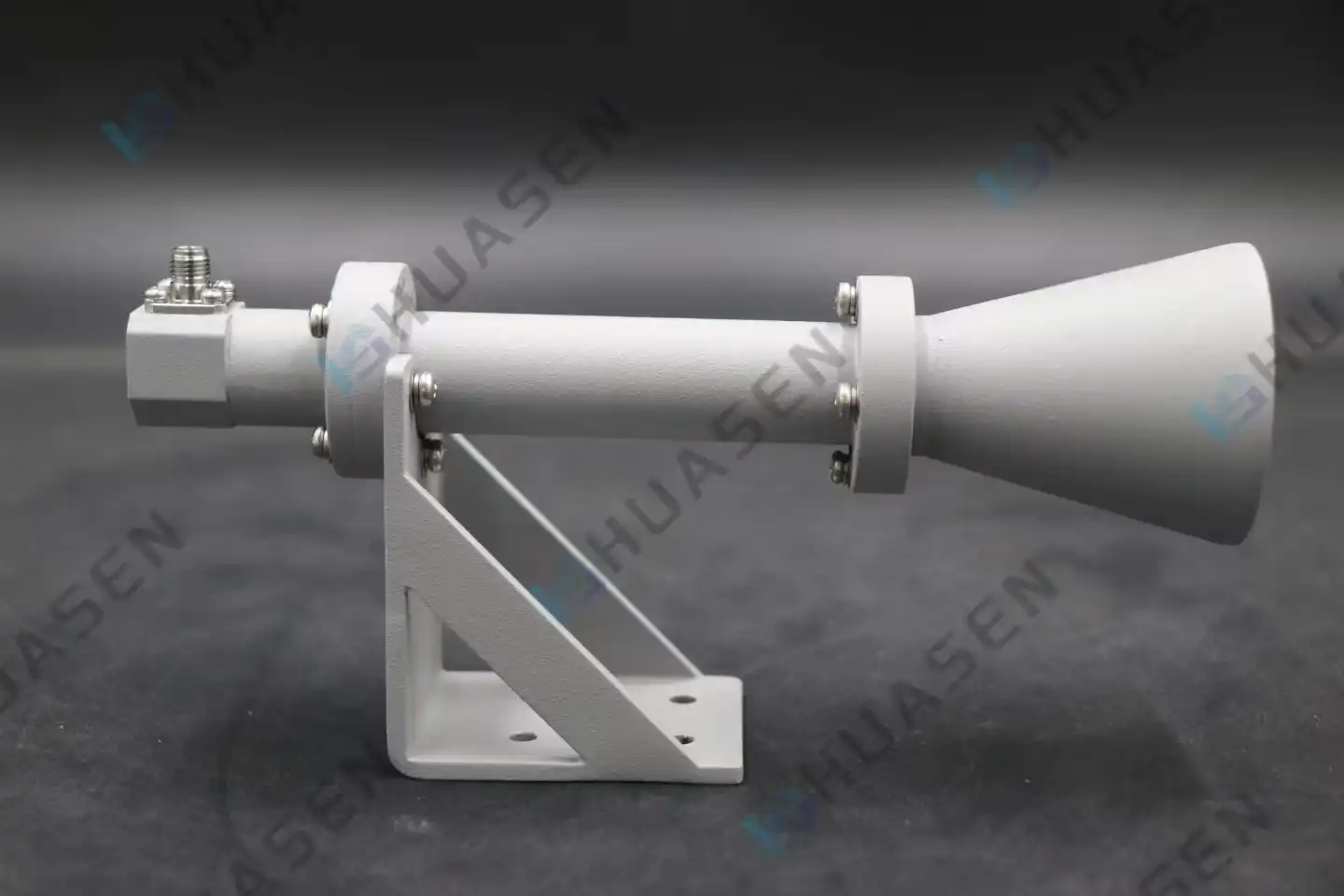
Key Performance Metrics for Circularly Polarized Microstrip Antennas
Evaluating antenna function means looking closely at a number of parameters that are all linked. Each measure has a direct effect on how reliable the system is, how good the signals are, and how well it works in real-world settings.
Axial Ratio: The Polarization Purity Indicator
The axial ratio is the best way to judge the strength of circular polarization. An ideal circular polarization has an axial ratio of 0 dB, which is the ratio between the ellipse's major and minor planes. Values below 3dB are aimed for in practical applications across the working bandwidth to ensure minimum polarization distortion. Axial ratio bandwidths of 1% to 2% are common for single-feed designs that use perturbation methods. These bandwidths can be increased to 5 to 8% for dual-feed setups that use external quadrature hybrids. When the axial ratio drops below 3dB, the antenna starts to act more and more like a linearly polarized element. It loses its ability to block multiple paths and its ability to work in any direction.
Gain and Radiation Efficiency
Compared to an isotropic reflector, antenna gain shows how well the structure focuses emitted power in the right directions. Because of surface wave losses and substrate dielectric losses, circularly polarized microstrip antennas have smaller gain than reflector or horn antennas. Single-element patches usually provide 5 to 8dBi of gain, and array configurations greatly improve directivity. Our hybrid waveguide-microstrip transmission networks at Huasen Microwave achieve radiation efficiency gains of up to 23dB through array designs that range from small 2x2 layouts to large 8x8 layouts. Microstrip technology is characterized by its thin, light design, which keeps the high efficiency of standard waveguide arrays without adding to their mass.
Impedance Bandwidth and Return Loss
Impedance matching makes sure that the feed network and radiating part send as much power as possible. The amount of power that is reflected back because of a difference in resistance is measured by return loss (or VSWR). For professional uses, the return loss must be more than 10dB (VSWR < 2:1) across all operating frequencies. Because they are responsive, microstrip antennas have limited bandwidth. For a circularly polarized microstrip antenna, a broader bandwidth is achieved with wider substrates that have lower dielectric constants, but the profile gets bigger. The impedance bandwidth is usually wider than the axial ratio bandwidth. This creates a crucial design constraint where circular polarization uniformity, not impedance matching, limits the frequency range that can be used.
Physical Size and Integration Constraints
Geometric factors have a big impact on system integration, especially for uses that need to fit in a small area, like on UAVs, aircraft, or handheld computers. The patch sizes get smaller as the frequency goes up and bigger as the square root of the substrate dielectric constant goes down. High-permittivity materials make antennas smaller, but they also make them less efficient and narrow the bandwidth. When it comes to flying platforms, weight is very important because every gram changes how long the flight lasts. When we use the best substrates and array layouts in our designs, we can make conformal shapes that can be integrated into aerodynamic surfaces and keep their structural integrity from -55°C to +125°C.
Together, these measures show if an antenna meets the needs of an application. When making procurement decisions, you have to weigh different needs. For example, wider bandwidth may mean less compactness, higher gain means bigger arrays, and better axial ratio purity often means a smaller frequency range that can be used.
Comparing Circularly Polarized Microstrip Antennas with Other Antenna Types
Understanding the trade-offs in performance between antenna technologies helps people make smart purchasing choices that meet their needs and stay within their budget.
Linear vs. Circular Polarization Trade-offs
Linearly polarized antennas are easy to use and have a slightly higher gain per element, but they are sensitive to direction. When the polarizations of the emitter and receiver are off by 90°, the signal loss is theoretically endless, but in practice, it is more than 20dB. This weakness isn't there with circularly polarized designs because the link stays strong no matter what the relative orientation is. This is important for mobile platforms, rotating satellites, or RFID applications where tag orientation changes randomly. As a trade-off, the design is more complicated, and the gain is usually 1-2dB lower than with comparable linear designs.
Helical and Spiral Antenna Comparisons
When used in axial-mode designs, helical antennas have a wide bandwidth and very pure circular polarization. But their three-dimensional structure sticks out, which doesn't work with the low-profile needs of conformal placements. Ultra-wideband performance with frequency-independent properties is provided by spiral antennas, but they need backing materials that absorb energy, which lowers their efficiency. When thin profiles, light weight, and easy assembly are more important than the smaller bandwidth that comes with resonant structures, microstrip antennas are the best choice.
Dielectric Substrate Selection Impact
The material of the base has a big effect on both electrical and mechanical performance. The Rogers 4003C has a balanced dielectric constant (εr = 3.38) and a low loss tangent, making it good for frequencies up to the X-band. Taconic RF-35 offers thermal stability for outdoor sites that are exposed to big changes in temperature. Ceramic-filled PTFE composites can be made smaller because they have higher dielectric constants, but they need to be carefully protected from moisture. For microstrip antennas, the choice of these materials directly impacts radiation efficiency and impedance matching. Costs vary by orders of magnitude. For example, normal FR-4 costs less than $10 per square meter, but specialized millimeter-wave materials cost more than $500 per square meter. At Huasen Microwave, we choose substrates based on what our customers want in the L-band to the Ku-band range. This way, we can make sure that the best balance is reached between electrical performance, environmental stability, and cost-effectiveness.
Practical Considerations for Procurement and Application
To turn technical specs into buying choices, you have to look at how antenna features match up with deployment scenarios, along with the supplier's services and skills after the sale.
Application-Specific Performance Requirements
To keep link budgets when spaceships are spinning, and cross-polarized interference is present, satellite communications need a high axial ratio purity. GNSS receivers put multipath rejection at the top of their list of priorities so that driverless cars and precise farms can get centimeter-level positioning accuracy. Drone command-and-control links need to be made in a way that keeps working even when the base shakes and the temperature changes quickly as the drone moves from one level to another. For long-term outdoor operations, base station applications focus on reliability, with IP67 waterproofing, UV-resistant radomes, and corrosion-resistant gear.
Supplier Evaluation Criteria
To find qualified manufacturers, you have to look at a lot of factors besides the listed specs. How well providers can change features like frequency coverage, polarization sense, link types, mounting interfaces, and microstrip antenna design to fit different system designs is based on their design customization capabilities. The different array configurations—single patch, 2x2, 1x4, 4x4, 6x8, 16x4, 8x8, and more—show that the manufacturing process is flexible and that the technical knowledge is deep. Different types of polarization, such as single linear, single circular, dual linear, and dual circular, can be used for a wide range of purposes, from simple point-to-point links to complex monopulse tracking radars.
Certification compliance shows a loyalty to quality. For military and aircraft uses, AS9100 production standards, MIL-STD-810 environmental tests, and MIL-STD-461 EMI/EMC compliance are necessary. ISO 9001 quality control and RoHS environmental standards are good for commercial deployments. Measured radiation patterns, axial ratio versus angle plots, Smith chart resistance data, and environmental qualification records should all be part of the testing paperwork.
Pricing Models and Lead Time Management
Structures for volume prices have a big effect on the total cost of acquisition. Most of the time, single-unit samples cost 300–500% more than production amounts. However, when you commit to buying more than 100 units, you can take advantage of economies of scale. Different makers have different minimum order amounts. For example, boutique suppliers may take orders as low as 10 units, but high-volume producers require at least 50 to 100 units. Lead times range from 4 to 6 weeks for catalog items with normal specs to 12 to 16 weeks for unique designs that need special tools and qualification tests. Shipping procedures for sensitive RF parts that need anti-static packing and customs paperwork for dual-use technologies that are controlled for export are some of the things that the global supply chain has to think about.
Huasen Microwave has been in business since 1993, and we know how to make high-frequency microwave and millimeter-wave parts, including microstrip antennas, so that the quality is always the same from one production run to the next. We help with design, pre-shipment testing with calibrated data packages, and fast technical support throughout the product lifecycle. We do this from the creation of prototypes to full-scale production.
Conclusion
To choose the best circularly polarized microstrip antennas, you have to weigh a lot of performance factors against the needs of your application and your budget. Pure polarization is set by the axial ratio, link budget reserves are set by the gain, frequency freedom is set by the bandwidth, and system integration is made possible by the physical characteristics. When you compare antenna systems, you can see that profile, bandwidth, and production complexity are all trade-offs. The success of procurement relies on how well suppliers can customize designs, get quality certifications, and provide quick support services. Circularly polarized microstrip antenna technology will be the basis for next-generation wireless systems in satellite communications, mobile infrastructure, and new Internet of Things (IoT) uses. This is because new materials and manufacturing techniques will make microstrip technology work better and cost less.
FAQ
1. What defines acceptable axial ratio performance?
For most uses, circular polarization purity is sufficient when the axial ratio is less than 3dB across the working frequency. For best multipath rejection and cross-polarization discrimination, numbers close to 1dB may be needed for accurate GNSS and satellite communications.
2. How does substrate thickness affect antenna performance?
It is true that thicker substrates improve impedance bandwidth and radiation efficiency, but they also make the antenna shape bigger. Applications that need to keep a low image can deal with the frequency limits that come with thin substrates, which are usually between 0.5 and 1.6 mm for microwave frequencies.
3. Can microstrip antennas handle high-power transmission?
How much power a base can handle depends on its breakdown voltage and how well it can handle heat. Standard designs can handle a few watts of power. For high-power uses, thick, low-loss boards with thermal vias and heat-sinking are needed, which can handle up to tens of watts of continuous power.
4. What frequency ranges suit microstrip antenna technology?
From UHF to Ku-band (300MHz to 18 GHz), microstrip antennas work best. Below UHF, the size isn't useful, and above Ku-band, production errors and losses make performance difficult. However, millimeter-wave designs can still be made if the parts are made with great care.
Partner with a Trusted Circularly Polarized Microstrip Antenna Manufacturer
Since 1993, Huasen Microwave Technology has been helping people in the science, aerospace, defense, and telecommunications industries develop and make high-performance antennas. Our Circularly Polarized Microstrip Antenna systems have hybrid waveguide-microstrip transmission networks that can gain up to 23dB while staying very thin and light. From single elements to 8x8 grids, the array designs that are available can be used for a wide range of tasks, from handheld screens to phased array radars. We offer a wide range of polarization choices, such as single linear, single circular, dual linear, and dual circular. We can also make unique designs for you, including monopulse tracking and beam shaping, that are exactly what you want. With decades of experience in RF, our engineering team can help with design, make prototypes, and test them to make sure they meet requirements. We provide dependable solutions with quick technical help, whether you need parts for next-generation base stations, satellite ground ports, or UAV communication systems. Email our team at sales@huasenmicrowave.com to talk about your antenna needs and get specific information that fits your purpose.
References
1. Garg, R., Bhartia, P., Bahl, I., & Ittipiboon, A. (2001). Microstrip Antenna Design Handbook. Artech House Publishers.
2. Kumar, G., & Ray, K. P. (2003). Broadband Microstrip Antennas. Artech House Antennas and Propagation Library.
3. Balanis, C. A. (2016). Antenna Theory: Analysis and Design (4th ed.). John Wiley & Sons.
4. IEEE Standard 149-2021. IEEE Standard Test Procedures for Antennas. Institute of Electrical and Electronics Engineers.
5. Pozar, D. M., & Schaubert, D. H. (1995). Microstrip Antennas: The Analysis and Design of Microstrip Antennas and Arrays. IEEE Press.
6. James, J. R., & Hall, P. S. (1989). Handbook of Microstrip Antennas (Volumes 1-2). IET Electromagnetic Waves Series.
Send Inquiry