Loop Antenna Design Principles for Better Efficiency






2026-06-26 17:01:14
Designing a high-performance Loop Antenna requires balancing electromagnetic fundamentals with practical engineering constraints. These compact antennas operate through magnetic field coupling rather than electric field propagation, making them exceptionally effective at rejecting electrostatic noise in congested RF environments. Whether you're integrating them into 5G infrastructure, satellite ground stations, or precision test equipment, understanding core efficiency principles transforms procurement decisions from guesswork into strategic advantage. The right design minimises insertion loss, maximizes signal-to-noise ratios, and delivers reliable performance across demanding operational conditions where failure isn't an option.
Understanding Loop Antenna Basics and Performance Bottlenecks
Magnetic Field Principles and Radiation Characteristics
Loop antennas generate perpendicular electromagnetic waves via moving current. In urban and industrial contexts, vertically polarised man-made noise is ubiquitous. Magnetic loop antennas are immune to it. In areas where switching power sources, digital electronics, and electrical tools interfere, H-field sensitivity improves signal-to-noise performance.
Radiation patterns vary greatly with electrical size. Small loop antennas (less than 0.1 wavelength) produce figure-eight patterns with distinct nulls perpendicular to the loop plane. This allows directed interference rejection. Larger resonant loop antennas with a one-wavelength diameter act like folded dipoles, but they span a wider angle and can be used in any direction. These pattern alterations should be considered when choosing antennas for base station coverage versus point-to-point connectivity.
Core Performance Challenges Limiting Efficiency
Real-world Loop Antenna performance is limited by many factors. Electrically tiny loop antennas have milliohm-low radiation resistance. Even minor wire loss in ohms affects efficiency. Network losses must be considered before setting; a tiny Loop Antenna with 0.1Ω radiation and loss resistance operates at 50% efficiency. Due to this constraint, conductor quality and joint stability must be monitored.
High-quality factor (Q) characteristics complicate. The narrow bandwidth is useful for adjacent-channel rejection and preselector filtering, but it must be tuned and modified frequently when frequencies change. Systems that must swiftly change frequencies over wide bands have trouble with mechanically tuned loop antennas. Environmental variables include proximity to metal structures that detune resonance, temperature fluctuations that alter part values, and vibrations that can shift mechanical tuning elements during critical operations. These exacerbate these issues.
Comparative Context Against Alternative Antenna Types
There are a number of trade-offs that come up when you compare loop antennas to dipoles and directed arrays. Dipoles have a wider bandwidth and make matching impedances easier, but they pick up a lot more local electrical noise. While Yagi and log-periodic antennas offer better gain and directionality, they need much bigger installation areas and support structures. Loop antennas work great in small spaces where full-sized wire antennas wouldn't work, especially for HF and VHF receive uses where reducing noise is more important than getting the highest possible gain.
Because they are so small, loop antennas can be used in places where regular antennas can't, like inside buildings, on ships with limited deck room, or built into equipment shelters. This size benefit solves important problems for system integrators who have to work with limited installation parameters while still letting the electrical performance be good enough for most test and transmission tasks.
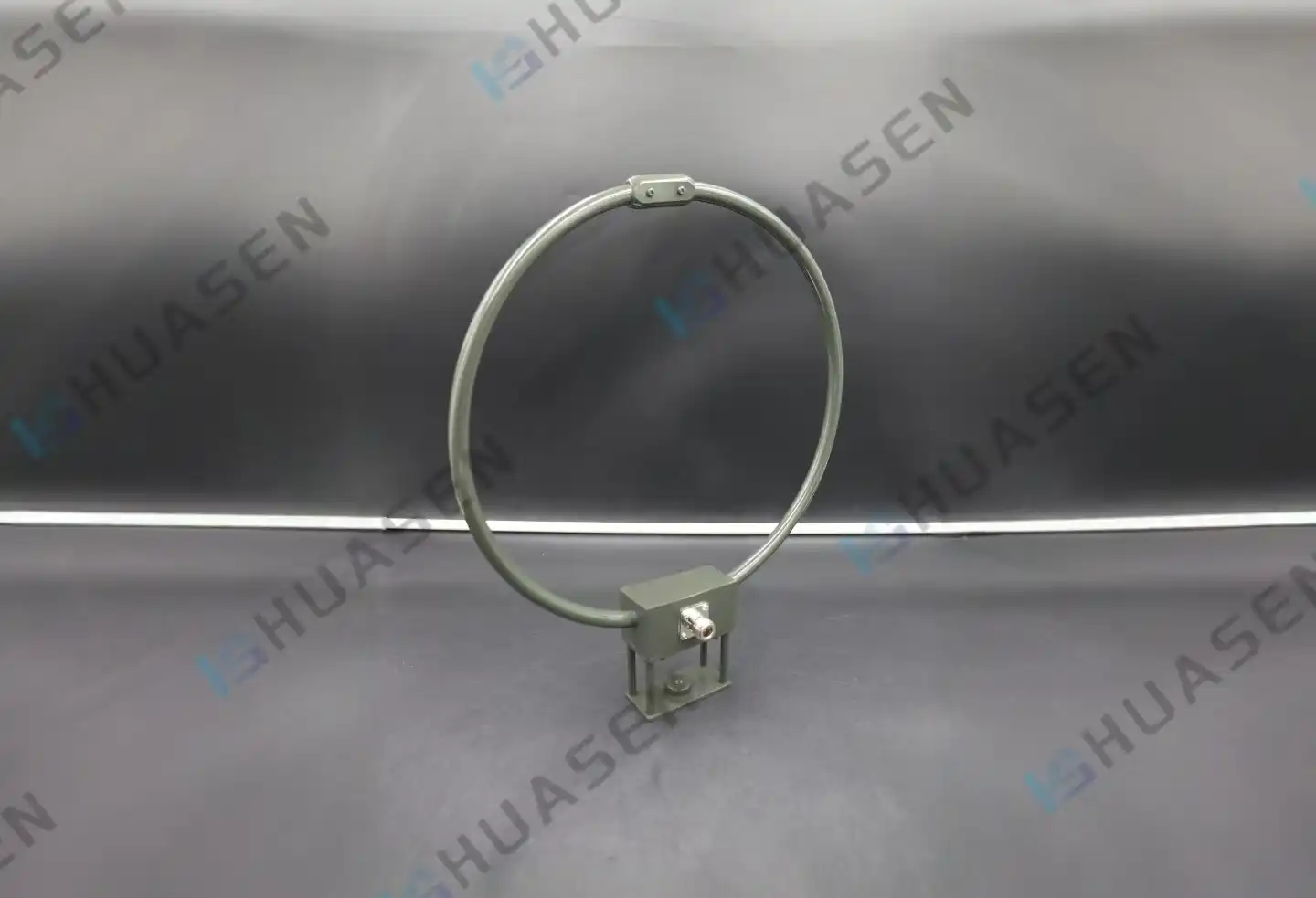
Core Principles for Optimizing Loop Antenna Efficiency
Loop Geometry and Frequency Range Correlation
The size of an antenna directly affects its working frequency ranges and bandwidth properties. In a circular loop antenna, the inductance goes up or down with the width and wire size, but the capacitance changes based on how close the conductors are to each other and the dielectric surroundings. To reach resonance at desired frequencies, careful planning of dimensions is needed—smaller loop antennas naturally respond at higher frequencies or need more capacitive loads for lower-band operation.
To get the best performance from your conductors, you need to find the right size that balances skin-effect losses with their usefulness. At high frequencies, copper tubing with a thickness of 12 to 25 mm can carry a lot of power while still being light enough to handle and not getting too windy. The way the surface is treated is crucial. Conductors that are cleaned or silver-plated have lower resistive losses than bare corroded metal. A study released by the IEEE Antennas and Propagation Society shows that optimising the conductor area in small transmission loop antennas can increase performance by more than 15%.
Material Selection and Conductor Configuration
Choosing complete copper, an aluminium alloy, or a particular blend influences the loop antenna's electrical performance and environmental durability. Copper has a higher conductivity (58 MS/m) but needs coatings in naval or industrial situations where corrosion speeds up losses. Aluminum is lighter for airborne usage, but it needs larger cross-sections to match copper's RF resistance.
High-quality replaceable capacitors are essential. High-power transmission lines need capacitors that can handle voltage breakdown and heat loss. Commercial ceramic or vacuum variable capacitors can constantly handle 5kV and 1kW. This meets base station and radar dependability needs. People must consider capacitor price and performance when buying. Because failed capacitors are still the major concern in transmitting Loop Antenna systems.
Tuning Techniques and Impedance Matching Strategies
To change the impedance correctly between the loop antenna's naturally low feed impedance (often less than 1Ω for small loops) and standard 50Ω transmission lines, you need either internal matching networks or external connection arrangements. Broadband matching with little loss is possible using a capacitive connection through a smaller secondary loop. Taped or Gamma-match setups let you change the transformation ratios.
In active loop antenna setups, low-noise preamplifiers are built right into the antenna leads. These turn the high-impedance loop into a buffered 50Ω source. The Active Loop Antenna (AHA) line from Huasen is an example of this method. It has preamplifiers that have a 20dB gain and a flat frequency response from 1kHz to HF bands. The built-in amplification makes up for the inefficiency of the loop itself, and the signal integrity is kept by careful control of saturation and insulation design.
Noise Reduction Methods and Shielding Approaches
To keep differential-mode signal receiving while blocking common-mode noise currents, it is important to have good grounding. Single-point grounding at the feed link stops ground loops that would let building electrical systems cause interference. When ferrite common-mode chokes or baluns are used in balanced transmission line setups, they keep the loop antenna even further away from coaxial shield currents that carry noise.
There are different types of physical shielding, from fully protected loop antennas with controlled openings to partial Faraday screens that keep H-field sensitivity while blocking E-field pickup. Passive Loop Antenna (KHA) designs get this mix just right, reaching 80dB isolation factors that let them work in places with very high interference. This rejection feature helps keep measurements accurate or links reliable even when there are strong RF backgrounds. It can be used in places like EMC test labs and military communications.
Procurement Guide: Selecting and Buying Efficient Loop Antennas
Critical Performance Specifications and Build Quality Indicators
Loop antenna providers should be assessed beyond marketing promises. Insertion loss statistics should be verified throughout the working range, not just at optimal tuning points. VSWR measures, which evaluate return loss, indicate network matching and bandwidth, which influences system integration. Reputable manufacturers provide calibrated vector network analyzer swept-frequency data instead of single-point readings.
The build quality review emphasizes mechanical strength and environmental ratings. Check out loop antenna conductor joining methods. Soldered or brazed connections live longer than rusty, temperature-changing mechanical ones. Weatherproof outdoor projects require gasket-sealed enclosures with pressure equalization vents to prevent moisture. Military loop antennas that satisfy MIL-STD-461 environmental criteria may withstand tough working conditions. Commercial-grade units may suffice in a lab.
Supplier Reputation and Customer Validation
Established makers with decades of RF engineering knowledge bring a track record of dependability to choices about what to buy. Companies that have been around since 1993, like Huasen Microwave, show that they are dedicated to microwave and radio technology. Their knowledge of waveguide components, millimetre-wave systems, and precision RF devices shows that they have a deep understanding of the electromagnetic principles that govern how antennas work.
Real-world performance claims for the Loop Antenna are backed up by customer comments from similar businesses. A lot more weight is given to testimonials from telecommunications infrastructure makers, aerospace integrators, or national research labs than to general recommendations. Ask for case studies that show how well antennas worked in situations like yours, like base station co-site installations, maritime communication systems, or radar test areas, based on where you are deploying them.
Cost Structures and Customization Options
Prices for the loop antenna vary a lot depending on the amount of customisation and performance. Standard catalogue designs with set frequency ranges and connector types have the lowest unit costs and are best for buying in bulk, where consistency saves time and money. Custom setups that deal with specific frequency bands, power ratings, or mechanical connections cost more, but they are worth it because they require more technical resources and are cheaper to make in small quantities.
When you buy loop antennas in bulk from well-known providers, you can usually save 15 to 30 per cent on costs and get priority production slots and special technical support. Framework deals that spell out delivery dates, quality standards, and guarantee terms protect against supply problems that could cause important projects to be delayed. Instead of just looking at unit antenna prices, you should also look at the total cost of ownership, which includes shipping, customs taxes, and work for putting the antennas together.
Internatdelay important projectsrations
Global loop antenna sales complicate shipment wait times, compliance, and after-sales support. Dual-use technology and export constraints make antenna packages difficult to classify, especially for high-frequency or military designs. Working with providers who understand foreign business jargon and customs documentation will reduce clearance delays.
varied location regions have varied loop antenna certification standards. CE marks and RoHS compliance may be required for some European installations. US government establishments only accept merchandise from approved suppliers. Make sure potential sellers have ISO 9001 or AS9100 quality control certifications and can prove compliance with paperwork. When you buy from pre-qualified sellers, you can reconsider or correct final system acceptance testing findings without spending much.
Practical Installation, Troubleshooting, and Maintenance Tips
Optimal Positioning and Environmental Adaptation
Where you put a loop antenna has a huge effect on how well it works. To avoid detuning and loss of performance, mount loops at least two diameters away from conductive objects. The electromagnetic environment is changed by metallic building parts, tower structures, and ground planes. These things change the resonance frequency and make pattern symmetry worse. If you have to put something close to metal for some reason, you should plan for the tuning elements to be adjusted in the field and accept that the spot will have less bandwidth.
When loop antennas are outside, they need to be thought about in terms of wind loads, the effects of rain and snow, and temperature changes. Water getting into sealed boxes would detune capacitive elements and cause rust. When metal conductors get hot, they expand and change their electrical dimensions. Designs that include temperature-compensated capacitors or mechanical adjustment features keep the setting stable even when the weather changes. Materials and finishes that are resistant to UV light and wear and tear make things last longer in places with a lot of sunlight.
Common Issues and Diagnostic Approaches
Problems with loop antenna interference show up as high noise floors or signals that have nothing to do with the receiving that is wanted. By rotating the antenna to take advantage of pattern nulls, you can cut interference from certain directions by 20dB or more. Check the integrity of the grounding; ground links that are loose or rusted allow common-mode pickup to happen, which disables the loop antenna's natural noise rejection. Check the coaxial feed lines for damage or corroded connectors that could let shield power leak out.
Loop antenna tuning steadiness and electrical efficiency are both affected by mechanical wear. Check the contacts of the variable capacitor for rust or too much play, which can mean the bearings are worn out. Discoloured conductor joints mean that high-resistance links are losing a lot of power as heat. When weatherseal breaks down, it lets water in, which can cause performance changes that are linked to humidity or rain.
Maintenance Protocols for Long-Term Reliability
Set up regular check plans that take into account common types of loop antenna failure. Check circuit surfaces every three months to make sure protective layers are still in place and to remove any oxidation that has built up on copper elements. Applying contact cleaner to a capacitor's moving contacts and tuning devices once a month will keep parts from seizing up. Check the active loop antenna amplifier current draw to find signs of wear and tear before a full failure stops work.
When planning to change loop antenna parts, you should take into mind how the capacitors wear out in transmitting loops that have a lot of circulating power. Plan to change the variable capacitor every three to five years in setups that run all the time, and sooner in high-power settings. Keep extra preamplifier units on hand for active loop antenna systems that support mission-criticoperations, where downtime has a significant big effect on those operations.
Conclusion
To get the most out of a loop antenna, you need to combine electromagnetic theory with real-world technical issues. To be successful, you need to choose the right active or passive setups, make sure that the size of the conductors doesn't affect their performance, and use the right tuning techniques. When making purchasing choices, it's better to look at suppliers' technical skills, the quality of their work, and their support system, rather than just price. When you put the loop antenna correctly and follow the maintenance steps, it will keep working even in tough operating environments. When companies put these design principles first, they get big improvements in signal quality, noise rejection, and system reliability. These are important differentiators in areas like communications infrastructure, aerospace platforms, and precision test applications where performance directly affects mission success.
FAQ
1. What frequency ranges work best with loop antenna designs?
Depending on the design details, loop antennas can operate over a very wide frequency range. Small magnetic loop antennas work well in the VLF to HF bands (below 30 MHz), and some active systems, like the AHA, can go down to 1 kHz for certain uses. When their sizes meet the wavelength needs, larger resonant loop antennas are used for VHF and UHF uses. The best range depends on how big the loop is in relation to the wavelength and whether active amplification can make up for the loop antenna's natural inefficiency at frequencies where it gets very small electrically.
2. How do I choose between active and passive configurations?
For receive-only uses where power is available, active loop antennas offer better awareness and easier integration. Spectrum tracking, EMC tests, and wideband spying are all things they do very well. For transmitting signals, sites that are far away and don't have access to power, and places with a lot of radio waves (RF) where active loop antenna amps would overheat, passive designs are best. Take into account the operating situation when figuring out the power needs, transmitting abilities, and awareness needs.
3. What power levels can loop antennas handle safely?
Different loop antenna systems handle power in very different ways. Small transmission loop antennas with good vacuum variable capacitors can handle power of 1 kW or more all the time, while cheap versions with ceramic capacitors may arc over 100 W. Active receive-only loop antennas can handle a small amount of power before the preamplifier gets too hot, but they're not meant to send data. Designs that are passive in both directions, like the KHA series, can handle power levels that are set by the values of the connectors and the heat capacity of the conductors. Always make sure that the manufacturer's specs meet the needs of your product.
Partner with Huasen Microwave for Superior Loop Antenna Solutions
Huasen Microwave can help you with your most difficult loop antenna problems because they have been experts in RF engineering for more than 30 years. As a maker of specialised loop antennas for the defence, aerospace, and telecommunications industries around the world, we know how important it is for mission-critical apps to work reliably. Our wide range of products includes both active and inactive loop designs that have been carefully designed to be as sensitive, wide, and resistant to environmental changes as possible. Whether you need loop antennas from a catalogue or antennas that are specially designed to fit your rollout needs, our technical team can help you from the planning stage all the way through to integration.
Email our technical experts at sales@huasenmicrowave.com to talk about your particular loop antenna needs. We provide sample evaluation programmes, thorough test data, and quick expert help to make sure that your purchasing choices are based on proven performance and not just marketing promises. Find out how working with a well-known loop antenna seller can change the way your system works.
References
1. Stutzman, W. L., & Thiele, G. A. (2012). Antenna Theory and Design (3rd ed.). John Wiley & Sons.
2. Balanis, C. A. (2016). Antenna Theory: Analysis and Design (4th ed.). Wiley Interscience.
3. IEEE Standards Association. (2013). IEEE Standard for Definitions of Terms for Antennas (IEEE Std 145-2013). Institute of Electrical and Electronics Engineers.
4. Carr, J. J. (2001). Practical Antenna Handbook (4th ed.). McGraw-Hill Professional.
5. Whitaker, J. C. (2018). The RF Transmission Systems Handbook. CRC Press.
6. Paul, C. R. (2006). Introduction to Electromagnetic Compatibility (2nd ed.). Wiley-Interscience.
Send Inquiry