Log Periodic Antenna Fundamentals: Design and Frequency Behavior






2026-04-30 22:41:38
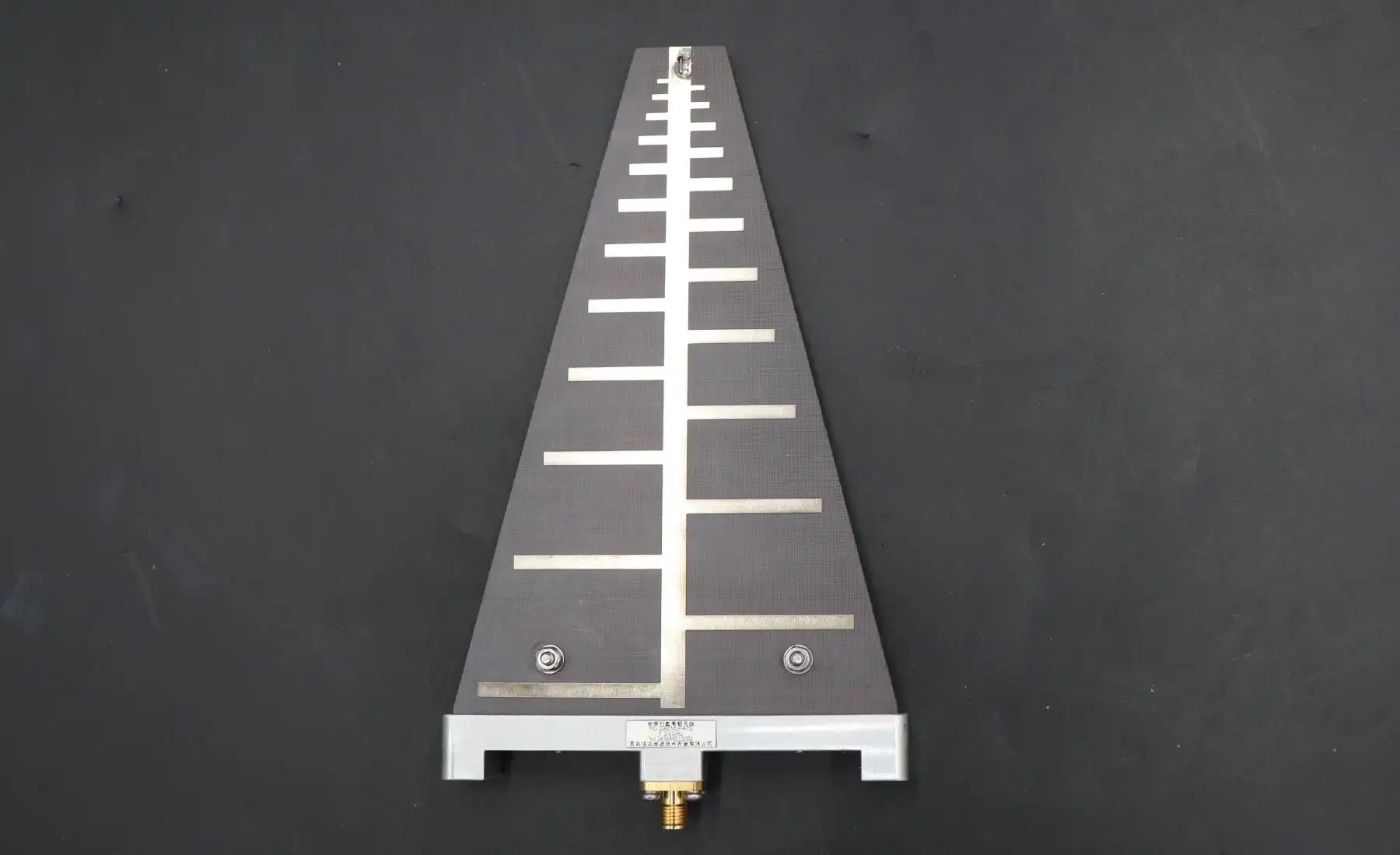
When we talk about broadband antenna solutions for tough RF environments, the log periodic antenna stands out as a reliable piece of engineering that gets rid of the need to switch between an annoyingly many antennas for different frequency bands. A logarithmic geometric progression of dipole elements is used in this wideband directional antenna to keep the impedance, gain, and radiation properties the same over a wide range of frequencies, usually from 30 MHz to 3 GHz or higher. The active region of a log-periodic dipole array moves along the boom dynamically as the operating frequency changes, which is different from narrowband Yagi-Uda designs. This gives frequency-independent performance that handles spectral fragmentation in EMC testing, spectrum monitoring, tactical communications, and satellite link applications.
Understanding Log Periodic Antenna Basics
What Defines a Log-Periodic Antenna?
The log periodic antenna is described as having a shape that is self-similar. Each dipole element is scaled by a constant ratio τ (tau), and the spacing between them follows a predictable logarithmic pattern set by σ (sigma). This mathematical beauty shows up in real life as well: as you change frequencies, different parts of the antenna become electrically active. This keeps the input impedance stable near 50 Ohms and lets you predict the radiation patterns. The design is very different from Yagi antennas, which are great for single-band applications and have higher peak gain, but they need to be carefully retuned or replaced when the frequency needs to change.
Operating Principles and Frequency-Independent Behavior
Log-periodic operation is based on an interesting idea: at any given frequency, only a small group of elements close to a certain electrical length contribute in a meaningful way to radiation. Higher frequencies move the shorter elements toward the front of the structure, while lower frequencies move the longer elements toward the back of the structure. This "traveling wave" behavior makes sure that VSWR stays below 2.0:1 throughout the whole passband. This is a very important requirement for RF engineers, who can't stand impedance mismatches that waste power or mess up signals that are received.
Most of the time, the boom acts as an infinite balun, sending power to the dipole array through a phase-reversed transmission line that stops common-mode currents from messing up the radiation pattern. The choice of material is very important here. Aerospace-grade 6061-T6 aluminum is strong and light, while stainless steel versions with passivated hardware meet MIL-STD-810 shock and vibration requirements for radar installations on ships or in the air.
Design Elements: Spacing, Ratios, and Material Considerations
To make a good log periodic structure, you have to balance different factors. Bandwidth is set by the scaling factor τ, which is usually between 0.7 and 0.95. Lower values give you wider coverage but lower peak gain. The spacing factor σ determines where elements are placed and how they reflect light. Values between 0.1 and 0.2 get the best front-to-back ratio while keeping the physical dimensions manageable. Engineers who want to cover frequencies from 80 MHz to 6 GHz might use 12 to 20 elements that span several meters. For 1-18 GHz applications, small microstrip implementations use PCB substrates like Rogers RO4003C to keep dielectric losses to a minimum.
For environmental resilience, it's important to pay attention to coatings that don't rust, radomes that don't fade in UV light for outdoor use, and thermal expansion coefficients that keep mechanical stress from building up at high and low temperatures. These things have a direct effect on the long-term dependability of maritime communications, base station installations, and spectrum monitoring stations, where getting to maintenance areas is expensive or doesn't happen very often.
Frequency Behavior and Performance Characteristics
Broadband Capabilities Across RF Spectrum
Log-periodic antennas can often get bandwidth ratios of 10:1 or even 20:1, which means they can cover HF to UHF bands with a single structure. This feature is very useful for EMC compliance laboratories that do radiated immunity testing according to IEC 61000-4-3: automated test sequences sweep from 80 MHz to 6 GHz without stopping to switch antennas, which cuts chamber occupancy time by 40% compared to setups with multiple antennas. Continuous spectral visibility helps telecom companies keep an eye on cellular, WiFi, and satellite bands at the same time, finding unauthorized transmissions or sources of interference that frequency-hopping signals might otherwise avoid.
The antenna factor (AF), which is the ratio of the strength of the electric field to the voltage received, stays very linear across the passband of a log-periodic antenna. This makes it easier to calibrate measuring tools. Because of this, log-periodic designs are the best choice for accredited test facilities that need accurate measurements that can be tracked back to ANSI C63.5 standards.
Radiation Patterns and Directivity Advantages
Gains usually fall between 6 and 8 dBi, and front-to-back ratios are higher than 20 dB. This gives you directional selectivity that blocks interference from angles you don't want. The radiation pattern stays mostly the same beamwidth, even as the frequency changes. This is very different from wideband discone antennas, which give up directionality for coverage in all directions. Direction-finding systems use this feature by putting LPD As on platforms that can be rotated to find three signal sources by scanning from side to side and up and down.
Yagi designs offer 10-15 dBi gain over narrower bandwidths. Log-periodic arrays trade operational flexibility for peak performance. The phase center doesn't change much with frequency, which is important for measuring radar cross-section and testing antenna range because physical reference points can't move when test signals do.
Gain Variation and Signal Quality Factors
Gain stays very flat over most of the passband, but there are small ripples (±2 dB) at the band edges where the active region changes between element groups. System integrators can better plan their budgets for link margins when they understand these details. For example, a 5G backhaul link engineer might choose a log periodic antenna that covers 3.3–4.2 GHz to accommodate multiple carrier bands, allowing for small changes in gain to simplify the antenna inventory.
Low VSWR directly means efficient power transfer—a 1.5:1 VSWR reflects less than 4% of the power that comes in, so the transmitter stays efficient and the receiver stays sensitive. This is very important for high-power radar or electronic countermeasure systems, where wasted RF energy makes it hard to control temperature and lowers the power that is actually sent out.
Design and Construction for Practical Applications
Material Selection and Fabrication Techniques
Choosing materials that are right for the working environment is the first step in building a strong log-periodic antenna structure. Marine-grade stainless steel with electropolished finishes is needed for coastal installations to protect against salt spray corrosion. On the other hand, carbon fiber composite booms with copper elements embedded in them are preferred for weight-sensitive aerospace applications. The diameter of the boom needs to be able to support mechanical loads without being too resistant to wind. Finite element analysis helps make sure that the structure is strong enough to withstand ice buildup and storm forces.
High-frequency laminates with controlled dielectric constants (εr) and low loss tangents (tan δ below 0.002) are used in microstrip variants. Rogers RT/duroid substrates keep their electrical properties from -55°C to +150°C, which is important for deploying drones or spacecraft in stratospheric areas where thermal cycling is higher than what is allowed by commercial standards.
Assembly Challenges and Quality Assurance
To keep the pattern from distorting, element length tolerances must be kept to within ±1% and alignment errors must be kept to less than 2 degrees. Automated fabrication equipment makes sure that the quality is the same from one production run to the next, and network analyzer testing checks that the VSWR and return loss meet design goals before the product is put into the environment. One common mistake is not weatherproofing the coaxial feed points properly. Potting compounds and heat-shrink boots stop moisture from getting in, which breaks down dielectric materials over time, and LPA must also be considered in this context.
When you add matching networks or balun transformers, you need to be aware of how parasitic inductance and capacitance can change resonances in unpredictable ways. Companies with a lot of experience, like Huasen Microwave, use simulation tools that have been tested against decades of real-world data. This speeds up the prototyping process and lowers the number of failures that happen in the field.
Customization for Specific Application Requirements
OEM clients often ask for customized frequency coverage that matches their own communication protocols or the bands that are allowed by law. A custom 400-470 MHz LPDA for public safety repeater systems might focus on being compatible with circular polarization and protecting against lightning surges. On the other hand, a 6-18 GHz electronic warfare antenna would focus on being hard to see, having radar-absorbing coatings, and having small sizes that can be mounted in a conformal way.
As an example, a European broadcaster improved its UHF TV reception networks by adding ruggedized log-periodic arrays that cover 470–790 MHz. These arrays were able to achieve 99.7% uptime across exposed hilltop sites. For example, defense contractors ask for LPDs. As to be used in shipboard radar warning receivers, where success is measured by more than just electrical performance. Salt fog, vibration, and electromagnetic pulse hardening are some of the conditions that must be met.
Comparison and Decision-Making Guide for Buyers
Performance Trade-Offs Versus Alternative Antenna Types
Which design to use—a log periodic antenna or a Yagi? That depends on the needs of the application. Yagi antennas have higher gain (12–17 dBi) within narrower bandwidths (10–20%). They are perfect for fixed-frequency links where longer physical apertures are needed for maximum range. Log periodic arrays give up 3–5 dB of peak gain to cover whole octaves. This helps spectrum monitoring stations keep an eye on transmitters that change frequencies quickly or test labs meet the needs of a wide range of clients without having to switch out antennas.
Discone antennas can pick up signals in all directions over a wide range of frequencies, but they don't have any directional gain, so they can't be used for point-to-point links or situations where interference needs to be blocked. Dipole arrays are still a good deal for single-band uses, but they need to be installed separately for each frequency range, which raises the cost of the hardware and makes maintenance more difficult.
Selection Criteria for Procurement Professionals
Buyers should compare these technical factors to operational needs: the frequency range should include both current and planned spectrum allocations with a 10-15% margin. Taking into account VSWR spikes and the weather, the power handling capacity should be twice as much (2:1) as the transmitter output. Rooftop or vehicle-mounted systems can't be too big or too small. Compact microstrip LPD As work well on platforms with limited space, while full-size wire arrays work better when space allows.
Connector standards are important. For example, N-type or 7-16 DIN interfaces can handle high power and weatherproofing, while SMA connectors are better for lab equipment. Certification compliance (MIL-STD-461 for electromagnetic compatibility, IP67 for ingress protection, and RoHS material restrictions) makes sure that the product is accepted by regulators and can be used for a long time.
Supplier Landscape and Procurement Best Practices
Reputable manufacturers show their dedication by providing accurate test data, allowing material tracking, and providing quick engineering support. Comet and Diamond Antenna make products for amateur and business communications, while Tonna makes products for UHF and VHF terrestrial uses. Prototype evaluation programs help the buying process because they show performance details that datasheets can't show. Sample units tested under real load conditions are more useful.
Customization complexity, order volume, and lead times all affect the price, along with LPA. Catalog items usually ship within a few weeks at reasonable unit prices. Custom designs, on the other hand, need engineering deposits and fabrication schedules that last between 8 and 12 weeks. The warranty should cover mistakes in the work that was done, as well as environmental testing reports that show how well the product can handle thermal cycling, salt spray exposure, and vibration endurance according to the standards that apply.
Conclusion
Log-periodic antennas meet important broadband needs in the aerospace, defense, telecommunications, and test instrumentation industries because they have a wide bandwidth, directional gain, and behavior that is independent of frequency. Engineers can come up with the best solutions that balance performance, cost, and environmental durability by understanding how geometric scaling factors, material properties, and application constraints work together. These flexible antennas get rid of the operational compromises that come with narrowband options and make systems more efficient and capable. They can be used to set up 5G backhaul networks, electronic warfare platforms, or EMC compliance laboratories.
FAQ
1. Can log periodic antennas handle transmitters with a lot of power?
Power ratings depend on the size of the element, how well it conducts electricity, and how the feed network is built. Most commercial-grade LPD It can handle 100 to 500 watts of continuous power. Military-grade designs with heavy-gauge elements and high-voltage insulators can handle several kilowatts at their peak. Costly mistakes can be avoided by talking to manufacturers early on in the system design process.
2. How do the conditions of the environment affect performance?
When ice builds up, it changes the resonant frequencies and makes the wind load higher. Radome enclosures lessen these effects, but they come with a small insertion loss of 0.3 to 0.8 dB. With regular visual checks and connector maintenance, finishes that don't rust and plastics that don't break down in UV light can make something last longer than 15 years in harsh climates.
3. What maintenance habits make things last longer?
Every year, the mechanical integrity, tightness of the connectors, and condition of the radome should be checked. Before failures happen, network analyzer measurements can see how the VSWR is slowly going down due to moisture getting in or elements rusting. Keeping maintenance logs helps with warranty claims and finding environmental factors that mean replacement units need to be designed differently.
Partner With Huasen Microwave for Advanced Antenna Solutions
Every Log Periodic Antenna that Huasen Microwave makes is the result of 30 years of precise engineering. We combine strict quality standards with the ability to make changes that meet your specific frequency, power, and environmental needs. Our engineering teams work closely with clients from the first specification to production. They offer design help, validated test data, and fast prototyping services that cut down on project timelines. As a supplier of log periodic antennas with a lot of experience, we keep up-to-date certifications like MIL-STD compliance and ISO quality management systems. This means that our products will work reliably in the most demanding aerospace, defense, and telecommunications applications. You can email our experts at sales@huasenmicrowave.com to talk about custom configurations, ask for calibrated sample units, or look into volume pricing that will save you money on purchases without sacrificing quality.
References
1. Stutzman, W. L., & Thiele, G. A. (2012). Antenna Theory and Design (3rd ed.). John Wiley & Sons.
2. Balanis, C. A. (2016). Antenna Theory: Analysis and Design (4th ed.). Wiley.
3. IEEE Standards Association. (2013). IEEE Standard 145-2013: Definitions of Terms for Antennas. Institute of Electrical and Electronics Engineers.
4. Carrel, R. L. (1961). "The Design of Log-Periodic Dipole Antennas." IRE International Convention Record, Volume 9, pp. 61-75.
5. International Electrotechnical Commission. (2014). IEC 61000-4-3: Electromagnetic Compatibility Testing and Measurement Techniques. IEC Publications.
6. Hall, G. (2011). The ARRL Antenna Book (22nd ed.). American Radio Relay League.
Send Inquiry