Lens Horn Antenna vs Standard Horn: Technical Comparison






2026-06-12 22:28:18
Performance trade-offs must be considered when choosing a lens horn antenna or a regular horn antenna for high-frequency communication systems. Lens horn antennas use precision dielectric lenses to transform spherical wavefronts into planar phase distributions, decreasing phase error and allowing compact high-gain systems. Standard horns are mechanically simpler and cheaper, but their flared waveguide design restricts gain efficiency in small arrangements. Space-constrained 5G backhaul, satellite ground stations, and radar test ranges struggle to maintain excellent directivity without unnecessary length. The lens-enhanced solution solves this problem.
Introduction
Modern communication infrastructure requires antennas that operate well under tight spatial and environmental restrictions. Lens horn antennas and standard horn antennas are important in telecommunications, the military, and testing. To balance gain, size, cost, and reliability, buying managers, system integrators, and engineers must understand their technological differences.
This comparison gives procurement teams the analytical basis to choose operationally compatible antennas. Recognising how these antenna architectures differ in gain-to-length ratio, sidelobe suppression, and phase correction efficiency affects system performance and total cost of ownership, whether you manage base station deployments, satellite links, or RF testing laboratories.
Our study addresses B2B decision-makers seeking technical proof to maximise sourcing methods.
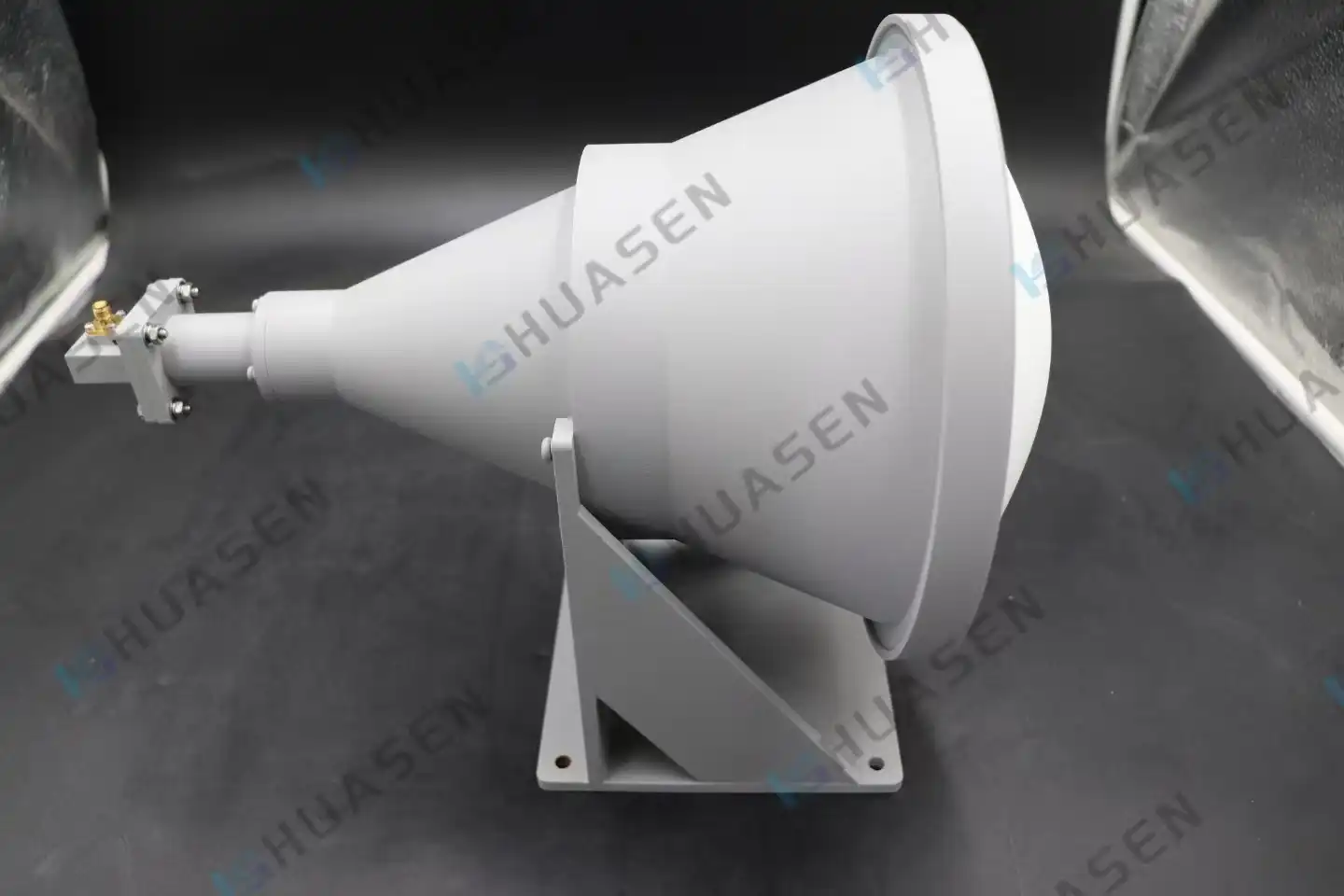
Understanding Lens Horn Antennas and Standard Horn Antennas
Operating Principles of Lens Horn Designs
Lens horn antennas include PTFE, Rexolite, or quartz dielectric lenses in conical or pyramidal feed horn apertures. As aperture diameter rises, standard horns emit spherical wavefronts that create phase inaccuracy. This mistake reduces aperture efficiency and increases sidelobes. The lens collimates electromagnetic waves into a uniform planar phase front to overcome this constraint.
This collimation substantially changes the radiation. Aperture efficiency can surpass 60%, compared to 50-55% in equivalent-size optimum-gain conventional horns. Phase correction reduces axial dimensions while preserving strong directivity, alleviating the compactness problem in millimetre-wave devices from Ka-band to sub-terahertz frequencies.
Standard Horn Antenna Basics
Flared waveguide structures in standard horn antennas gradually increase apertures from rectangular or circular to bigger ones. Pyramidal horns extend two-dimensionally, whereas conical ones flare radially. These designs manage beam properties only with geometric shaping.
High gain requires extensive structures since there is no phase correction factor. Electromagnetic physics dictates that doubling the gain takes four times the horn length. Airborne radar and tower-mounted backhaul lines have size constraints, making this constraint troublesome.
Material and Construction Characteristics
Lens-integrated designs use precision-moulded dielectric elements and machined horns, such as the Lens Horn Antenna, usually silver-plated aluminium or gold-plated copper for conductivity and corrosion resistance. To maintain phase integrity, lens surface accuracy tolerances are generally λ/50 RMS throughout manufacturing. Standard horns are made of sturdy metal without optical components, simplifying manufacture and improving mechanical endurance under vibration and temperature stress.
Technical Comparison: Performance and Characteristics
Gain and Directivity Metrics
The biggest performance difference is gain-to-length efficiency. At 26 GHz, a 30 dBi lens horn antenna may be 150 mm long, whereas a normal horn with comparable gain might be 500 mm. The lens eliminates phase error losses from large-aperture horns without correction, making it smaller.
Beam patterns vary substantially. Lens correction produces rotationally symmetric patterns with uniform beamwidth across polarisation planes, essential for dual-polarisation MIMO systems. In pyramidal arrangements with diverging E- and H-plane beamwidths, standard horns have moderate pattern asymmetry.
Sidelobe Suppression and Pattern Purity
Lens horn antennas improve sidelobe performance for interference-sensitive applications, including dense 5G small-cell networks and precision radar. Typical specs accomplish E-plane sidelobes below -15 dB and H-plane suppression over -26 dB. These qualities lessen wireless connection co-channel interference and multipath distortion.
Depending on design optimisation, standard horns provide modest sidelobe control from -10 to -20 dB. This performance is suitable for many testing and communication jobs, but pattern-cleaning applications may require more.
Frequency Bandwidth Considerations
Both antenna types offer broadband; however, their bandwidths differ. Careful flare angle adjustment allows standard horns to cover octaves or wider. Lens designs provide equivalent fractional bandwidth; however, dielectric dispersion in lens materials can cause slight phase changes at high frequencies.
S-band to W-band and beyond are operational bands. Lens horn antennas thrive in millimetre-wave regimes (30-300 GHz) due to their compactness. For simple ultra-wideband coverage, such as EMC testing or spectrum monitoring, standard horns are best.
VSWR and Impedance Matching
Transmission efficiency is affected by return loss. Well-designed lens horn antennas optimise lens curvature and impedance transitions to reduce VSWR below 1.5:1 throughout operating bands. The lens progressively transitions from waveguide impedance to free space as a matching transformer.
Careful flare profile engineering gives standard horns comparable VSWR. Pyramidal and conical designs have known impedance due to decades of optimisation studies. Properly developed, neither architecture has performance drawbacks.
Lens Horn Antenna vs Standard Horn Antenna: Application & Use Case Analysis
5G/6G Millimetre-Wave Infrastructure
E-band (71-86 GHz) and V-band (57-66 GHz) base station fronthaul and backhaul lines require small, high-gain antennas that fit urban tower-mounting areas. Lens horn antenna topologies—specifically Conical Horn Lens (LHA) and Point-Focus Lens (PLHA) variants—give 35-40 dBi gain in 60% smaller containers than ordinary horns. This space efficiency allows denser site deployments in metropolitan areas with connection budgets above 1 km.
Low sidelobe features enable network densification methods needed to meet 5G capacity objectives by reducing sector interference. Lens antenna and waveguide phase shifter integration enables circular polarisation, which improves performance in multipath-affected non-line-of-sight circumstances.
Compact Antenna Test Range (CATR) Applications
Automotive radar calibration and huge MIMO array OTA testing require quasi-plane-wave illumination in anechoic chambers. Pyramidal horn lens antennas generate consistent phase fronts at half-field distances as CATR feed sources. A 77 GHz automobile radar under test may be described at 2-3 metres instead of 15+ metres, decreasing chamber space and facility expenditures.
Device-under-test characterisation at compact distances requires phase consistency, which standard horns lack. While adequate as reference antennas in typical far-field ranges, they cannot recreate the plane-wave conditions needed for contemporary mmWave device certification.
Satellite Ground Stations and Radiometry
Lens horn antennas' effectiveness and mechanical compactness aid Ku- and Ka-band satellite terminals. Feed-illuminated lenses enhance reflector illumination and reduce spillover losses and cross-polarisation. A beam efficiency of 90% maximises geostationary satellite signal acquisition for high-throughput data links.
Radiometric remote sensing payloads on aircraft and spacecraft assess atmospheric brightness temperature using lens horn antennas. Sidelobe suppression ensures weather forecasting and climate research data accuracy by removing ground radiation from air observations.
Military Radar and Electronic Warfare
Radar systems on UAVs and naval platforms are limited in size and weight. Phased array feeds and monopulse tracking systems can achieve strict performance requirements within airframe volumes with lens horn antennas. Pulsed radar operation without dielectric breakdown is possible due to their tremendous power handling—often surpassing 10 kW peak.
Broadband electronic support measures (ESM) and signal intelligence applications use standard horns because frequency coverage trumps gain and size. Simple mechanical design improves dependability in high-vibration, high-shock military settings.
Procurement Considerations for B2B Buyers
Performance Specification Evaluation
The key technical factors purchasers must check while sourcing are the following:
- Gain and Beamwidth: Match antenna gain to link budget and beamwidth to pointing tolerances. Gain overspecification raises expenses without operational advantage. Standard horns of equal aperture diameter have 3-6 dB less gain than lens horn antennas.
- Frequency Range and Bandwidth: Operating bands should match system frequencies, including mobile application Doppler shifts. Get S-parameter data from the whole range and check VSWR below 1.5:1.
- Polarisation Purity: Dual-polarisation MIMO requires isolation over 30 dB to avoid cross-polarisation interference. Check if linear polarisation is enough or if circular polarisation needs phase shifters.
These parameters affect system performance. Insufficient power management causes component breakdown under operating loads, while inadequate sidelobe suppression violates regulatory emission masks.
Supplier Reliability and Quality Assurance
Supply chain risks are reduced by working with proven manufacturers, including those who produce the Lens Antenna. Huasen Microwave Technology, founded in 1993, manufactures millimetre-wave components in ISO-certified facilities. Three decades of radar, telecommunications, and aerospace experience show the capacity to achieve stringent demands.
Review supplier quality systems using MIL-STD, RoHS, sample testing, and reference customer validation. Request national standards laboratory-traced calibration data to verify measurement accuracy. Long-term supply relationships with experienced manufacturers lessen procurement uncertainty compared to single-source wholesalers without technical assistance.
Customisation Capabilities and Lead Times
Custom focal lengths, polarisation combinations, and environmental sealing are needed in many applications. Evaluation of supplier engineering support through design consultation responsiveness. Can they simulate bespoke specs using electromagnetic simulation before prototyping?
Production lead times vary greatly. Standard catalogue parts arrive in 2-4 weeks, while bespoke lens horn antennas needing precision dielectric machining take 8-12 weeks. Framework agreements for big purchases guarantee manufacturing slots and preferential prices.
Total Cost of Ownership Analysis
Price per unit is just one cost component. Consider:
- Performance value: Lens horn antennas' increased gain may eliminate amplification stages, lowering system costs despite higher antenna prices.
- Installation efficiency: Compact designs simplify mounting hardware and minimise tower wind loading, saving structural reinforcing costs.
- Lifecycle reliability: MIL-STD-810 antennas reduce replacement frequency in tough outdoor applications, enhancing long-term ROI.
Above 50 units, volume price discussions are attractive. OEM collaborations with antenna manufacturers can save 20-30% over distributor channels, especially for long-term manufacturing.
Conclusion
Application priorities determine lens horn antenna or standard horn antenna selection. Lens-integrated designs provide excellent gain-to-size ratios, sidelobe suppression, and phase uniformity for millimetre-wave systems, CATR testing, and space-constrained installations. Standard horns are reliable and cost-effective for broadband applications with fewer size limits. Performance specifications—gain, bandwidth, polarisation, and environmental resilience—must match operational and fiscal objectives for procurement success. Investing in antennas from experienced manufacturers with customised options and rapid technical assistance provides dependable, high-performance communication systems.
FAQ
1. What primary factors should drive my decision between lens-horn and standard-horn antennas?
Focus on application needs: small installations with space limits choose lens horn antennas, whereas budget-sensitive projects with bigger footprints prefer regular horns. Compare gain targets to space—if you require 35+ dBi in less than 200 mm at Ka-band, lens adjustment is necessary. Lens designs are needed for sidelobe suppression below -25 dB in interference conditions.
2. Can lens horn antennas accommodate custom frequency bands and polarisation requirements?
Absolutely. Manufacturers like Huasen Microwave customise focal length, aperture diameter, and beamwidth for system topologies. Integrated waveguide phase shifters augment linear polarisation with circular polarisation. Custom frequency optimisation from 6 GHz to 110 GHz is possible; however, lead times are longer than for catalogue goods.
3. How do lens-horn antennas compare to parabolic reflector antennas in cost and performance?
Lens horn antennas surpass tiny parabolic dishes in sidelobe control and phase consistency for smaller applications requiring 40+ dBi gain. Parabolic systems scale economically at apertures >500 mm in diameter, making their reflector approach cost-competitive. Lens horn antennas remove front-fed reflector feed blockage losses, increasing aperture efficiency by 5-10%.
Partner with Huasen Microwave for Superior Antenna Solutions
Explore precision-engineered Lens Horn Antenna performance with Huasen Microwave Technology. Our comprehensive Conical Horn Lens, Pyramidal Horn Lens, Feed-Illuminated Lens, and Point-Focus Lens portfolio meets telecommunications, radar, and test equipment needs. With configurable focal lengths, aperture diameters, and polarisation choices and 30 years of RF component experience, we satisfy the most stringent technical demands. Please contact our technical team at sales@huasenmicrowave.com to discuss your application, obtain datasheets, or inquire about volume pricing as a trusted Lens Horn Antenna manufacturer. Experience quick technical assistance, dependable quality assurance, and competitive lead times that turn procurement issues into strategic benefits.
References
1. Balanis, C.A. (2016). Antenna Theory: Analysis and Design, 4th Edition. Hoboken: Wiley.
2. Granet, C. & Bolton, R. (2014). "Shaped Corrugated Horn Design for Millimeter-Wave Applications." IEEE Transactions on Antennas and Propagation, 62(9), 4530-4540.
3. Milligan, T.A. (2005). Modern Antenna Design, 2nd Edition. Hoboken: IEEE Press.
4. Olver, A.D., Clarricoats, P.J.B., Kishk, A.A., & Shafai, L. (1994). Microwave Horns and Feeds. London: IEE Press.
5. Stutzman, W.L. & Thiele, G.A. (2012). Antenna Theory and Design, 3rd Edition. Hoboken: Wiley.
6. IEEE Standard 149-1979 (R2008). IEEE Standard Test Procedures for Antennas. New York: Institute of Electrical and Electronics Engineers.
Send Inquiry