Lens Horn Antenna Design and Radiation Pattern Explained






2026-06-03 21:37:09
You can make a lens horn antenna by cleverly putting a dielectric lens inside the opening of a horn antenna structure. This changes circular wavefronts into flat ones. This design solves the phase error problems that come with regular horn antennas, making them small while still getting high gain, better directivity, and better sidelobe suppression. The lens material, which is usually PTFE, Rexolite, or quartz, fixes problems with electromagnetic waves as they travel. This is why these antennas are essential for millimeter-wave applications in the aerospace, radar, and telecommunications industries, where system performance depends on signal purity and efficiency.
Understanding the Lens Horn Antenna: Design Principles and Theory
Core Components and Architectural Distinctions
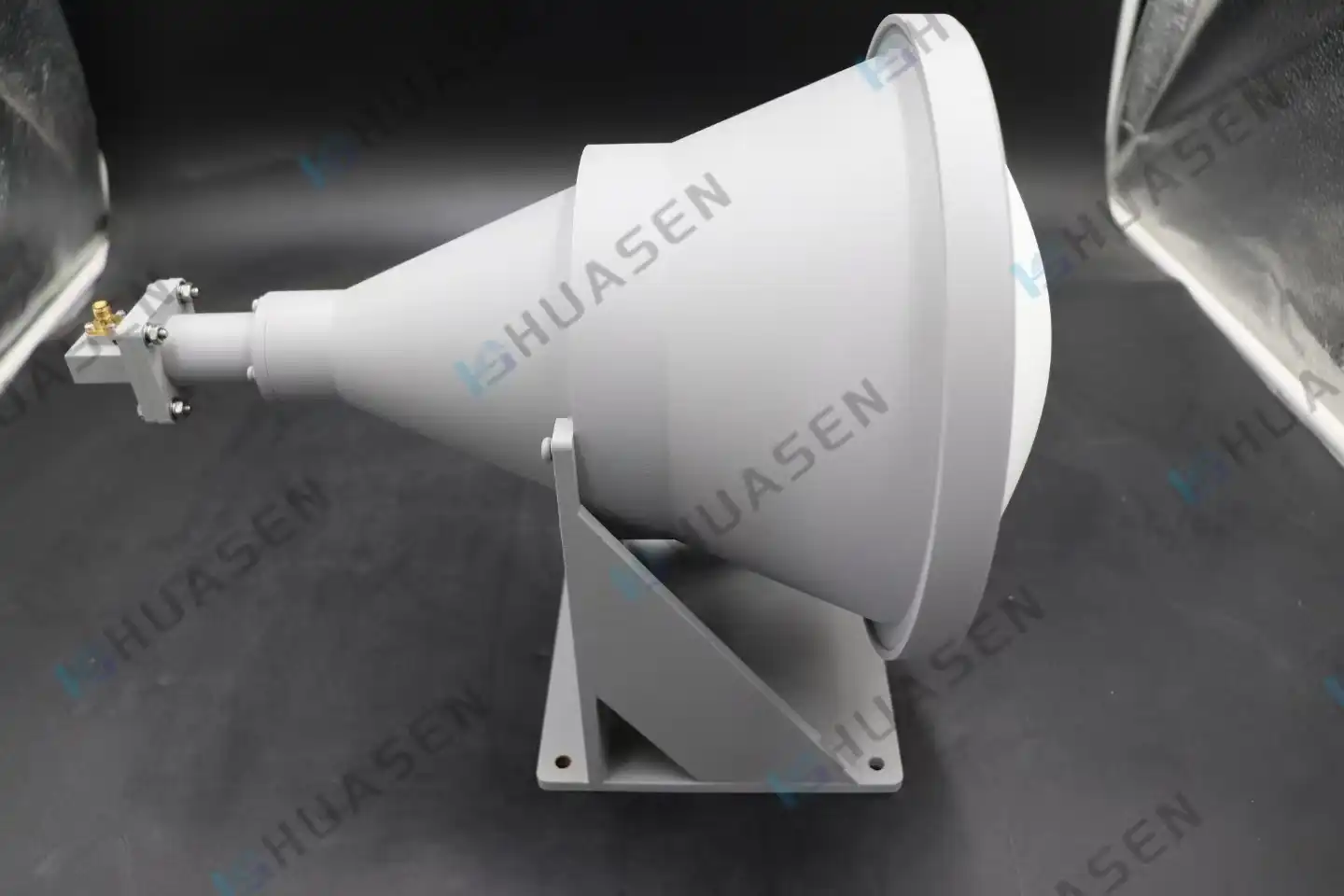
A conical or pyramidal feed horn and a precision-engineered dielectric lens placed at the aperture plane make up the lens horn antenna design. Unlike most horn antennas, which only use changes in flare angle to control beam features, this design uses optical principles in microwave engineering. The shape of the lens turns electromagnetic waves that are spreading out into beams that are focused. This gets rid of phase mistakes that would normally make the aperture less effective as the antenna gets bigger.
Lens Material Selection and Electromagnetic Properties
Choosing the right material has a direct effect on insertion loss, temperature stability, and the amount of power it can handle. Low-loss dielectrics protect the purity of signals over a wide range of operating bandwidths and can withstand stresses from the environment. PTFE is very resistant to chemicals and keeps its dielectric qualities even when the temperature changes a lot. This makes it a reliable material for outdoor setups in marine communications and base station deployments. Rexolite is more mechanically stable in labs where accuracy in measurements affects the accuracy of testing. Quartz is very important in high-power radar uses because it keeps materials from breaking down when waves are sent continuously.
Frequency Range and Operating Band Characteristics
For the next-generation 6G study, these antennas work best in the Ka-band (26.5–40 GHz), V-band (50–75 GHz), E-band (60–90 GHz), and W-band (75–110 GHz) frequency ranges, going up to sub-terahertz levels. The shape of the lens makes up for the fact that diffraction effects are stronger at shorter wavelengths, so the image stays stable over a wide range of bandwidths. This feature makes it easier to buy solutions with a single antenna that can handle multiple frequency assignments. This makes inventory management simpler and makes system integration easier across 5G backup networks and satellite ground stations.
Electromagnetic Wave Propagation Through Dielectric Lenses
When electromagnetic waves leave the feed horn, they hit the edge of the lens, where changes in the lens's refractive index cause controlled phase delays. Different path lengths are used across the opening by the lens shape, which is often hyperbolic or stepped to save weight. When waves move through thicker parts of the lens, their electrical lengths are longer to make up for the shorter physical paths at the aperture edges. This equalization makes the phase distribution constant at the exit plane. This makes planar wavefronts that spread as highly directional beams with little phase ripple.
Impact on Radiation Pattern Characteristics
Lens correction methods make antenna performance measures much better. When aperture efficiency is maximized, gain goes up, and it often goes over 70% compared to 50–60% in horns of the same size that aren't adjusted. In radar imaging, the beamwidth gets narrower, which improves spatial precision and lowers confusion in networks with a lot of users. Sidelobe suppression, which means getting E-plane levels below -15 dB and H-plane levels below -26 dB, stops energy spilling that lowers signal-to-noise ratios in receiving systems and causes co-channel crosstalk in sending systems.
Comparing Lens Horn Antennas with Other Antenna Types for Optimal Solution Selection
To choose the right antenna technology, you have to weigh the performance requirements against the limitations of the installation space and your budget. Each type of receiver has its own pros and cons that affect how the system works as a whole.
To get a high gain, standard horn antennas need to be very long. They are simple and durable, but they need to be very long. At Ka-band, a standard horn with 30 dBi gain might be 600 mm long, but a lens-corrected design can achieve the same gain in 300 mm, which is useful when space is limited on busy tower platforms or in small test rooms. Parabolic reflectors have a very high gain, but they need to be perfectly aligned and can be damaged by wind when installed outside. Their big shapes make it harder to put them on drones or planes, where aerodynamic drag can change mission parameters.
Patch antenna arrays have low profiles that make them good for flush-mounted uses. However, when they are scaled up to high-gain designs, they have narrower bandwidths and cost more to make. Electronic beam steering is possible with phased arrays, but they add complexity through phase shifter networks that raise insertion loss and power usage, both of which are important factors to consider in UAV communication systems that run on batteries. Helical antennas naturally produce circular polarization, but they take up more space and can't increase their gain very much. At lower frequencies, Yagi-Uda systems work well, but they can't be used at millimeter waves because the element spacing tolerances get too small.
Lens horn antennas work really well when you need a small, high-gain option with great pattern control. The fact that they don't have any moving parts or computer parts makes them more reliable in harsh settings where military radar systems are used. The built-in lens protects the environment, so there's no need for a separate radome, which would add weight and could fail. Customization options let you change the focal length and aperture to fit your link budget. Changing the polarization through circular waveguide phase shifters helps with a wide range of tactical needs, from tracking satellites to putting electronic defenses in place.
Practical Applications and Performance Insights of Lens Horn Antennas
Satellite Communication Ground Stations
In VSAT networks, ground terminal antennas use lens horn antenna designs to keep uplink and downlink performance stable across Ku-band and Ka-band allocations. The narrow beamwidth cuts down on interference from nearby satellites, which lets orbits be closer together and makes more transponders available. When there isn't enough room on the deck for big parabolic dishes, maritime ships can use small systems instead. The low sidelobe features stop signal leakage that could break regulatory emission masks.
5G and 6G Wireless Backhaul Infrastructure
For E-band backup links that connect cell towers, high-gain antennas are needed to get around the oxygen absorption in the air, which causes a lot of path loss beyond 10 km. Lens horn antennas give you the 35–40 dBi gain you need in weatherproof packages that you can put on existing equipment without having to add extra support. The planar wavefront creation increases link budget margins, making gigabit data rates possible in densely populated cities where fiber installation is too expensive.
Radar and Electronic Warfare Systems
Lens horn antennas are used in small antenna test ranges by automotive radar test sites to create plane wave conditions that are like those in the far field, but in the lab. The correct phase distribution makes it possible to precisely calibrate 77 GHz collision avoidance systems, which makes sure they meet legal requirements before the car is made. Defense uses the low cross-polarization properties—more than 30 dB isolation—to keep the signal pure in electronic countermeasure situations where polarization detection tells the difference between friendly and dangerous emissions.
Communications Testing and RF Metrology
Lens horn antennas are built into vector network analyzers and spectrum analyzer tools by instrument makers so that wireless devices can be characterized over-the-air. The repeatability of measurements is ensured by the stable radiation pattern across wide frequency sweeps, and test chipsets working at milliwatt power levels can send weak signals that can be picked up by the high-gain sensitivity. The directional properties of these antennas are used by research institutions studying transmission to separate multipath components in channel sounding tests.
Metrics for performance directly lead to practical benefits. A 40 dBi gain lens antenna focuses radiated power into 1-degree beamwidths, increasing point-to-point transmission ranges from 5 km to 15 km at the same power levels. This is very important in situations where emitter output is limited by licenses. Specifications for VSWR below 1.3:1 make sure that the most power is transferred and that there is no mirrored energy that could damage sensitive amplifier stages in send chains. The environmental toughness, which has been proven by MIL-STD-810 testing procedures, means that it can work in temperatures ranging from -40°C to +60°C, which is typical for aircraft platforms.
Procurement Guide: How to Buy Lens Horn Antennas for Industrial Use?
Identifying Reputable Manufacturers and Supply Chain Partners
Reliability guarantees from well-known makers with decades of RF engineering experience are important for mission-critical deployments. Businesses like Huasen Microwave Technology Co., Ltd., which was established in 1993, consistently provide high-quality parts for the aircraft, radar, and telecommunications industries. When judging a vendor, you should look at their production skills, such as their precision machining tolerances, dielectric lens fabrication methods, and electromagnetic modeling tools that check the performance of the design before it is manufactured.
Understanding Pricing Structures and Volume Advantages
The unit costs are very different depending on the frequency band, the gain specs, and the level of customization needed. Standard stock goods that work in common bands usually have prices that range from low-cost options for models with low gain to more expensive ones with high power or a wider frequency range. When you buy in bulk, you can take advantage of economies of scale. This means that the costs of setting up the factory are spread out over a bigger order, which lowers the cost per unit by 15 to 30 percent for orders over 50 units. Lead times depend on how complicated the manufacturing is. Standard configurations ship in 4 to 6 weeks, but 10 to 14 weeks for unique designs that need lens optimization and pattern proof.
Custom Manufacturing for Specialized Requirements
System developers often need to change parameters to work with their specific operating needs. Custom focal lengths make lighting patterns work best for hybrid antenna systems with non-standard reflector shapes, including those using a lens antenna. Adjusting the aperture size strikes a balance between the need for gain and the space available for placement on flying platforms, where every millimeter changes the aerodynamic profiles. In polarization setups, circular waveguide phase shifters can be used to get axial ratios below 1.5 dB. This is necessary for satellite transmission standards that require precise circular polarization purity. You can choose from different connector interfaces that work with waveguide flanges (WR-28, WR-19, and WR-12) or coaxial changes that meet the standards for system design.
Technical Support and Integration Services
Deployments that work rely on full help that goes beyond just delivering parts. Pre-sales engineering helps buyers turn link budget needs into antenna specs so they don't overspecify, which drives up costs, or underspecify, which lowers performance profits. Sample programs let prototypes be tested in real-world settings before full buying promises are made. After the product is delivered, there is fitting help that includes choosing the right mounting tools, following weatherproofing steps, and following alignment steps to get the best boresight accuracy. Calibration data packages include measured radiation patterns, gain curves, and VSWR plots that help with regulatory paperwork and system proof tests.
Certification and Quality Assurance
Defense contractors and telecom providers who need to be able to track quality standards need to keep compliance paperwork. Getting ISO 9001 certification means that you have set up quality control systems that make sure your work processes are always the same. RoHS compliance makes sure that the materials chosen are in line with environmental rules that apply in North American and European markets. Conformance to military standards (MIL-STD-461 for EMI/EMC and MIL-STD-810 for environmental stress) proves that the product works well in harsh conditions like those found in wartime communications and airborne radar sites.
Lens Antenna warranty terms show how confident the company is in the product's durability. Standard coverage for the lens antenna lasts between 12 and 24 months and protects against flaws in the materials or the work itself. Longer programs that come with maintenance contracts for Lens Antennas offer replacement units that cut down on system downtime during repair rounds. This is especially helpful in rural sites where it's hard for field service technicians to get to the lens antenna system.
Conclusion
Lens horn antennas are an excellent choice for situations that need small, high-gain performance with precise pattern control. When precision dielectric lenses are built into horn antenna designs, they solve basic electromagnetic problems by making the antennas smaller while improving their aperture efficiency and sidelobe suppression. In areas like internet infrastructure, radar systems, aerospace platforms, and test instruments, where room limitations and signal purity are important for function, these traits are necessary. When making purchasing decisions, it's helpful to know the technical differences between antenna types, the capabilities of different manufacturers, and how customization options fit with specific system needs. This way, deployments can meet performance goals while staying within budget and meeting deadlines.
FAQ
1. What frequency ranges do lens horn antennas typically cover?
These antennas work best in microwave and millimeter-wave bands that range from 18 GHz to 110 GHz. These bands include Ka-band, V-band, E-band, and W-band. As the frequency goes up, the lens correction system becomes more useful because wavelengths get shorter, making phase error control very important for keeping aperture efficiency.
2. How does radiation pattern quality affect system performance?
The features of the radiation pattern have a direct effect on how reliable the link is and how easily it can be hacked. Low sidelobes stop energy leakage that causes co-channel interference in links next to each other and lower the signal-to-noise ratios in systems that receive it. Narrow beamwidths focus the power being sent toward the targets that it's meant for, increasing operating ranges while reducing spectrum occupancy—essential for following the rules in frequency bands that are already full.
3. Can lens horn antennas be customized for specialized 5G or satellite applications?
Customization options meet a wide range of operating needs. By changing the focal length, you can get the best lighting patterns for different reflection shapes. The size of the aperture changes to meet the gain requirements within the limits of the placement area. Integrated phase changer networks let polarization setups change to meet circular or dual-linear needs. Manufacturers with experience designing RF components offer technical help that turns application needs into the best antenna specs.
4. What factors distinguish lens horn antennas from phased array alternatives?
Lens horn antenna designs are mechanically simple because they don't have any electrical beam steering parts. This means they use less power and don't have any phase shifter insertion losses. This passive design makes the system more reliable in harsh settings where breakdowns of active components could make the system unavailable. Phased arrays offer electronic beam movement that is useful for tracking, but they are too complicated and expensive for fixed-link deployments, where lens horn antennas are more cost-effective.
Partner with Huasen Microwave for Advanced Antenna Solutions
Huasen Microwave Technology Co., Ltd. has been making high-frequency microwave and millimeter-wave parts for 30 years and has a track record of dependability in the defense, aircraft, telecommunications, and radar industries. Our large collection includes the Conical Horn Lens (LHA), the Pyramidal Horn Lens, the Feed-Illuminated Lens, and the Point-Focus Lens (PLHA). These lenses have small axial dimensions, great sidelobe suppression (E-plane ≤-15dB, H-plane ≤-26dB), and a variety of polarization choices. Custom engineering lets you make focal lengths, apertures, and beamwidths that fit your system's needs, and full technical support makes sure that everything works smoothly from the design stage to deployment. Talk to our team at sales@huasenmicrowave.com about your project needs and find out why top system designers trust Huasen Microwave as their Lens Horn Antenna provider for mission-critical applications.
References
1. Balanis, C.A. (2016). Antenna Theory: Analysis and Design, Fourth Edition. John Wiley & Sons, Hoboken, New Jersey.
2. Milligan, T.A. (2005). Modern Antenna Design, Second Edition. IEEE Press, Wiley-Interscience, New York.
3. Silver, S. (1984). Microwave Antenna Theory and Design, IET Electromagnetic Waves Series. Institution of Engineering and Technology, London.
4. Stutzman, W.L. and Thiele, G.A. (2012). Antenna Theory and Design, Third Edition. John Wiley & Sons, New York.
5. Olver, A.D., Clarricoats, P.J.B., Kishk, A.A., and Shafai, L. (1994). Microwave Horns and Feeds. IEEE Press, New York.
6. Kraus, J.D. and Marhefka, R.J. (2002). Antennas for All Applications, Third Edition. McGraw-Hill Higher Education, New York.
Send Inquiry