How to Calculate the Gain and Beamwidth of a Pyramidal Horn?






2019-02-27 11:24:16
Calculating the gain and beamwidth of a pyramidal horn antenna is essential for optimizing its performance in various applications. These crucial parameters determine the antenna's directivity and radiation pattern, influencing its effectiveness in telecommunications, radar systems, and other high-frequency applications. In this comprehensive guide, we'll explore the methods for calculating gain and beamwidth, as well as the intricate relationship between aperture size and these vital characteristics.
How do you calculate the gain of a pyramidal horn antenna?
The gain of a pyramidal horn antenna is a measure of its ability to concentrate radio frequency energy in a specific direction. Calculating this parameter involves considering several factors:
Aperture Efficiency Method
One common approach to calculating gain uses the aperture efficiency method:
Gain = (4π * Aperture Area) / (λ^2) * Aperture Efficiency
Where:
- Aperture Area is the physical opening of the horn
- λ is the wavelength of the operating frequency
- Aperture Efficiency typically ranges from 0.5 to 0.8 for well-designed horns
Directivity Calculation
Another method involves calculating the directivity and relating it to gain:
Gain = Directivity * Efficiency
Directivity can be approximated using the horn's dimensions and wavelength. The efficiency factor accounts for losses within the antenna structure.
Simulation and Measurement
For precise results, many engineers utilize electromagnetic simulation software or conduct physical measurements using anechoic chambers and network analyzers.

Beamwidth calculation methods for pyramidal horn antennas
Beamwidth is another critical parameter that describes the angular width of the main lobe in a pyramidal horn antenna's radiation pattern. There are several methods to calculate beamwidth:
Approximate Formulas
For the E-plane (vertical) beamwidth:
θE ≈ 56λ / LE
For the H-plane (horizontal) beamwidth:
θH ≈ 70λ / LH
Where LE and LH are the vertical and horizontal aperture dimensions, respectively.
3dB Beamwidth Method
This method involves finding the angular separation between points where the power drops to half (-3dB) of its maximum value. It often requires detailed pattern measurements or simulations.
Aperture Distribution Technique
More advanced calculations consider the field distribution across the horn's aperture, which can provide more accurate results for specialized horn designs.
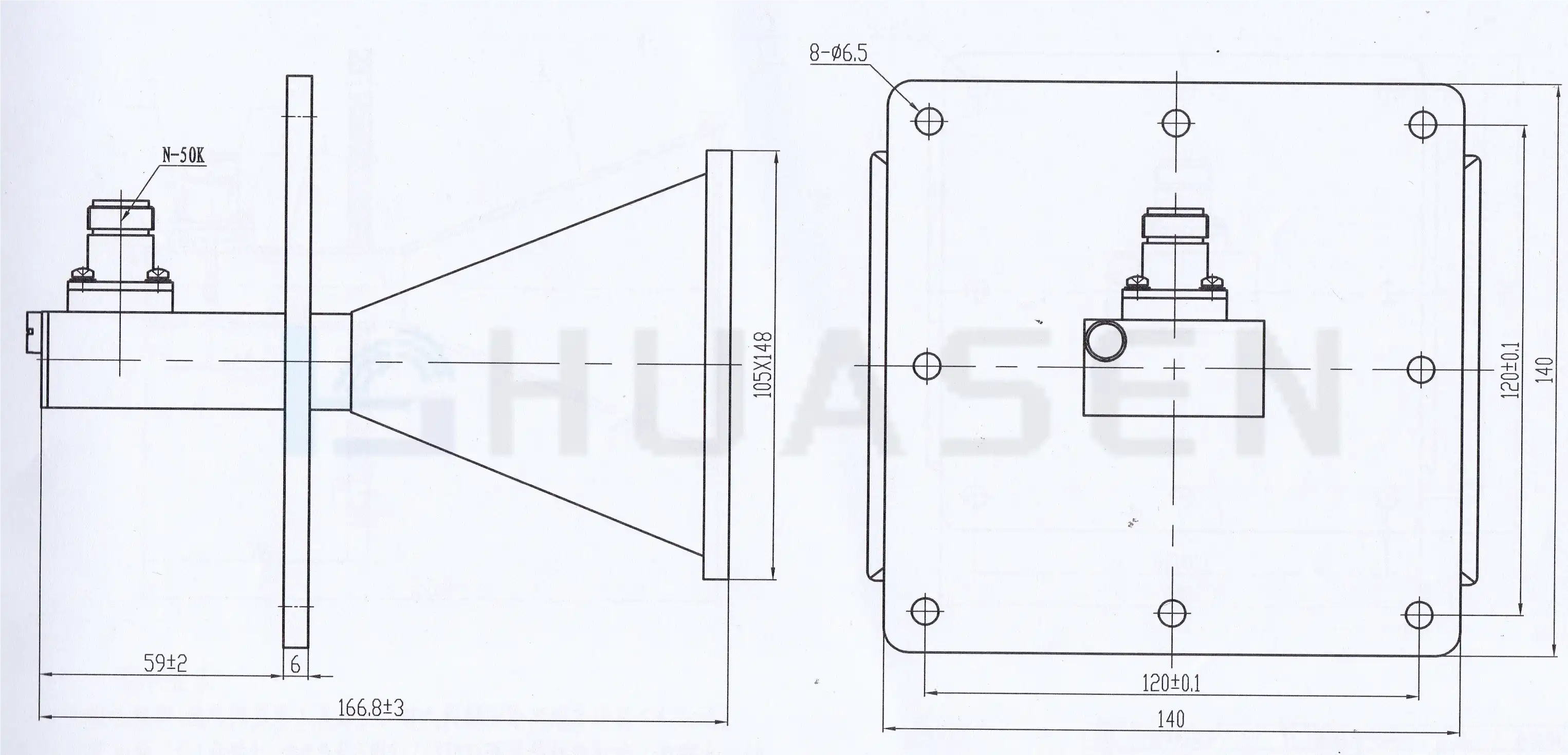
Relationship between aperture size, gain, and beamwidth in horns
Understanding the interplay between aperture size, gain, and beamwidth is crucial for optimizing pyramidal horn antenna design:
Aperture Size and Gain
Generally, increasing the aperture size leads to higher gain. This relationship is approximately linear when expressed in dB:
Gain (dB) ∝ 10 log(Aperture Area)
However, this relationship holds true only up to a certain point, after which other factors like phase errors become significant.
Aperture Size and Beamwidth
Beamwidth is inversely proportional to aperture size. As the aperture increases, the beamwidth narrows:
Beamwidth ∝ 1 / Aperture Dimension
This relationship allows designers to control the antenna's directivity by adjusting its physical dimensions.
Gain-Beamwidth Product
An interesting property of horn antennas is that the product of gain and beamwidth remains relatively constant for a given frequency. This allows engineers to make trade-offs between these parameters based on specific application requirements.
Optimization Considerations
When designing a pyramidal horn antenna, engineers must balance these relationships to achieve the desired performance. Factors such as side lobe levels, cross-polarization, and phase center location also play crucial roles in the overall antenna performance.
In conclusion, calculating the gain and beamwidth of a pyramidal horn antenna involves careful consideration of its physical dimensions, operating frequency, and efficiency factors. By understanding the intricate relationships between these parameters, engineers can design antennas that meet specific requirements for various applications in telecommunications, radar systems, and beyond.
FAQ
1. What factors affect the gain of a pyramidal horn antenna?
The gain of a pyramidal horn antenna is influenced by several factors, including the aperture size, operating frequency, aperture efficiency, and the overall design of the horn. Larger apertures and higher frequencies generally result in higher gain, while factors like surface roughness and manufacturing precision can affect the aperture efficiency.
2. How does polarization impact pyramidal horn antenna performance?
Polarization significantly affects the performance of pyramidal horn antennas. These antennas can be designed for linear (vertical or horizontal) or circular polarization. The choice of polarization impacts the antenna's ability to transmit and receive signals effectively in different environments and applications.
3. Can pyramidal horn antennas be used in array configurations?
Yes, pyramidal horn antennas can be effectively used in array configurations. Antenna arrays allow for increased gain, improved directivity, and the ability to electronically steer the beam. However, designing horn antenna arrays requires careful consideration of mutual coupling effects and phase relationships between elements.
4. What are the advantages of using a pyramidal horn antenna over other antenna types?
Pyramidal horn antennas offer several advantages, including high gain, wide bandwidth, and predictable radiation patterns. They are also relatively simple to manufacture and can handle high power levels. These characteristics make them ideal for applications in radar systems, satellite communications, and electromagnetic testing.
Elevate Your RF Performance with Custom Pyramidal Horn Antennas | Huasen Microwave
Ready to enhance your communication or radar systems with precision-engineered pyramidal horn antennas? At Huasen Microwave, we specialize in creating high-performance antennas tailored to your exact specifications. Our team of expert engineers is prepared to work closely with you to design and manufacture antennas that meet your unique requirements for gain, beamwidth, and frequency range. Don't let suboptimal antenna performance hold back your project's potential. Take the first step towards optimizing your RF systems by reaching out to us today. Contact our sales team at sales@huasenmicrowave.com to discuss your needs and discover how our custom pyramidal horn antennas can propel your technology to new heights of efficiency and reliability.
References
1. Balanis, C. A. (2016). Antenna Theory: Analysis and Design. John Wiley & Sons.
2. Milligan, T. A. (2005). Modern Antenna Design. John Wiley & Sons.
3. IEEE Antennas and Propagation Society. (2013). IEEE Standard for Definitions of Terms for Antennas. IEEE Std 145-2013.
4. Silver, S. (1949). Microwave Antenna Theory and Design. McGraw-Hill Book Company.
5. Pozar, D. M. (2011). Microwave Engineering. John Wiley & Sons.
6. Volakis, J. L. (2007). Antenna Engineering Handbook. McGraw-Hill Education.
Send Inquiry