Custom Circularly Polarized Horn Antenna: What Parameters Need to Be Provided?






2026-02-23 19:47:59
When specifying a custom horn antenna circular polarization solution, engineers must provide comprehensive technical parameters to ensure optimal performance. Essential specifications include operating frequency range, required axial ratio performance, gain characteristics, polarization sense (RHCP or LHCP), connector types, and environmental requirements. Additionally, power handling capabilities, bandwidth specifications, radiation pattern requirements, and mechanical constraints such as mounting configurations and dimensional limitations must be clearly defined. These parameters enable manufacturers to design precisely tailored solutions that meet stringent application demands across satellite communications, radar systems, and advanced wireless networks.
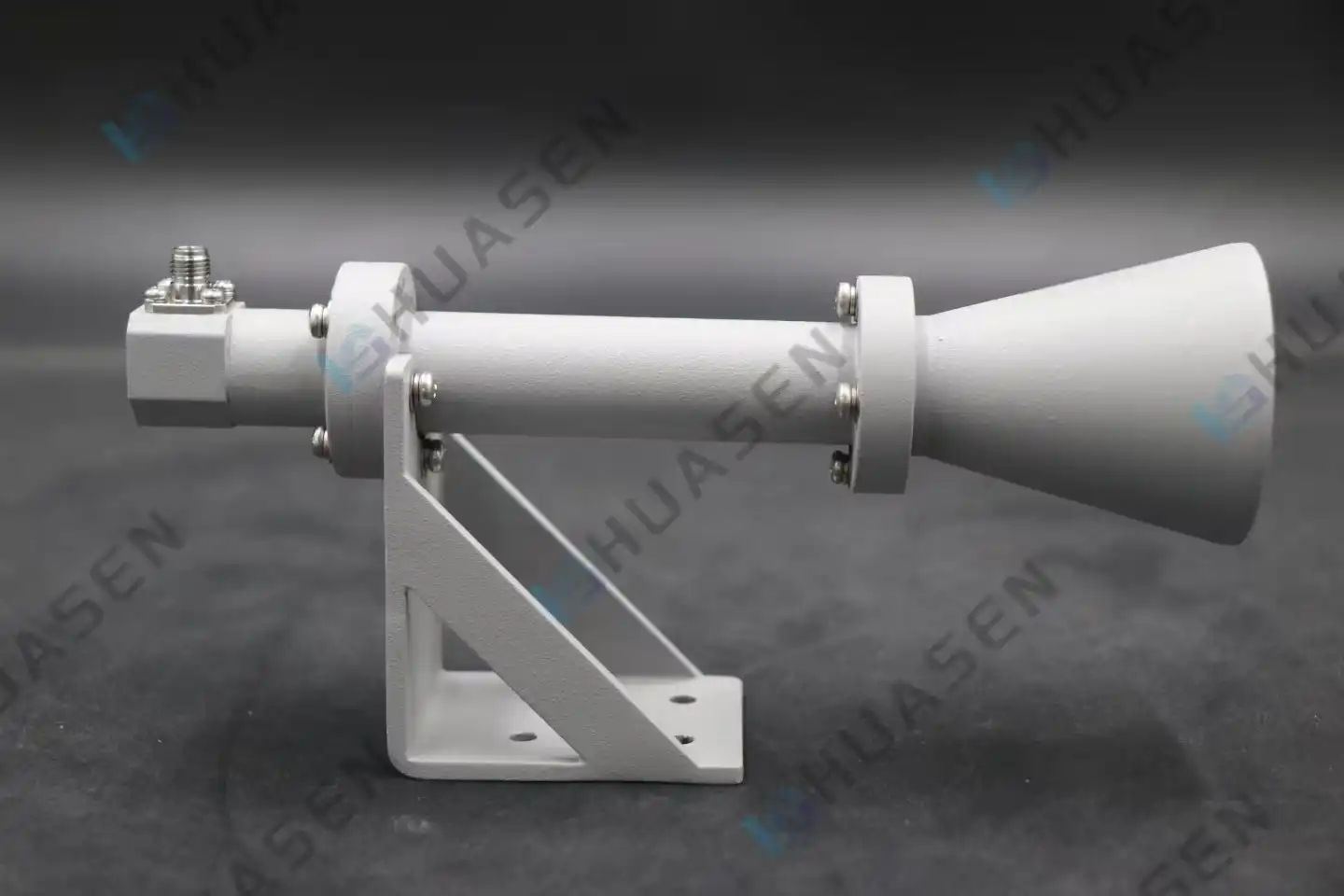
Understanding Circular Polarization in Horn Antennas
A big step forward in electromagnetic wave transmission technology is circular polarisation, in which the electric field vector spins in a helical pattern all the time as the wave moves through space. This rotation happens at the same frequency as the signal being sent, and based on the direction of rotation, it makes either right-hand circular polarisation (RHCP) or left-hand circular polarisation (LHCP).
Fundamental Principles of Circular Polarization
In order for circular polarisation to work, two orthogonal linear polarisations with equal amplitude and a 90-degree phase difference must be mixed. This mathematical relationship makes a circularly polarised wave that keeps the same signal strength no matter which way the receiving antenna is turned around the transmission axis. This polarisation is achieved by stepped septum polarisers, dielectric vanes, or curved waveguide feeds inside horn antennas. These structures change basic waveguide modes into circularly polarised radiation.
Advantages Over Linear Polarization Systems
When compared to standard linear systems, circular polarisation has a lot of operational benefits. Because reflected signals change their polarization sense, receivers can tell the difference between direct and reflected signals, and multipath interference is greatly lessened. In places like cities or buildings with metal structures, where signal reflections are frequent, this trait is especially useful. Also, circular polarisation gets rid of the need for exact antenna alignment between the transmitter and receiver. This makes installation easier and keeps link performance stable even when working conditions change.
Applications in Modern Communication Systems
Circular polarisation is used a lot in modern satellite transmission systems to get around ionospheric effects and satellite rotation. Dual-polarized horn antennas are used in weather radar sites tohorn antenna circular polarizationtell the difference between different types of precipitation and ground clutter. Circular polarisation is used for over-the-air measurements in advanced 5G testing facilities. This makes tests simpler while keeping measuring accuracy across different device orientations.
Essential Design Parameters for Custom Circularly Polarized Horn Antennas
Successful custom antenna development requires precise specification of multiple interconnected technical parameters. Each parameter directly influences antenna performance and must align with specific application requirements to ensure optimal system operation.
Critical Performance Specifications
The most important thing to know about horn antenna circular polarisation quality is the axial ratio, which shows how close the broadcast field is to perfect circular polarisation. Axial ratios must be less than 1.5 dB across the operating bandwidth for most high-performance uses, and premium systems must achieve 0.5 dB or better. The CPHA series from Huasen Microwave has great performance with axial ratios of 0.5dB or less, thanks to advanced step diaphragm designs and careful production methods. The operating frequency range and bandwidth requirements have a direct effect on the size and complexity of the antenna's internal structure. Narrowband designs (≤ 5% bandwidth) can improve axial ratio performance but make operations less flexible. Broadband alternatives (with up to 67% bandwidth) give you more options while still keeping the polarisation purity at a good level. To meet the needs of a wide range of applications, Huasen Microwave provides flexible bandwidth choices ranging from 0.5GHz to 110GHz.
Gain and Radiation Pattern Requirements
In order for antenna gain standards to work, they need to balance the need for directivity with the need for beamwidth. Gains usually fall between 10 and 25 dBi, based on the size of the aperture and the frequency band chosen. Higher-gain antennas boost signal strength but have narrow beamwidths that might make it harder to point. Specifications for the radiation pattern include the main lobe direction, the levels of the side lobes, and cross-polarization detection to make sure that interference is blocked and the signal quality is good.
Mechanical and Environmental Considerations
Physical limitations have a big effect on how feasible it is to build an antenna. During the design process, it is important to be clear about mounting requirements, size limits, and weight limits. You can choose from different types of coaxial connections, waveguide interfaces, and specialised high-frequency connectors. The connector you choose affects both the RF performance and the mechanical integration. Environmental specifications include working temperature ranges, resistance to humidity, vibration tolerance, and electromagnetic compatibility requirements that are necessary for reliable operation in the field.
Comparison Insights: Circular Polarization Horn Antenna vs. Alternatives
Understanding the performance trade-offs between different antenna technologies enables informed selection decisions based on specific application requirements and operational constraints.
Performance Characteristics Analysis
Horn antennas with circular polarization offer superior gain stability and predictable radiation patterns compared to patch or helical alternatives. Their metallic construction provides excellent power handling capabilities and long-term reliability in harsh environments. However, they typically require larger physical volumes than compact alternatives, andhorn antenna circular polarization,which may limit installation options in space-constrained applications.
Helical antennas achieve circular polarization through their geometric structure but often exhibit narrower bandwidth and lower gain compared to horn designs. Patch antenna arrays can provide circular polarization with compact form factors but may suffer from limited power handling and environmental sensitivity. Linear horn antennas offer simpler designs and lower costs but lack the multipath rejection and orientation flexibility of circular polarization systems.
Application Suitability Considerations
Satellite communication terminals benefit significantly from circular polarization's immunity to Faraday rotation and satellite orientation changes. Test and measurement applications leverage the orientation independence to simplify measurement procedures and improve repeatability. Radar systems utilize dual circular polarization to enhance target discrimination and weather classification capabilities. The selection process must evaluate factors including required link margin, environmental conditions, installation constraints, and lifecycle cost considerations. High-reliability applications typically favor horn antenna designs despite size penalties, while mobile or temporary installations may prioritize compact alternatives despite performance limitations.

Key Steps to Specify When Ordering a Custom Circularly Polarized Horn Antenna
Successful procurement of custom antenna solutions requires systematic specification development and supplier evaluation to ensure project requirements are met within budget and schedule constraints.
Technical Specification Development
When you evaluate a supplier, you look at their technical skills, the level of their work, and how reliable their delivery is. Established companies like Huasen Microwave have decades of experience developing microwave technology and can make a lot of them. Suppliers who have quality certifications, test facilities, and advanced design tools are ready to handle complicated custom requirements. With prototype development timelines and testing options, you can make sure everything works before committing to full production. Support from suppliers for improving designs and fixing performance issues is a useful partnership throughout the development cycle. Stable supply chains over the long term make sure that parts are available for help throughout a product's lifecycle and for replacements in the field.
Supplier Evaluation and Selection
The papers you send out for quotes should have full technical details, quantity needs, delivery schedules, and quality standards. Multiple supplier reviews let you compare costs and get a variety of technical approaches. The terms of the contract should include information about intellectual property, how to change the design, and the need for acceptance testing. Quality assurance protocols need to spell out how to test, what the acceptance standards are, horn antenna circular polarization,and what kind of documentation is needed. Design iteration time and production wait times should be taken into account when planning deliveries. Cost structures should take into account technical fees that don't happen very often, the cost of tools, and price breaks for large orders.
Procurement Process Optimization
To make sure that delivered antennas meet specification requirements and work consistently in operational environments, accurate performance verification needs high-tech test tools and methods.
How to Measure and Verify Circular Polarization Performance
Accurate performance verification requires sophisticated test equipment and procedures to ensure delivered antennas meet specification requirements and perform reliably in operational environments.
Axial Ratio Measurement Techniques
To measure axial ratios, you need to be able to precisely control the polarisation and find the field strength across a certain frequency range. Anechoic chamber testing gets rid of reflections from the surroundings that could change the accuracy of measurements. When you use an automated measurement system, you get uniform results while cutting down on test time and operator error. To measure, a probe antenna with a linear polarization is turned all the way around while the incoming signal strength is recorded. The axial ratio number is the ratio between the highest and lowest amount of power received. Multiple measurement places spread out across the radiation pattern make sure that the performance is consistent and find any possible manufacturing differences.
Gain and Pattern Verification
For reliable results in gain measurements, reference antennas must be calibrated, and test distances must be kept under control. For radiation pattern measurements to be true, far-field conditions must be set up. Pattern measurements record the main beam direction, beamwidth, side lobe levels, and null depths in all three major planes. Cross-polarization tests show that orthogonal polarisation channels in dual-polarized systems are completely separate from each other. These measurements find possible flaws in the manufacturing process or design limits that might hurt operational performance. Frequency sweep measures make sure that the performance stays the same across the whole bandwidth.
Quality Assurance Protocols
Comprehensive RF performance verification, mechanical inspection, and external stress screening should all be part of factory acceptance testing. Third-party testing labs offer independent confirmation for important uses that need objective confirmation. The test results must include a study of measurement uncertainty and a link to national standards. Long-term reliability testing checks how stable performance is when the environment is stressed. Accelerated ageing tests find possible failure modes and help make predictions about dependability. Using statistical process control during production ensures that quality is always consistent and that any differences are identified quickly.
Conclusion
To specify circularly polarised horn antennas that are made just for you, you need to know a lot about technical parameters, application requirements, and measurement verification processes. To be successful, you need to clearly define operational goals, evaluate the capabilities of suppliers, and put in place strong quality assurance protocols. When you spend time and money on making sure your specifications are correct and choosing the right supplier, you'll get a lot back in the form of better system performance, lower integration risk, and long-term operating reliability. High-performance circular polarisation solutions that meet stricter technical standards are still in high demand for modern uses in satellite communications, radar systems, horn antenna circular polarization,and wireless testing.

FAQ
1. What is the typical axial ratio requirement for satellite communication applications?
Most satellite communication systems specify axial ratios below 1.5 dB across the operating bandwidth to ensure adequate cross-polarization isolation. Critical applications may require 1.0 dB or better performance to maximize frequency reuse efficiency and minimize interference between orthogonal channels.
2. How does circular polarization improve radar system performance?
Circular polarization enables weather radar systems to differentiate between precipitation types and ground clutter through differential reflectivity measurements. Raindrops become oblate during fall, creating different reflection characteristics for circular polarization that help meteorologists distinguish weather phenomena from fixed targets.
3. Can circularly polarized horn antennas handle high-power transmission?
Modern horn antenna designs using metallic construction readily handle kilowatt power levels when properly designed for thermal management. Huasen Microwave's CPHA series incorporates robust construction techniques that support both high average power and peak pulse applications across its frequency range.
4. What connector options are available for custom designs?
Connector selection depends on frequency range, power requirements, and mechanical constraints. Common options include SMA, Type-N, and various waveguide interfaces. Huasen Microwave provides extensive connector customization to match specific system requirements and ensure optimal RF performance.
5. How long does custom antenna development typically require?
Development timelines vary based on design complexity and performance requirements. Standard modifications may require 4-6 weeks, while completely new designs can take 8-12 weeks, including prototype testing and validation. Huasen Microwave's experienced engineering team works to minimize development time while ensuring thorough design validation.
Partner with Huasen Microwave for Superior Horn Antenna Circular Polarization Solutions
Huasen Microwave stands as your trusted horn antenna circular polarization manufacturer, delivering three decades of proven expertise in custom RF component development. Our advanced CPHA series combines innovative step diaphragm technology with precision manufacturing to achieve exceptional axial ratio performance ≤ 0.5dB across frequencies from 0.5-110GHz. Whether you require narrowband precision or broadband versatility, horn antenna circular polarization,our engineering team collaborates directly with your specifications to optimize performance, reduce development risk, and ensure timely delivery. Contact our technical specialists at sales@huasenmicrowave.com to discuss your custom requirements and discover how our proven solutions can enhance your system performance while meeting the most demanding application requirements.
References
1. Balanis, Constantine A. "Antenna Theory: Analysis and Design, Fourth Edition." John Wiley & Sons, 2016.
2. IEEE Standard for Test Procedures for Antennas. "IEEE Std 149-2021 - IEEE Standard for Test Procedures for Antennas." Institute of Electrical and Electronics Engineers, 2021.
3. Ludwig, Arthur C. "The Definition of Cross Polarization." IEEE Transactions on Antennas and Propagation, vol. AP-21, no. 1, January 1973.
4. Milligan, Thomas A. "Modern Antenna Design, Second Edition." McGraw-Hill Professional, 2005.
5. Rudge, Alan W., et al. "The Handbook of Antenna Design, Volume 1." IET Press, 1986.
6. Silver, Samuel. "Microwave Antenna Theory and Design." MIT Radiation Laboratory Series, Volume 12, McGraw-Hill Book Company, 1949.
Send Inquiry