Corrugated Conical Horn Antenna: Beamwidth & Sidelobe Guide






2026-06-29 21:52:40
When building high-frequency communication systems, it is very important to choose an antenna with the right beamwidth and few sidelobes so that signals are sent accurately. The corrugated conical horn antenna is one of a kind because it has a special internal groove structure that handles problems like interference and uneven patterns. This antenna's HE11 hybrid mode creates rotationally symmetric radiation patterns with better cross-polarisation suppression. This makes it an essential tool for satellite feeds, radio astronomy, and small antenna test areas where signal clarity is key to system success.
Understanding Corrugated Conical Horn Antennas
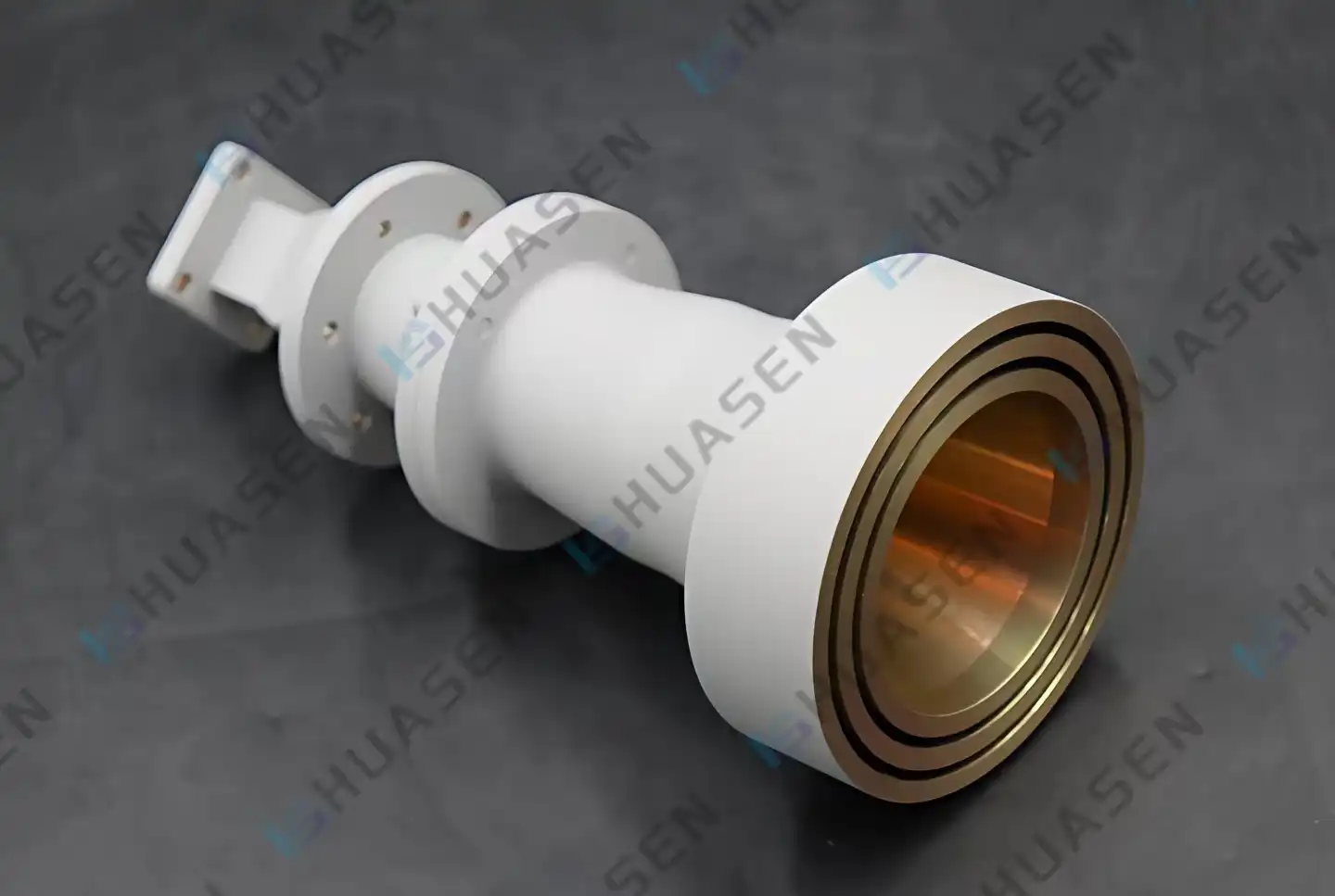
Some types of corrugated conical horn antennas have lines cut around the inside of the cone shape, usually at depths between λ/4 and λ/2. Compared to versions with smooth walls, this structural change fundamentally changes the electromagnetic boundary conditions. Standard horns that are conical or pyramidal support different transverse electric and transverse magnetic modes that create elliptical beam patterns. The corrugated shape, on the other hand, creates a balanced hybrid mode. The astigmatism that comes with smooth designs is taken care of by this mixed-mode structure, which creates circular Gaussian beam profiles with almost equal E-plane and H-plane beamwidths.
Core Design Elements That Drive Performance
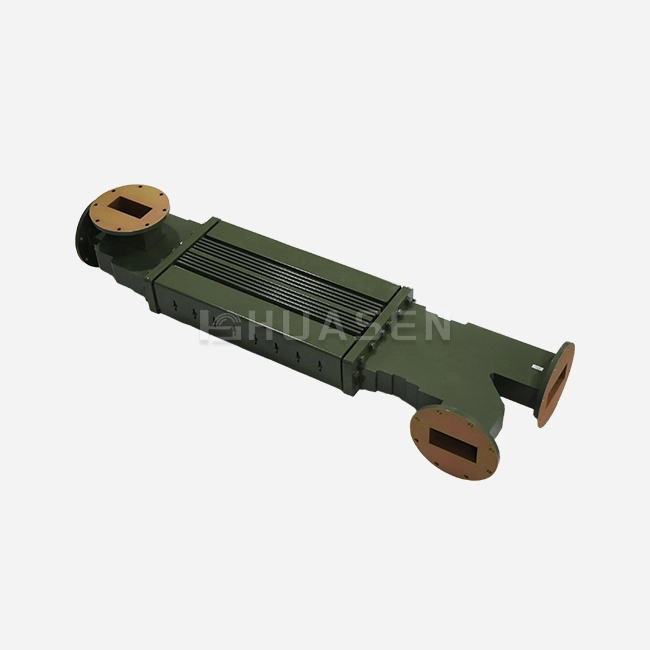
The accuracy of the internal corrugation shape has a direct effect on how well an antenna works. Slot width limits kept within ±0.01mm make sure that the mode stays pure across all operating bandwidths. Precision concave slot structures and a large-angle horn shape make it possible to cover a wide frequency range, from 1.76GHz to 300GHz. Standard circular waveguide connectors with sizes from 2.388mm to 114.58mm make it easy to connect to current RF transmission systems. When choosing materials, choosing high-conductivity platings like silver or gold helps keep resistance losses to a minimum. This is especially important at millimetre-wave frequencies, where surface current levels rise.
Why System Integrators Choose This Architecture
When procurement professionals look at antenna choices for radar systems, base station frontends, or satellite ground terminals, they know that corrugated conical horn antennas solve more than one engineering problem at the same time. In the HE11 hybrid mode, the E-H plane beam equalisation error is less than -15dB and stays within ±5°. In broadband feed-forward and offset feed antenna systems, where aperture illumination consistency has a direct effect on reflector efficiency, this property is very important. The antenna keeps its VSWR below 1.30 when it's working at full bandwidth, and it stays below 1.06 when it's working in narrowband mode. This makes sure that power is transferred efficiently and that there isn't too much returned energy that could damage the transmitter stages.
Beamwidth and Sidelobe Characteristics Explained
Engineers can guess how a system will work in the real world by knowing the details of the radiation pattern. Beamwidth measures how far apart the main lobe is at an angle. It is usually found at the half-power (-3dB) points. Narrower beamwidths focus energy into smaller areas, which raises the directed gain but lowers the coverage area. Sidelobe levels, which are given as decibel ratios to peak gain, show the amount of unwanted radiation outside the main beam. In electronic defence uses, high sidelobes create interference paths that lower signal-to-noise ratios and weaken system security.
Measurement Protocols That Verify Specifications
Radiation traits can be proven by testing them in far fields inside anechoic rooms. To make sure that impedance matching is correct across certain frequency bands, vector network analysers check for return loss and VSWR. Coordinate measuring tools make sure that the throat width, aperture dimensions, and most importantly, the uniformity of the slot depth are all geometrically correct. These quality control methods, which are in line with IEEE Standard 149 measurement techniques, make it possible to compare vendor products in an unbiased way. MIL-STD-810 outdoor compliance testing confirms performance in harsh conditions like high and low temperatures, vibrations, and high and low humidity, which are common in space and at sea.
Interpreting Datasheets for Procurement Decisions
Radiation pattern plots show how the sidelobes are spread out and how the beamwidth is symmetrical across the horizontal and elevation planes. Cross-polarisation discrimination specifications above 35dB show higher polarisation purity, which is needed for transmission lines that use both polarisations. The phase centre stability graphs show that the source doesn't change much across working bandwidths, which is needed to keep the focal alignment in reflector systems. Instead of depending only on theoretical design goals, buying teams should ask for calibration certificates and sample test data that show real measured performance when comparing rival goods.
Comparing Corrugated Conical Horn Antennas with Other Horn Types
Because their shapes are easier and rectangular, standard pyramidal horns are cheaper, but they make patterns that aren't symmetrical and have different E-plane and H-plane beamwidths. This astigmatism makes it harder to create reflection lighting and makes apertures less useful. Even though smooth conical horns get rid of rectangular geometry, they keep higher amounts of cross-polarisation and sidelobes that aren't acceptable for precision measurement systems. Sectoral horns have narrow beamwidths in one plane but wide patterns in the opposite dimension. They are good for specific coverage patterns, but don't have the circular symmetry that most microwave uses need.
Performance Trade-Offs in System Design
The corrugated conical horn antenna structure creates uniform Gaussian beam profiles with very low cross-polarisation, usually 30–40dB less than peak gain. For this performance, the production process is more complicated and needs advanced CNC cutting or electroforming, which makes the unit cost higher than smooth options. Tight internal tolerances require skilled manufacturing and longer production processes. But the benefits to the system as a whole often make the expense worth it. In radio astronomy, radiometers are most sensitive when they pick up less sidelobe from warm ground sources. The features of clean patterns keep excess loss to a minimum in Cassegrain feed systems. This directly improves the gain-to-noise temperature ratios at satellite earth stations.
Application-Specific Selection Criteria
Base station builders who are adding 5G millimetre-wave frontends need antennas that can handle octave bandwidths and stable phase centres to make designing the beamforming network easier. Low sidelobes are important for radar system designers because they cut down on clutter returns and make it easier to find targets in difficult settings. Operators of compact antenna test ranges need Gaussian illumination patterns that make quiet areas that are the same size for measuring the radar cross-section of stealth platforms. When antenna traits are matched to the needs of an application, costly redesigns are avoided, and the system works at its best from the start.
Procurement Guide for Corrugated Conical Horn Antennas
Sourcing tactics that work well combine technical requirements with delivery times and price limits. When evaluating a vendor, you should look at their manufacturing skills, quality control methods, and how stable their supply chain is. Companies that have been around for a long time and have a lot of experience with radio frequency (RF) usually have a wide range of products that cover standard frequency bands and can be customised to meet specific needs. During the quotation process, asking for thorough mechanical drawings and electromagnetic modelling reports helps make sure the design is good before committing to buying a lot of them.
Certification and Compliance Considerations
Applications that work with the defence, aircraft, or telecoms sectors often need to follow strict rules set by regulators. RoHS approval proves that dangerous materials can't be used in certain manufacturing processes. Registration of an ISO 9001 quality management system means that production rules are always the same. Products that are going to be used by the military may need to go through MIL-STD approval testing that shows how well they work when they are subjected to shock, pressure, and changes in temperature. By checking certifications and asking for copies of the certificates, procurement teams can keep the supply chain running smoothly even if compliance problems are found during system integration or final acceptance testing.
Navigating Customisation and Lead Times
A lot of system designs need setting changes that go beyond what is listed in the catalogue. If the customer and seller need to change the frequency band, customise the polarisation, or make custom mechanical interfaces, they need to work together as engineers. The process of customisation goes faster when electricity needs, environmental restrictions, and interaction requirements are clearly communicated. Sample trials and pattern verification tests that are part of prototyping deal with lower technical risk before full-scale production commitments. Realistic planning for projects and stock is made possible by knowing that lead times range from 6 to 12 weeks for standard goods and 12 to 20 weeks for unique designs.
Optimising Antenna Selection for Your Specific Application
To match antenna properties to practical needs (corrugated conical horn antenna), you need to carefully look at gain budgets, coverage patterns, and interference situations. To get the best G/T ratios, satellite communication ground stations need to have the most efficient apertures and the least amount of transfer loss. Point-to-point microwave backup links focus on narrow beamwidths and high front-to-back ratios that lower interference from channels next to them. To make sure that measurements are always the same, RF testing labs need stable phase centres and resistance traits that can be predicted across a wide frequency range.
Real-World Integration Considerations
In order to keep electrical alignment limits, mechanical mounting options must work with installation limitations. Standard flange mounting designs make it easier to connect waveguide feed networks and rotating joints. When it comes to environmental sealing, the needs of temperature-controlled indoor sites are very different from those of open marine platforms that are exposed to UV radiation and salt spray. When it comes to high-power radar receivers, being able to handle power is very important because internal arcing or multipactor breakdown could damage expensive feed components. Talking about practical factors with antenna providers while the specifications are being made keeps the product's capabilities from not matching up with the real deployment conditions.
Future-Proofing Technology Investments
New transmission standards and more frequency slots are driving the creation of antennas. Ultra-wideband designs that allow frequency ratios of 2:1 or more give systems the ability to be flexible as spectrum use changes. Updating technology is easier with modular interface standards because they don't require replacing the whole feed system. By keeping an eye on developments in additive manufacturing, improved dielectric materials, and computational electromagnetic optimisation, buying teams can use next-generation solutions that protect capital investments and make systems last longer.
Conclusion
Precision microwave systems need antennas with a symmetrical radiation pattern, the ability to block sidelobes, and the ability to cross-polarise signals. Corrugated conical horn antennas meet these needs. The HE11 hybrid mode architecture gets rid of the pattern confusion that comes with smooth horn designs. It does this by giving Gaussian beam profiles that are needed for radio astronomy, antenna measurement, and lighting reflectors. When defining these parts, procurement workers should know the technical trade-offs between cost, performance, and the ability to make changes. Working with seasoned manufacturers gives you access to goods that have been checked for quality, full technical support, and dependable supply lines that lower project risk and improve system performance.
FAQ
How do corrugations reduce sidelobes compared to smooth horn designs?
The slots inside make a dynamic impedance surface that works with the HE11 hybrid mode. This balanced mode creates surface currents that spread fields at the opening in a way that is symmetrical around the rotation axis. The hybrid mode keeps the same amplitude and phase across the opening width, which is different from smooth horns, where the TE and TM modes move separately and cause pattern asymmetry and high cross-polarisation. This evenness reduces the scattering effects at the opening edges that cause sidelobe energy in regular designs.
What factors influence beamwidth selection for specific use cases?
Beamwidth traits are mostly determined by the size of the aperture in relation to the frequency. Larger openings make beams that are smaller and more directed, but they are bigger and heavier. Application standards balance the need for gain with the growing limitations. For the best link margin, satellite ground stations choose narrow beams. Radar surveillance systems, on the other hand, may need a wider range for quick scanning. The best beamwidth standard is based on the covering area, the level of accuracy needed for pointing, and any mechanical limitations.
Can customers request custom corrugation patterns for specialised requirements?
Customisation services are available from experienced makers, who change the shape of the slots to get certain electrical properties. By changing the depth, spacing, and shape of the corrugations, the profile can be optimised for different frequency bands or bandwidth needs. Before going into production, custom designs need to be tested using electromagnetic simulations and prototypes to make sure they work well. This usually adds 4 to 8 weeks to the lead time compared to standard catalogue goods.
Partner with Huasen Microwave for Your Antenna Requirements
Since 1993, Huasen Microwave Technology has been making high-precision microwave parts. They have 30 years of experience designing and making high-frequency antennas. Our selection of corrugated conical horn antennas covers frequencies from 1.76GHz to 300GHz and has VSWR performance below 1.30 for full-bandwidth and 1.06 for narrowband. These antennas meet the strict needs of satellite communications, radar systems, and RF measurement applications. As a company that makes corrugated conical horn antennas and is dedicated to technical quality, we offer customisation services that take into account specific frequency coverage, interface compatibility, and environmental requirements. You can email our technical team at sales@huasenmicrowave.com to talk about the needs of your project, get full product details, or set up sample evaluation programs that show how committed we are to quality and performance.
References
1. Balanis, Constantine A. Antenna Theory: Analysis and Design, Fourth Edition. Wiley, 2016.
2. Clarricoats, P.J.B., and A.D. Olver. Corrugated Horns for Microwave Antennas. IEE Electromagnetic Waves Series, Peter Peregrinus Ltd., 1984.
3. Granet, Christophe. "Designing Classical Offset Cassegrain or Gregorian Dual-Reflector Antennas from Combinations of Prescribed Geometric Parameters." IEEE Antennas and Propagation Magazine, vol. 44, no. 3, 2002.
4. IEEE Standard 149-1979. IEEE Standard Test Procedures for Antennas. Institute of Electrical and Electronics Engineers, 1979.
5. Olver, A.D., et al. Microwave Horns and Feeds. IEE Electromagnetic Waves Series, Institution of Electrical Engineers, 1994.
6. Thomas, B. McA., et al. "Design of Wide-Band Corrugated Conical Horns for Cassegrain Antennas." IEEE Transactions on Antennas and Propagation, vol. 34, no. 6, 1986.
Send Inquiry