Circularly Polarized Horn Antenna Applications in Weather Radar






2026-06-10 21:43:06
Weather tracking systems are now essential for keeping an eye on the weather and making predictions about it. Among the different antenna technologies used, circularly polarized horn antennas stand out because they can keep the signal strong even when the weather is bad. These special parts send and receive electromagnetic waves with a helix electric field, which can have either right-hand or left-hand circular polarization. This is a big improvement over regular linear designs. This rotating polarization property lets weather radars tell the difference between different kinds of precipitation, cut down on interference from disturbances in the atmosphere, and keep working the same way no matter which way the target is facing. These features have revolutionized the ability to find and predict severe weather.
Understanding Circularly Polarized Horn Antennas in Weather Radar
These antennas work by changing signals with linear polarization into waves with circular polarization. They do this by using carefully designed internal structures. With this change, weather radar systems can get around some of the problems that come up with older linear polarization methods.
Operating Principles and Signal Enhancement
When an electric field vector turns at the frequency of the signal being sent, circular polarization makes electromagnetic waves. When these waves hit bits of precipitation like rain, hail, or snow, the depolarization effects are very different from those of linear polarization. Disturbances in the atmosphere, like wind, moisture gradients, and temperature inversions, make linear signals lose their direction, which leads to big mistakes in measurements. Circularly polarized signals keep rotating even when these problems happen, which makes it easier to collect solid data.
The antenna design uses stepped septum polarizers or corrugated waveguide feeds to divide the receiving energy into two linear parts that are not parallel to each other and have an exact phase difference of 90 degrees. The circular spinning pattern is kept going by this phase relationship, and the quality of this translation has a direct effect on how well the radar works. If the axial ratio readings are bad—more than 3 dB—the polarization is oval instead of truly circular, which makes it harder to tell the difference between weather events.
Radiation Patterns and Gain Characteristics
Typical weather radar setups need antennas with strengths between 15 and 25 dBi, which is the right amount of focus for the beam and enough coverage for the area. To make sure that the radar volume is evenly lit, the radiation pattern must be symmetric across both the E-plane and the H-plane. Asymmetries in these patterns show production flaws that can cause blind spots or measurement errors in finding bad weather.
Cross-polarization discrimination is very useful for telling the difference between different types of precipitation. High-performance units separate co-polar and cross-polar components by more than 25 dB. This lets radar computers tell the difference between round raindrops and irregular ice crystals based on how they spread signals differently. This ability to tell the difference between things has changed the way dual-polarization weather radar systems are used across national meteorology networks.
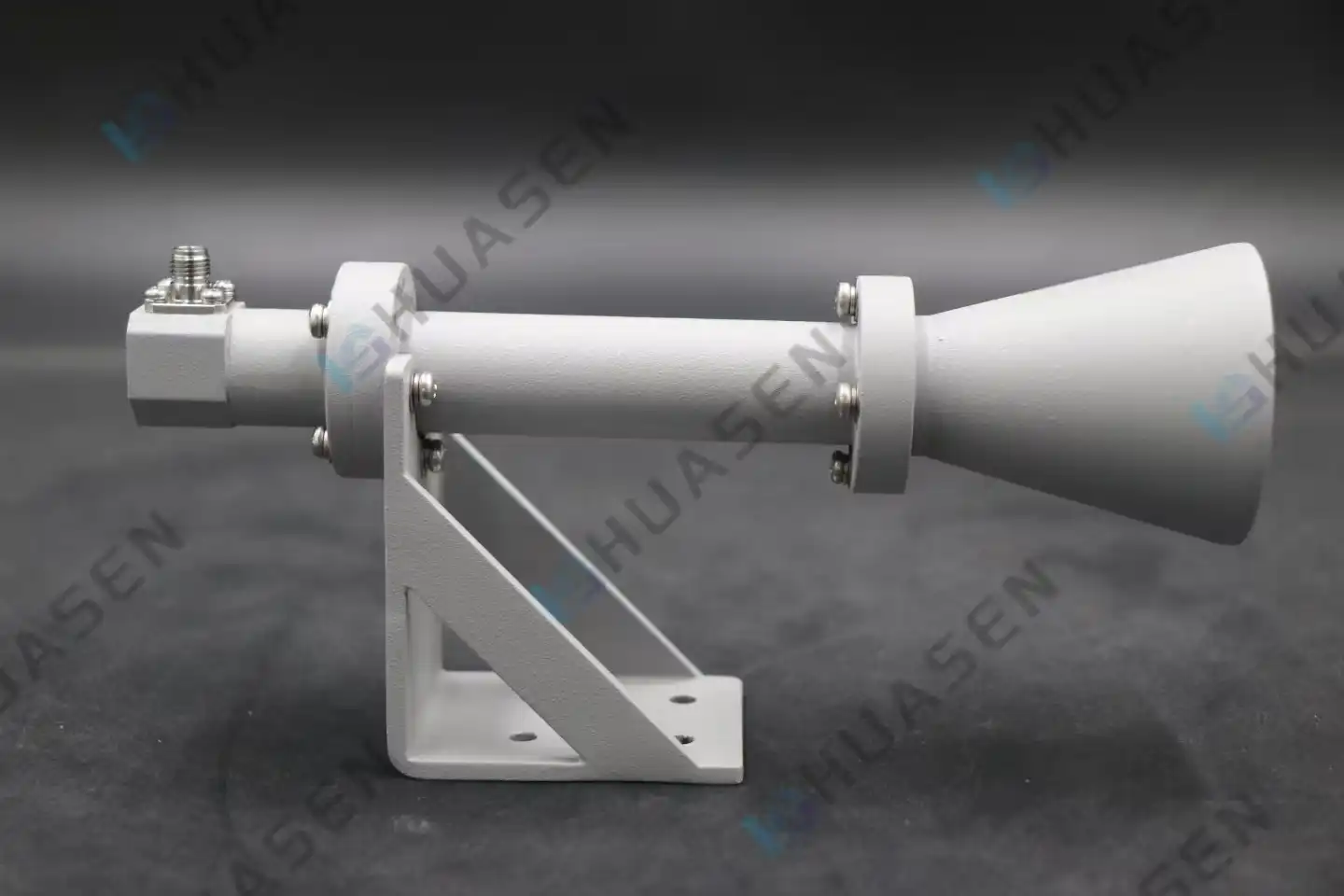
Design Principles and Manufacturing Considerations of Circularly Polarized Horn Antennas
When designing weather-proof circularly polarized horn antennas, you have to pay close attention to a number of design factors that are all connected. When it comes to weather uses, operational success is based on frequency band selection, bandwidth coverage, polarization purity, and mechanical strength.
Feed Mechanisms and Polarization Generation
To get circular polarization in modern designs, there are three main methods used. In the first way, linear-to-circular polarization converters are used. These have dielectric vanes or metallic septa placed inside the waveguide neck. The second method uses dual linear polarization orthogonal stimulation to send quadrature stepped signals to two ports that are not parallel to each other. The third method combines horn structures with spiral lines that naturally create circular polarization because of the way the shapes are put together.
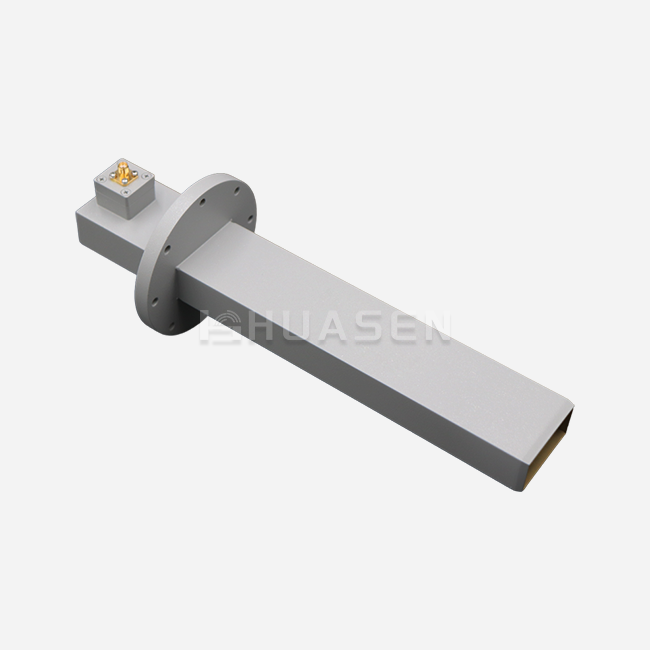
Huasen Microwave's circularly polarized horn antennas work with both linear-to-circular converters and dual orthogonal stimulation methods, so they can be used with a variety of system designs. The cone-shaped horn design and wideband dual linear polarization synthesis make it possible to work with frequencies ranging from 0.5 GHz to 110 GHz. This wide spectral coverage works with different types of weather radar bands, such as S-band systems for long-range tracking and X-band setups for more detailed mapping of precipitation.
Critical Performance Metrics
The axial ratio is the best way to measure the strength of circular polarization for a circularly polarized horn antenna. Axial ratios of high-end weather radar antennas stay below 1.5 dB throughout the working span, and metrology-grade units get as low as 0.5 dB. The designs made by Huasen Microwave always have axial ratios at or below 0.5 dB. This guarantees very pure polarization, which directly leads to better target separation and lower measurement mistakes.
Bandwidth needs change based on the type of application. Narrowband setups that serve specific weather channels may be able to work within a 5% fractional bandwidth, which is the best way to get the best polarization performance in a limited spectrum. To support multiple radar modes or frequency-agile operation, broadband systems need bandwidths that go up to or above 67%. However, keeping the axial ratio low over such wide ranges is very hard to do in engineering. Because the strength can be changed from 10 to 25 dB, system designers can perfectly match the antenna's features to their coverage needs and power budgets.
Manufacturing Excellence and Environmental Durability
Precision manufacturing methods have a direct effect on how well and how long an antenna works. CNC cutting makes sure that measurements are accurate to within a few microns, which is very important for keeping phase relationships in polarization converters. Passivation, silver or gold plating, and other surface processes can help reduce skin-effect losses. This is especially important at millimeter-wave frequencies, where surface roughness can cause measurable insertion loss.
In coastal locations, weather radar stations have to be able to handle harsh conditions like temperature changes from -40°C to +70°C, driving rain, ice buildup, UV exposure, and corrosive salt air. Environmental seals and sealed construction protect the internal parts, and materials that don't rust ensure that the machine will work for decades without any upkeep. Standardized waveguide flanges (WR-series) or precision coaxial standards for connector interfaces make sure that connections are safe and reliable and that the electrical performance stays the same during installation and service life.
Comparative Analysis: Circularly Polarized Horn Antenna vs. Alternative Antenna Types
To choose the best antenna technology, you need to know how different designs work in working conditions that are important for weather radar operations.
Performance Against Linear Horn Antennas
Linear horn antennas are easier to build and cost less, but they lose polarization when the target's direction changes. When hailstones or raindrops move back and forth in the wind, they cause the polarization angles of linear systems to change all the time. This makes signals fade, and measurements become inaccurate. Circularly polarized horn antennas get rid of this dependence on particle direction, so returns stay the same no matter how the particles are arranged. This stability is very important for figuring out how much rain fell, because the accuracy of measurements has a direct effect on predicting floods and managing water resources.
Comparison with Patch and Helical Alternatives
Microstrip patch antennas have small sizes that make them good for setups with limited room, but they can't be used with weather radars because they have a narrow bandwidth and can't handle a lot of power. The circular polarization of helical antennas is very good over middling bandwidths. However, they are bigger and have less gain than horn designs, so they need bigger groups to get the same performance.
Spiral antennas can work across many octaves, which makes them useful for study systems that need to work with a lot of different frequency bands. However, because they are less directed than horn antennas, they need either bigger openings or people to be okay with less range performance. When making purchases, people have to think about these trade-offs along with working needs, available hanging space, and budgets.
Integration with Modern Communication Systems
More and more weather data is being fed into networks that support 5G environmental sensing and satellite-based nowcasting, using horn antenna circular polarization. Circularly polarized horn antennas can be used as both main radar transducers and feed horns for reflector systems, which makes system designs more flexible. Because they don't get affected by Faraday spin during trans-ionospheric transmission, they work great for satellite uplink terminals sending weather data to orbital platforms, making sure that connections stay strong no matter what the ionosphere is like.
Applications and Case Studies of Circularly Polarized Horn Antennas in Weather Radar
The usefulness of these devices in a variety of weather situations is shown by their use in real life.
Dual-Polarization Weather Radar Networks
All over the world, national weather services have updated old systems to dual-polarization designs that can send and receive both horizontal and vertical polarizations at the same time or quickly one after the other. Circularly polarized horn antennas allow a different method where right-hand and left-hand circular polarizations give extra information about the details of the precipitation. It is because of atmospheric forces that raindrops smooth into oblate spheroids as they fall. This unevenness leads to different backscatter between the two circular polarization senses. This lets computers figure out drop size distribution, rainfall rate, and precipitation type more accurately than with single-polarization readings.
Severe Weather Detection and Characterization
One of the most important jobs of weather radar is to find tornadoes. Tornadic winds carry debris that has unique polarimetric fingerprints because the materials are arranged and made in random ways. By measuring the correlation value between channels of different polarizations, circularly polarized systems are very good at finding these debris fingerprints. Several regional warning centers have reported that changing to systems with circular polarization capability has cut the time it takes to identify tornadoes by more than 15 minutes. This has directly saved lives and protected property.
Emerging AI-Driven Optimization
More and more, computational electromagnetics and machine learning techniques are being used in modern antenna development, including horn antenna circular polarization, to improve designs before they are made into real prototypes. Parametric models simulate tens of thousands of different geometric configurations to find the ones that increase axial ratio bandwidth, reduce sidelobe levels, and improve gain characteristics all at the same time. With these AI-assisted design processes, development times are cut from months to weeks, and solution places are explored that humans wouldn't normally think of. The antennas that come out of this have performance levels that were previously impossible to reach with traditional design methods.
Conclusion
Circularly polarized horn antennas are important parts of current weather radar systems because they allow measurements that weren't possible with older linear polarization technologies. Their ability to keep signals strong even when the atmosphere changes, tell the difference between different types of precipitation, and work well regardless of direction directly improves the accuracy of finding and predicting bad weather. This piece talks about design principles, performance trade-offs, and procurement issues. By reading it, system integrators and procurement workers can learn how to make decisions that improve radar performance while keeping costs and deadlines in check.
FAQ
1. When compared to linear forms, what benefits do circularly polarized horn antennas offer weather radar?
When particles in the air fall or spin, they can affect linear antennas, but circular polarization stops this orientation-dependent signal fading. This stability makes it easier to measure the amount of rain that falls and find the right signs of storm debris. Systems that send weather data to satellites through the atmosphere will also benefit from not being affected by Faraday spin.
2. What effect does axial ratio have on the quality of weather radar measurements?
The axial ratio tells you how close the antenna is to having ideal circular polarization. Values below 1.5 dB make sure that the signal keeps its rotational properties as it travels through the atmosphere. This lets you make accurate measures of differential reflection between channels with different polarizations. Elliptical polarization happens when the axial ratio is less than or equal to 3 dB. This makes measurements less accurate and makes it harder to tell the type of precipitation.
3. Can these receivers work with more than one type of weather radar?
Broadband systems that use quad-ridged lines or corrugated structures can operate over multiple octaves, but it can be hard to keep the axial ratio low across very wide bandwidths. Narrowband setups that are best for certain weather radar assignments, like S-band, C-band, or X-band, usually provide better polarization purity within their assigned spectrum. Huasen Microwave's customizable bandwidth choices can be used for either method, based on the needs of the system.
4. What kinds of weather resistance are most important for installing weather sensors outside?
Temperature cycle resistance from -40°C to +70°C makes it possible to use it all year round in all climates. Sealed construction with materials that don't rust guards against water getting in, salt spray in coastal areas, and UV damage. Vibration and shock resistance that meets MIL-STD-810 standards makes sure that the mechanical integrity stays the same during shipping, installation, and high winds.
Partner with a Proven Circularly Polarized Horn Antenna Manufacturer
When working on weather radar projects, antenna options need to be able to do their best in the worst circumstances. Huasen Microwave adds more than 30 years of experience in microwave engineering to every unique antenna design. This makes sure that your weather systems have the best possible detection sensitivity and measurement accuracy. Our Circularly Polarized Horn Antennas have the best axial ratios in the business, at 0.5 dB or better, across frequency ranges from 0.5 GHz to 110 GHz. You can change the bandwidth, gain, and socket configurations to fit your needs. Our expert team offers full design support, quick prototypes, and on-time production delivery, whether you're upgrading current weather radar infrastructure or making the next generation of dual-polarization systems. Email us at sales@huasenmicrowave.com to talk to one of our engineering experts about your project details and get full datasheets and performance data for antenna types that might work for your weather radar application.
References
1. Bringi, V.N., and Chandrasekar, V. (2001). Polarimetric Doppler Weather Radar: Principles and Applications. Cambridge University Press.
2. IEEE Standard 149-2021. IEEE Standard Test Procedures for Antennas. Institute of Electrical and Electronics Engineers.
3. Skolnik, M.I. (2008). Radar Handbook, Third Edition. McGraw-Hill Education.
4. Zrnić, D.S., and Ryzhkov, A.V. (1999). "Polarimetry for Weather Surveillance Radars." Bulletin of the American Meteorological Society, 80(3), 389-406.
5. Kumagai, H., et al. (1996). "A New Approach for Measuring Precipitation with Circularly Polarized Radar." Journal of Atmospheric and Oceanic Technology, 13(4), 679-695.
6. Seliga, T.A., and Bringi, V.N. (1976). "Potential Use of Radar Differential Reflectivity Measurements at Orthogonal Polarizations for Measuring Precipitation." Journal of Applied Meteorology, 15(1), 69-76.
Send Inquiry