Loop Antenna vs Dipole Antenna: Performance Comparison






2026-07-01 23:33:19
When looking at antenna options for business communication systems, picking between a Loop Antenna and a dipole antenna has a big effect on signal strength, noise control, and how well the system works. Loop Antennas work best in places with a lot of electromagnetic pollution because they react mostly to magnetic fields instead of electric fields, which is a big benefit in places like cities or factories. Dipole antennas can cover all directions and have a wider bandwidth, so they can be used for a variety of tasks. Knowing these basic differences helps procurement managers and system designers choose parts that improve gearbox efficiency, lower insertion loss, and guarantee reliable performance in a range of deployment situations.
Introduction
Choosing the right parts for modern transmission systems is very important. Antenna performance has a direct effect on system stability and signal integrity, no matter if you are building 5G base stations, satellite ground terminals, radar systems, or RF testing labs. Both Loop Antennas and dipole antennas are different ways that electromagnetic waves can travel, and each has its own benefits for different uses.
When making buying choices in the defence and telecommunications sectors, it's important to look closely at technical specs, how well the product can work in different environments, and the overall cost of ownership. Choosing the right antenna cuts down on interference, lowers return loss, and makes sure that you meet government standards like MIL-STD-461 and IEEE 145-2013. This comparison gives B2B clients useful information for making decisions based on performance measures, customisation options, and long-term supply chain security.
Understanding Loop Antennas and Dipole Antennas
Operational Principles of Loop Antennas
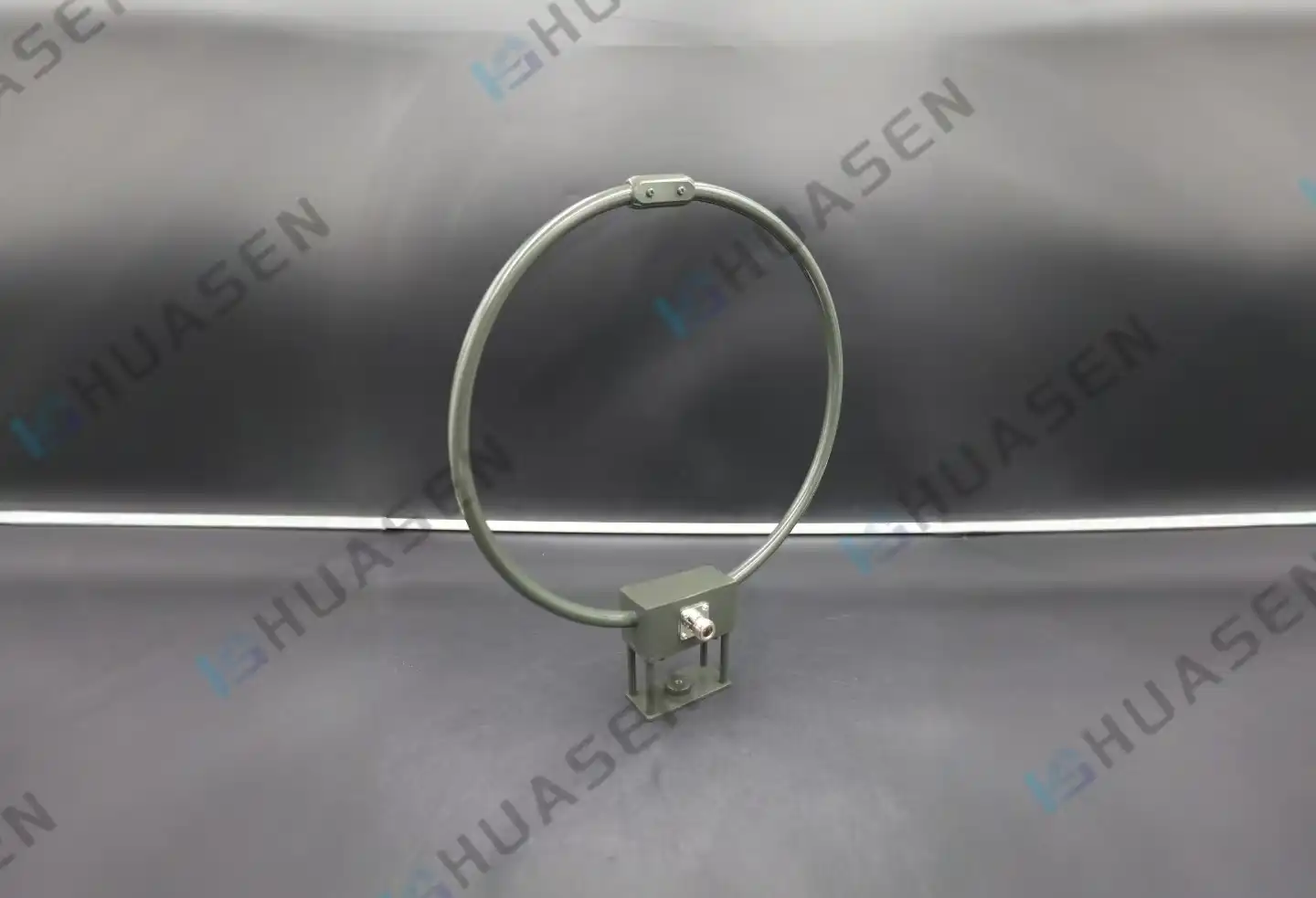
The relationship between loop circumference and working frequency determines the performance traits of Loop Antennas, which operate through magnetic field coupling. Electrically small loops, with a diameter of less than 0.1λ, have high Quality Factor (High-Q) properties that make their bandwidth very narrow but their ability to reject electrostatic noise very well. Because of this, they are very useful in EMC testing labs and urban receiving situations where influence from people is common.
The choice of circuit material is very important for keeping the efficiency. Skin-effect losses are kept to a minimum with polished copper or silver-plated tubes. This is important because radiation resistance in small loops is very low, often measured in milliohms. Active loop designs use preamplifiers to make up for the losses that are built in. The Active Loop Antenna (AHA) design has built-in amplification, a flat response, and a high sensitivity that goes down to 1 kHz. It also works from a 13.8VDC recharging battery and has signs that let you know when the battery is fully charged. For lab and field connection, these units usually come with BNC(F) ports.
Dipole Antenna Fundamentals
Electric field resonance is how dipole antennas work. They directly turn electromagnetic waves into electrical messages. It's easy to make them because they only have two conductive parts that are oriented in opposite directions. This makes them faster and cheaper. When the total length of a dipole approaches half of its operating frequency, it is said to be in resonance. This creates bidirectional radiation patterns in a plane perpendicular to the antenna axis.
Standard dipole setups have a wider immediate bandwidth than small loop designs. They can usually work across 10-15% of the centre frequency without having to retune. This feature makes it easier to integrate into systems with more than one frequency and makes operations simpler. It is best to use dipole antennas in open areas with few ground plane effects and close conductive buildings so that they work consistently. This makes them the best choice for broadcasting and base station installations.
Material and Construction Considerations
When making professional-grade Loop Antennas, you have to pay close attention to the ohmic resistance and joint stability. Due to high-flowing currents, even 0.1 Ohm of link loss can cut efficiency by half in electrically small loops. Micro-ohmmeter checks of all welded or crimped joints, high-voltage breakdown tests of tuning capacitors, and Vector Network Analyser (VNA) runs to make sure VSWR stays below 1.5:1 at design frequencies are all common steps in the manufacturing process.
The building of a dipole antenna focuses on how straight the elements are, how good the baluns are, and how waterproof the connectors are. Industrial dipoles are made of materials that don't rust, like stainless steel or aluminium alloys with protective coatings. They are used for marine communications, outdoor broadcasting, and base station applications that are exposed to UV radiation, extreme temperatures, and moisture.
Performance Comparison: Loop Antenna vs Dipole Antenna
Radiation Patterns and Directivity
Figure-eight radiation patterns with sharp nulls perpendicular to the loop plane are produced by Small Loop Antennas. This two-way feature lets precise interference avoidance happen by turning mechanically. Applications that use direction-finding take advantage of this feature, which lets users block out certain noise sources by changing the orientation of the antenna. Small loops usually have low gain (negative dBi values), but this is okay when noise reduction skills make the signal-to-noise ratio better overall.
When placed vertically, dipole antennas make panoramic patterns in the horizontal plane. This gives broadcast and mobile communications 360-degree coverage. Gain is usually about 2.15 dBi in empty space, but it goes up to about 5–7 dBi when placed over ground planes or reflector structures. This wider range works well for uses that need to communicate in more than one way at the same time without using mechanical steering.
Frequency Range and Tuning Flexibility
Passive Loop Antenna (KHA) designs can send and receive signals in both directions up to 30 MHz with an insertion loss factor of 80dB. They offer great isolation and don't need any extra power. These passive setups have BNC-K or N-K ports and work well for sending signals where being able to change frequencies in the high-frequency range is important. Because the frequency is so narrow, you have to retune when you change frequencies. However, this feature also works as a preselector filter to lower intermodulation distortion.
Dipoles can handle a bigger immediate bandwidth, which lets them work on multiple channels without any changes. Broadband dipole designs that use resistive loading or special shapes can increase the useful bandwidth to octave ranges, but they usually do so at a lower efficiency. Because bandwidth and gain have pros and cons, system makers can choose the best one for each deployment situation, such as narrowband operation for high efficiency or wideband operation for freedom.
Noise Immunity Characteristics
Electric field disturbance with a vertical polarisation is the main form of local man-made noise. As magnetic field monitors, Loop Antennas exhibit amazing insensitivity to near-field E-field components. People who live in electrically noisy places, like factories, cities, and places close to power lines, can get better signal-to-noise rates with this feature. When checking for compliance with FCC, CISPR, and EN standards, testing labs use standardised Loop Antennas to measure emitted magnetic field emissions from 9 kHz to 30 MHz.
Through electric field interaction, dipole antennas pick up both wanted signals and local interference. This makes them more vulnerable to noise sources close by. The right placement height and distance from conductive buildings can lessen this effect, but they can't get rid of it completely. This is less of a problem for applications in controlled RF settings or in rural areas.
Physical Size and Installation Requirements
Electrically small Loop Antennas (magnetic loop antenna) are incredibly small compared to their wavelength of operation. A resonant dipole needs about 20 meters of linear room, while a magnetic loop working at 7 MHz might only need one metre of width. This edge in size is very important for installs on ships, tactical communications that can be carried around, and lab sets that don't have a lot of room. If you want to put a loop close to a metal structure, you need at least two loop diameters of space around it to keep it from detuning and losing its efficiency.
For best performance, dipole setups need enough room for the elements to be set up and are usually elevated above the ground or nearby buildings. Tower-mounted dipole arrays have better coverage than compact loop designs, but they are harder to place and need more support structures.
Application Suitability and Typical Use Cases
EMC Testing and Laboratory Applications
Calibrated Loop Antennas are the usual way for electromagnetic compatibility labs to measure radiated magnetic field emissions. The known reaction features and antenna factor make it possible to precisely measure the strength of the H-field without any E-field disturbance. Because these measurements make sure that the device meets the standards for product certification, Loop Antennas are a must-have for companies that want to sell their products in countries with strict legal rules.
You can use active Loop Antennas with Vector Network Analysers and spectrum analysers to study radio waves over a wide frequency range. The ability to work at very low frequencies (down to 1 kHz) is especially useful for checking emissions and analysing power line data. Laboratory-grade Loop Antennas come with testing certificates that can be traced back to national standards. This makes sure that the measurements are accurate enough for official compliance paperwork.
Tactical and Rapid Deployment Communications
In places where signal propagation is difficult, the features of Loop Antennas help military and emergency response activities. Near Vertical Incidence Skywave (NVIS) transmission methods use Loop Antennas that are mounted close to the ground and are oriented horizontally. This allows for effective coverage across a large area without the ground loss problems that plague monopole antennas. The small size makes it easy to set up quickly in places with lots of plants or narrow canyons in cities where standard antenna setups would not work.
Designs with passive loops that don't need external power sources work well for secret activities and situations where batteries are limited. KHA-type passive loops have a high isolation factor of 80dB, which makes them very good at transferring signals while keeping the mechanical design simple.
Broadcast and Infrastructure Applications
Dipole antenna arrays are most often used in FM radio, TV transmission, and base station sites, where they can cover all directions and have a history of being reliable. Controlled radiation patterns are made by phased dipole arrays, which allow cellular networks to have sectored coverage and directed transmission for regional service areas. The mature design principles and large amount of field experience lower the risk of adoption for major projects that need to be used for decades.
Dipole antennas are used by a lot of amateur radio users for both home stations and actions in the field. Dipoles are easy to use for people of all skill levels and budgets because they are simple to build and use materials that are easy to find. They also work on multiple bands using antenna tuners or trap circuits.
Procurement Considerations for B2B Clients
Performance Benchmarks and Specifications
There should be clear acceptance standards in the procurement specs for insertion loss, return loss (VSWR), gain, and frequency coverage. For receiving uses, Loop Antenna specs must address Q-factor, tuning range, and sensitivity. For sending setups, they must address maximum power handling. Specifications for dipoles usually focus on bandwidth, gain over ground, and mechanical wind stress rates.
For outdoor operations, environmental standards are a must. Operating temperature ranges (-40°C to +70°C) are common for harsh settings, resistance to humidity, protection against corrosion passing ASTM B117 salt spray standards, and resistance to shaking and shock according to MIL-STD-810 testing methods are some of the things that are needed. Connector standards must match the needs of the system. For example, SMA connectors work best with lab equipment, Type-N connectors work best with higher power uses, and weatherproof designs work best for long-term outdoor setups.
Supply Chain and Customisation Capabilities
Reliable suppliers keep a wide range of products in stock and offer quick expert help. Well-known companies offer customisation services that change frequency bands, polarisation settings, connector types, and mechanical mounting connections to fit the needs of each system. Custom Loop Antenna designs are made to fit specific size limitations, impedance matching needs, or study uses that need unique tuning mechanisms.
Production lead times are very different for catalogue items (usually 2 to 4 weeks) and fully custom designs (8 to 16 weeks, including development and validation testing). B2B procurement strategies work best when suppliers are involved early on in the system design process. This lets antenna standards and host equipment integration needs be worked on at the same time. Long-term supply deals keep prices stable and make sure that infrastructure projects that last more than one year get the power they need.
Quality Assurance and Reliability Validation
Suppliers of antennas with a good reputation use strict quality control methods. VSWR testing with a VNA is done on every output unit to make sure that the impedance matches across certain frequency bands. High-potential (Hi-Pot) testing is done on tuning capacitors in transmitting Loop Antennas to make sure that voltage doesn't drop when operating at full power. Mechanical stability testing makes sure that the shape of the circular loop stays the same when it is exposed to changes in temperature and pressure.
When reliability is checked for mission-critical uses, sample units are put through accelerated life testing that includes extreme temperature changes, high humidity, and mechanical stress that is above and beyond standard operating conditions. Mean Time Between Failure (MTBF) estimates based on stress analysis of components help plan repair schedules and spare parts inventories. Supplier quality standards like ISO 9001, AS9100 for aircraft uses, or meeting the needs of defence contractors give buyers even more faith in the maturity of the manufacturing process.
Making the Decision: Loop Antenna or Dipole Antenna?
Matching Antenna Type to Application Requirements
To choose between loop and dipole configurations (magnetic loop antenna), you need to look at what your practical goals are. When noise protection is more important than system performance, especially in cities with lots of RF interference, choose Loop Antennas. Because it's small, it can be used in places where bigger antennas wouldn't fit. Loop shapes are usually better for applications that need to find their way, be portable, or test for electromagnetic compatibility (EMC).
Dipole antennas are good for situations that need coverage in all directions, a wider immediate bandwidth, and easier placement that doesn't need to be retuned often. Dipole traits are useful for base station applications, broadcast services, and systems that work in controlled RF settings with enough room for antenna placement. The lower starting cost and simpler design make it a good choice for jobs on a budget where standard options can meet performance needs.
Environmental and Integration Factors
The installation setting has a big impact on the choice of antenna. Practical success depends on how close you are to conductive buildings, how much mounting room you have, and how loud the noise is in the area. Loop Antennas can handle bad ground conditions better than monopoles and are less sensitive to close metal items than dipole antennas are.
Antenna design must match system integration needs such as connection types, feedline impedance (usually 50Ω for professional systems), and mechanical contact details. Active Loop Antennas that need power from outside sources add more wiring and power budget issues to think about. Passive designs make installation easier, but the receiver may need low-noise preamplifiers to make up for the weaker signals.
Future-proofing and being able to grow
Communication systems change as technology gets better and as the needs of operations change. When investing in antennas, it's helpful to think about how frequency bands will be used in the future, how modulation schemes might change, and how the system might grow. Broadband antennas or designs that let you change the setting over a wide range are most useful in the long run.
As the need for coverage grows, modular antenna systems that let you change the polarisation or add more antennas to an array offer scalable solutions. In areas that change quickly, like 5G/6G infrastructure development, procurement contracts that include technology refresh options or upgrade paths protect against becoming obsolete.
Conclusion
Choosing between Loop Antenna and dipole antennas depends on the needs of the operation, the surroundings, and the need to integrate the system. Loop Antennas have better noise immunity and smaller sizes that are needed for EMC tests, setups with limited room, and places with a lot of electrical noise. Dipole antennas are a cost-effective way to cover all directions with a wider bandwidth for television and infrastructure uses. When making professional purchasing choices, it's important to look closely at performance requirements, source dependability, customisation options, and long-term support promises. When correctly matched to the needs of the application, both types of antennas play important roles in defence, study, and telecommunications.
FAQ
1. What advantages do magnetic loop antennas offer over dipole designs?
Magnetic Loop Antennas react to H-fields instead of E-fields, which makes them very good at blocking local electrical noise that is common in factories and cities. Even though the exact gain is smaller, this feature makes the signal-to-noise ratio better. The small size lets it be used in places with limited room, and the sharp directional nulls make interference avoidance easier by rotating mechanically.
2. Can loop antennas handle high-power transmission applications?
Power handling capacity is based on the voltage values of the tuning capacitors and the current capacities of the conductors. When built with the right high-voltage capacitors and low-resistance wires, professional transmitting loops can handle power levels above 1 kW. Most entry-level designs can only handle 100W or less. Passive Loop Antenna (KHA) designs with separation factors of 80dB allow bidirectional operation up to 30 MHz without the need for external power.
3. Where can procurement managers source professional-grade loop antennas?
Some of the well-known sources are companies that make RF parts for defence and telecommunications uses. Custom engineering services can work with certain frequency bands, kinds of connectors, and mechanical connections. When evaluating a supplier, you should check to see if they have quality certifications, can track their calibrations, and offer expert help. Direct connections with manufacturers, authorised distributors, and specialised RF component catalogues that serve B2B markets are all types of distribution methods.
Partner with Huasen Microwave for Superior Antenna Solutions
Huasen Microwave has been making RF components for 30 years, which helps system designers and procurement workers find trusted Loop Antenna suppliers. Our product line includes Active Loop Antenna (AHA) designs with built-in preamplifiers and Passive Loop Antenna (KHA) designs that can work in both directions up to 30 MHz. Customisation options let you choose the frequency range, connector standards, and environmental conditions that meet MIL-STD and foreign safety standards.
Engineering help includes design advice, sample evaluation programs, and recording of calibration data that makes system integration easier. As part of our dedication to quality control, we try the VNA thoroughly and make sure it works properly. We also make sure it is reliable. Email our expert sales team at sales@huasenmicrowave.com to talk about your project needs and find out how our antenna options improve performance in tough testing, radar, and telecommunications situations.
References
1. Stutzman, W. L., & Thiele, G. A. (2012). Antenna Theory and Design (3rd ed.). John Wiley & Sons.
2. Balanis, C. A. (2016). Antenna Theory: Analysis and Design (4th ed.). John Wiley & Sons.
3. IEEE Standard 145-2013: IEEE Standard for Definitions of Terms for Antennas. Institute of Electrical and Electronics Engineers.
4. MIL-STD-461G: Requirements for the Control of Electromagnetic Interference Characteristics of Subsystems and Equipment. U.S. Department of Defense.
5. Belrose, J. S. (2000). Short Antennas for Mobile Applications. Proceedings of the IEEE, 88(10), 1672-1686.
6. Carr, J. J. (2001). Practical Antenna Handbook (4th ed.). McGraw-Hill Professional.
Send Inquiry