How to Compare Circularly Polarized Horn Antenna Manufacturers Globally






2026-05-13 21:55:10
When evaluating global suppliers for circularly polarized horn antennas, buyers should prioritize manufacturers demonstrating consistent axial ratio performance below 1.5 dB, comprehensive frequency coverage across mission-critical bands, and verified compliance with international standards like MIL-STD and ISO certifications for the circularly polarized horn antenna. The comparison process centers on technical specifications, customization flexibility, supply chain reliability, and post-sale engineering support—elements that directly impact system integration success and long-term operational costs.
Understanding Circularly Polarized Horn Antennas and Their Market Landscape
Core Operating Principles and Performance Metrics
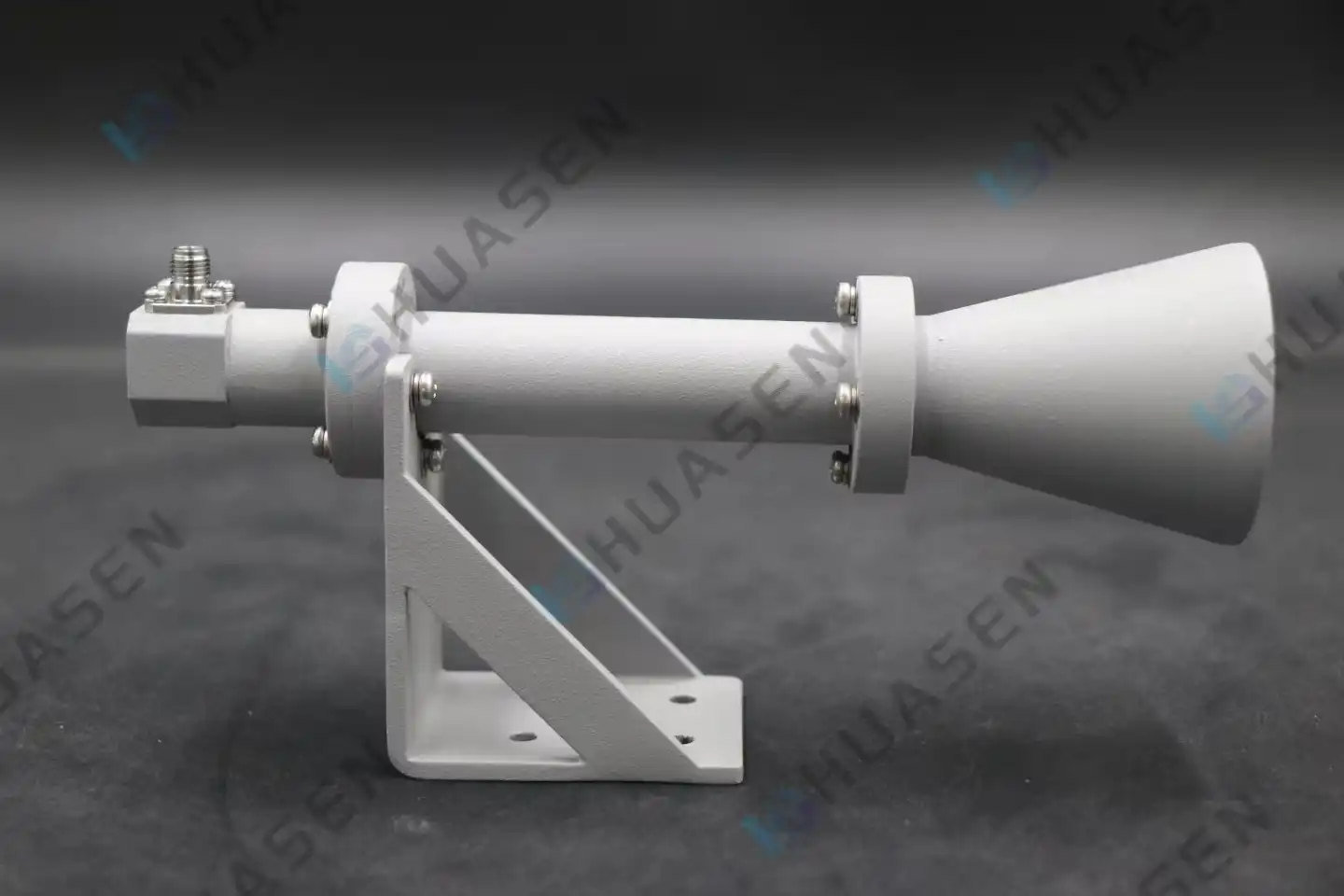
When an electric field vector repeatedly spins in either right-hand circular polarization or left-hand circular polarization, circularly polarized horn antennas are a special type of RF component designed to send out electromagnetic waves. This rotation happens perpendicular to the direction of wave travel, so the information stays the same no matter which way the listener is facing. Internal polarization converters, like stepped diaphragms or dual orthogonal linear feeds, change normal waveguide modes into circular polarization states. This is how the technology works.
Performance analysis is based on a number of measurable factors. The axial ratio shows how pure the polarization is; numbers below 1.0 dB mean that the circularity is almost perfect. Depending on the size of the opening and the frequency of operation, gain values are usually between 10 and 25 dBi. A voltage standing wave ratio less than 1.5:1 makes sure that power moves smoothly along the transmission line. Cross-polarization discrimination above 20 dB stops signal leaks between orthogonal polarization channels. This is very important in situations where satellite earth stations recover frequencies.
Industry Demand Patterns Across Critical Sectors
These parts are very important for satellite communication networks because without them, signal dropouts would be very bad when spaceships rotated, which happens during monitoring, tracking, and command links. The aircraft industry needs units that can handle sudden changes in temperature, vibrations greater than 15 G, and pressure differences caused by altitude. Defense uses need frequency-aware systems that can work with a number of different radar bands while keeping radar cross-sections low.
The telecoms industry now uses these antennas in 5G and the soon-to-be-released 6G networks, mainly for backhaul lines that go through areas with bad signal propagation. Broadcast TV uses circular polarization to get through trees and buildings in cities better than linear polarization. This technology is used by maritime communication systems to stay connected even when ships are moving around in rough seas.
Global Manufacturing Distribution and Regional Specializations
A lot of manufacturing is concentrated in places where RF tech environments are already well-established. North American manufacturers focus on making aerospace-grade parts that meet strict NASA and DoD requirements and often use their own unique curved waveguide designs. European producers focus on making sure their products are precisely machined and tested in a way that meets ETSI standards for telecoms equipment. In recent years, Asian providers have improved their ability to make a lot of things at low prices, especially business satellite ground equipment.
Market classification shows different levels of products. Metrology-grade antennas are used by testing labs and test equipment makers who need measurement standards that can be tracked. Ruggedized versions are made for military and space platforms that need to be resistant to shock. For television and telecom systems, commercial-grade units strike a mix between efficiency and cost. Different evaluation methods are needed for each market group when comparing manufacturers.
Essential Criteria to Evaluate When Comparing Manufacturers
Technical Performance Specifications and Material Integrity
To judge how well an antenna works, you need to look at recorded test data across the operating span. Consistency in the axial ratio is more important than accuracy in a single test. Reliable makers provide plotted data that shows performance stability across temperature ranges and frequency sweeps. Gain flatness is a sign of good waveguide design, and changes of less than 1 dB across the band are a sign of better factory control. When the return loss is less than -20 dB, it means that the impedance matching is accurate, which stops standing waves in the feed system.
Choosing the right materials has a direct effect on how long they last and how well they conduct electricity. For mild settings, aluminum construction with a chemical conversion coating is enough to prevent rust. However, for naval use, hard-anodized surfaces or electroless nickel plating are needed. For a circularly polarized horn antenna, internal dielectric parts need to have stable permittivity across all operating temperatures; using low-quality materials will lead to axial ratio degradation as environmental conditions change. Choosing the right connector affects both how long it lasts mechanically and how much insertion loss there is. High-quality SMA and K-type connections are better than cheaper options.
Innovation Capacity and Engineering Support Infrastructure
Investing in research and development is what separates technology partners from basic providers. Manufacturers who keep their electromagnetic modeling tools up to date with CST or HFSS software can make plans work best for certain uses. Rapid iteration on unique geometries is possible with prototyping agility, which cuts the time it takes to build something from months to weeks. Antenna measurement tools with far-field or small ranges make it possible to test things in the real world before committing to production.
Collaboration in engineering goes beyond the initial idea. Customers can deal with system-level issues like feed network timing and radome openness with the help of suppliers who offer integration assistance. Help with thermal analysis is useful for high-power uses where passive intermodulation products need to stay below -150 dBc levels. Electromagnetic compatibility advice makes sure that antennas meet pollution standards without affecting their ability to send signals.
Certification Standards and Quality Management Systems
Compliance paperwork is direct proof of how well something was made. While ISO 9001 certification shows that quality management methods have been formed, AS9100 certification usually shows that more controls need to be put in place for critical components in aerospace uses. The MIL-STD-810 test confirms outdoor performance by changing the temperature and humidity under controlled conditions, checking for salt fog resistance, and making sure the vibration profiles match the working platforms.
Traceability systems that connect raw materials to finished goods make it possible to figure out why something went wrong in the field. Statistical process control data shows that the manufacturing process is consistent across production runs. This is especially important for phased array uses that need to match the amplitude and phase of multiple elements. Third-party registrar audit reports on suppliers show patterns of nonconformance and how well corrective actions worked.
Supply Chain Architecture and Delivery Reliability
A production capacity estimate keeps things from getting backed up during the growing phases. When manufacturers depend on a single supplier for important waveguide parts, they run the risk of shipping plan problems for their customers. Vertically linked processes that handle the steps of machining, plating, and assembly are better at sticking to schedules. Supply chain management that uses buffer stocking methods for long-lead parts like precision connectors shows that the system is stable.
Being clear about lead times is what sets professional providers apart from impulsive ones. In a realistic schedule, getting the raw materials, the position of the production line, the frequency of quality inspections, and the export compliance paperwork are all taken into account. The ability to place a rush order shows that the business is flexible, but the extra cost for fast shipping should be fair for the service it provides. Shipping prices and import tax structures vary from market to market, depending on where the factories are located.
How to Approach the Procurement Process with Circularly Polarized Horn Antenna Manufacturers?
Defining Comprehensive Technical and Commercial Requirements
For procurement to go well, there must be thorough specification papers that include both performance factors and operational limits, such as for a horn antenna's circular polarization. Guard bands and possible future spectrum allocations must be taken into account when figuring out frequency coverage. For radar uses, the power handling needs should list both the average and peak amounts, as well as the pulse characteristics. For environmental requirements to work, the temperature ranges, humidity levels, vibration patterns, and shock levels must all match the conditions of release.
Commercial terms include more than just prices. They also include release dates, payment goals, and issues of intellectual property for unique designs, such as for a horn antenna's circular polarization. Tooling amortization and unit cost patterns are affected by volume forecasts. Shipping methods and security needs are affected by where the package is being sent. Export control classes decide how much it costs to get a license for foreign business, which is especially important for defense-related uses.
Critical Qualification Questions for Supplier Evaluation
Ask possible makers specific technical questions that show how deep your capabilities go. Ask for electromagnetic computer models that show how to build and improve something. Find out about the measuring tools and how they are calibrated, as well as the radio range settings and the accuracy of the instruments. To figure out what a reasonable delivery time frame is, you should ask about production ability and the current backlog state.
When asking about a quality system, you should look into the inspection methods, acceptance test routines, and ways that non-conformances are handled. Look into methods for getting materials and requirements for qualifying suppliers for important parts. Talk about the frameworks for support after delivery, such as the availability of a technical hotline and tools for field application engineers. These talks show the levels of organizational maturity that affect the success of the relationship.
Sample Evaluation and Documentation Requirements
Independent measures of a physical sample back up what the maker says. Coordinate the delivery of sample antennas with access to the right test facilities, whether they are internal or provided by a third party. Verification tests should be done in the same way that they would be used in real life, including changing the temperature if outdoor performance is important. Compare the recorded results to the specs in the datasheet, making note of any differences that need to be explained.
Technical paperwork packages should have tolerated measurement drawings, material lists with surface finish instructions, and step-by-step instructions for putting together field-replaceable parts. The design is clear because the electromagnetic simulation results for the circularly polarized horn antenna show how the current is distributed and what the radiation pattern will be. Test records that include information on how the instruments were calibrated and a study of measurement uncertainty show that the measurements are valid. During different stages of a product's development, these papers are used as guides.
Negotiation Strategies and Risk Mitigation Approaches
The terms of the contract should include performance promises and clear criteria for acceptance that are linked to payment goals. Intellectual property terms need to make it clear who owns custom design features, especially when the design is co-developed. Limits on liability and guarantee exclusions need to be carefully looked over to avoid unexpected risks. Force majeure clauses cover problems in the supply chain that are out of the control of the maker.
Tracking progress based on milestones and early warning systems for possible schedule slips is helpful for managing delivery schedules. Penalty terms for late deliveries need to strike a balance between fair responsibility and long-term relationships with suppliers. Quality trust provisions that hold off on final payment until field validation is complete give you the power to fix bugs that have been hiding. Long-term deals on prices protect against changes in the market, and multi-year pledges to buy ensure that capacity is allocated.

Case Studies: Successful Collaborations with Top Circularly Polarized Horn Antenna Manufacturers
Satellite Ground Station Modernization Project
For a global ground station network reboot that covered 14 countries, a big phone company needed 200 circularly polarized horn antennas with circular polarization. The requirements said the device had to work from -40°C to +60°C, cover 18–22 GHz, and have an axial ratio of less than 1.2 dB across the whole band. It also had to be able to withstand Category 5 storm winds. The chosen maker made special mounting connections that fit old pedestal designs. This kept expensive structural changes from having to be made.
Through collaborative design reviews, radome materials were made to have the least amount of placement loss while still meeting standards for impact resistance, with horn antenna circular polarization also considered. In addition to normal business procedures, thermal cycles and vibration screening were used as part of factory acceptance testing. Schedules for phased deliveries that took into account the availability of installation crews in different parts of the world. The project was finished two weeks early, and all 200 units met specs when they arrived. This shows how important it is to carefully vet suppliers and work together to complete a project.
Defense Radar System Integration
A company that builds radar systems and is working on an aircraft platform needed small, light, dual-polarized horn antennas that could work across the X band and have great cross-polarization detection. Each unit could only weigh 450 grams and still have a 20 dBi gain and be able to handle 20 gm of shaking. The partner factory used advanced aluminum-lithium metals and topology-optimized interior structures to make the 410-gram product.
During environmental suitability testing, problems with moisture getting in during mountain riding were found. This led to a quick rethink of the sealing surfaces. Within three weeks, the manufacturer's quick-thinking engineering team put in place sealed feed-through connections and conformal coating, meeting program deadlines. Low passive intermodulation performance was confirmed by electromagnetic compatibility tests when the send power was less than 20 watts. The partnership showed that technology flexibility and a strong desire to solve problems can get around unexpected integration problems.
Conclusion
To compare circularly polarized horn antenna makers around the world, you need to carefully look at their technical specs, ability to make changes, quality control systems, and the dependability of their supply chains. A good procurement process combines performance needs with budget limits and gives priority to providers that can show they can work with engineers and provide quick customer service. This analysis framework includes operating principles, evaluation standards, differentiation factors, and buying strategies. It gives decision-makers a structured way to choose a seller. By focusing on empirical proof through sample testing, reviewing paperwork, and checking references, buyers can lower the risks that come with global sourcing while also getting access to specialized services that they can't get from local sellers alone.
FAQ
1. What factors most significantly influence axial ratio performance in circularly polarized horn antennas?
The axial ratio is mostly determined by how precisely the polarizer was designed and how accurately it was manufactured. To make sure that orthogonal field components are balanced, stepped septum measurements must stay accurate to the micrometer level. Phase imbalance decline can't happen if the dielectric material stays stable across temperatures. Feed symmetry is affected by the strength of the connector contact; even small changes in size can cause polarization tilt in circularly polarized horn antennas.
2. How can people make sure that a product is real and of good quality before they buy a lot of it?
Ask for sample units to be tested by independent, approved labs that can measure patterns from far away. Check the results against the manufacturer's datasheets and write down any differences you find. Do checks of your suppliers, looking at their production sites, quality systems, and measuring tools. Check certificates against records of the issuing body. Check with customer references from similar applications to make sure they have practical experience.
3. What kind of wait times should buying teams expect when they order custom antennas?
Standard store items usually ship within two to four weeks for well-known companies that keep stock. It takes 6 to 8 weeks to make and test custom frequency bands. Timelines are extended to 12 to 16 weeks for completely new designs that use electromagnetic modeling and prototype changes. Once manufacturing investments are made, shortening the time it takes to make a single unit is better for high-volume production runs. However, the initial setup time adds 4 to 6 weeks to the delivery of the first item.
Partner with a Proven Circularly Polarized Horn Antenna Manufacturer
Huasen Microwave can help you with your mission-critical communication infrastructure projects because they have been great at RF engineering for 30 years. We've been a leader in high-frequency microwave and millimeter-wave parts for the aerospace, military, telecommunications, and research industries around the world since our start in 1993. Our line of circularly polarized horn antennas has great axial ratios of 0.5 dB across a frequency range from 0.5 to 110 GHz. You can also make a lot of changes to the bandwidth, gain, and connection specs.
We are a dedicated seller of precision RF components, so we know what system integrators and equipment makers need and how hard it can be to get it. During the planning, prototyping, and production stages, our engineering team works closely with customers to make sure that the new systems work with the old ones. You can email our expert sales team at sales@huasenmicrowave.com to talk about your specific needs, get full datasheets, or set up sample evaluation units that show how committed we are to quality and performance.
References
1. Balanis, Constantine A. Antenna Theory: Analysis and Design. 4th ed. Hoboken: John Wiley & Sons, 2016.
2. Olver, A. D., et al. Microwave Horns and Feeds. London: Institution of Engineering and Technology, 1994.
3. Milligan, Thomas A. Modern Antenna Design. 2nd ed. Hoboken: John Wiley & Sons, 2005.
4. IEEE Standard 149-2021. IEEE Recommended Practice for Antenna Measurements. New York: Institute of Electrical and Electronics Engineers, 2021.
5. Rudge, Alan W., et al. The Handbook of Antenna Design. Volume 1. London: Peter Peregrinus Ltd., 1986.
6. Clarricoats, P. J. B., and A. D. Olver. Corrugated Horns for Microwave Antennas. London: Peter Peregrinus Ltd., 1984.
Send Inquiry