How Does a Dual Channel Coaxial Rotary Joint Transmit Signals?






2026-06-25 21:08:19
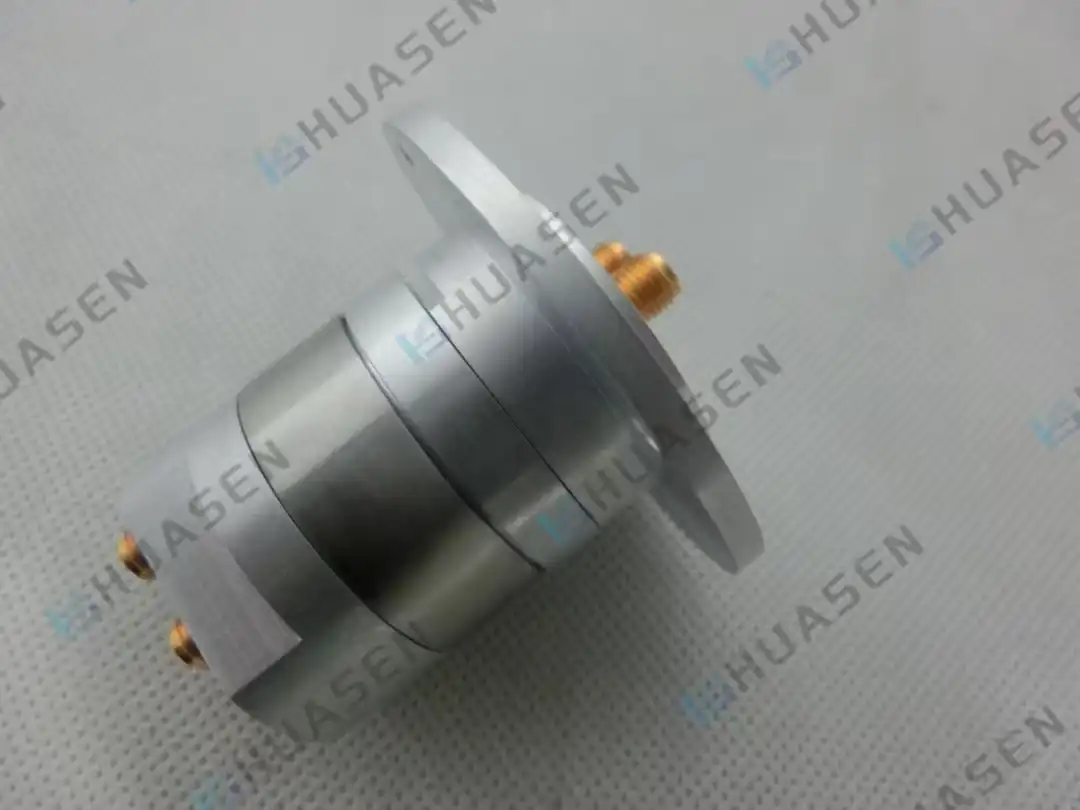
A Dual Channel Coaxial Rotary Joint sends signals using a complex network of circular conductors. This lets two separate RF or microwave channels work at the same time while the joint rotates in a circle that goes around 360 degrees. The device has a precisely machined stator and rotor unit with different inner and outer wire paths, and each one has its own impedance. Good contacts, usually beryllium copper that has been gold-plated, keep the electricity flowing even when they are spinning, so the signal doesn't get messed up too much. The two channels are kept separate by advanced internal filtering structures that achieve isolation levels above 50dB to stop leakage. This two-path design keeps the cables from twisting and lets signals flow freely in situations where both fixed and moving parts need to send and receive high-frequency data.
Understanding Dual Channel Coaxial Rotary Joints
When engineers make spinning antenna systems or radar platforms, they always have to figure out how to send more than one RF signal without getting wires tangled up. Dual Channel Coaxial Rotary Joints solve this issue by combining mechanical and electrical parts in new ways.
Core Structural Design
The basic construction consists of wires arranged in a circle. The conductor closest to the interior normally carries one signal route, while a parallel line runs parallel to it through a neatly divided layer on the outside. Precision dielectrics maintain wire spacing and impedance. The system runs smoothly on low-friction bearings even at high speeds. This combination reduces system complexity and mechanical size by 40% compared to single-channel choices that pair two devices. This matters when developing small maritime or aviation communication systems.
Comparison with Single-Channel Variants
Single-channel devices only deal with one data line and work well when system needs are simple. Dual-channel units, on the other hand, can send and receive signals at the same time or support different frequency bands within the same mechanical frame. This doubled capacity makes installation easier, cuts down on the tools needed for mounting, and lowers the load on drive motors' rotational power. When compared to adding two separate single-channel joints, the weight savings can reach 30%. This is a huge benefit for uses that need to save weight, like radar on drones or satellite ground stations.
Critical Design Considerations
Many tech factors affect performance. Material choice affects electrical and stress resistance. Stainless steel housings avoid corrosion in marine applications, while aluminium alloy housings reduce weight in aviation. Rotational longevity depends on contact quality. A precious metal layer prevents billions of rotations from wearing down material. High frequencies require micron-scale machining tolerances to maintain impedance across operating ranges. IP65 and IP67 protect internal parts from dust and water outdoors.
Signal Transmission Mechanism and Performance Factors
Figuring out how signals stay intact while the component is rotating shows why these parts are so expensive in demanding situations.
Independent Signal Path Architecture
The Coaxial Rotary Joint uses channels as distinct communication lines. Channel 1's centre wire is coaxially paired with its shield to provide a 50-ohm impedance environment. Channel 2 works like Channel 1, but well-designed electromagnetic walls keep it separate. Conductive walls and clever grounding points prevent electromagnetic waves from touching signal wires. Spring-loaded contact fingers maintain the electrical link between moving and non-moving parts during rotation. The contact force, typically measured in grams, must be optimised to minimise mechanical wear and contact resistance.
Bandwidth and VSWR Performance
Operating bandwidth indicates the device's frequency range without overreflecting information. Huasen Microwave's Dual Channel Coaxial Rotary Joint II Type can handle L-band satellite downlinks and Ku-band radar returns from DC to 18 GHz. The voltage standing wave ratio (VSWR) indicates a resistance match. The signal power passes through 98.3% of the time with a VSWR of 1.2:1. Lower VSWR values immediately improve sign clarity and broadcast range. Insertion loss in the device monitors signal weakening. In power-constrained satellite systems, every tenth of a decibel affects the link margin, and 93% of input power reaches the output at 0.3 dB.
Channel Isolation and Crosstalk Prevention
Channel 1 provides a strong signal, and Channel 2 receives a faint signal, causing crosstalk. Channel 2 is improperly isolated, allowing the emitter to overpower the receiver. The interference signal is weakened by a million times before reaching the next channel with 60 dB separation. Full-duplex communication systems can perform this well without self-interference. The isolation standard is crucial for measuring small signals with precision equipment and large reference signals. Huasen's shielding includes physical conductor separation, dielectric walls with regulated permittivity, and resonance-suppression designs that eliminate rotational interface cavity modes.
Dynamic Performance Under Continuous Motion
Rotation speed affects electrical stability. High RPM contact bounce and tiny vibrations can create phase noise. The "wow" test detects spinning-phase change. Premium coaxial rotary joints maintain phase stability within ±3 degrees during 360-degree rotation. This guarantees coherent data processing in phased array radars. Rapid life testing demonstrates that gold-on-gold contact systems can handle 50 million revolutions with contact resistance less than 10 microohms. This approach increases system availability and reduces service calls. Remote areas like offshore wind farm communication cables and Arctic research sites where servicing calls are expensive benefit from these features.
Applications and Use Cases of Dual Channel Coaxial Rotary Joints
Real-life application examples show why system designers choose these parts even though they cost more.
Radar Systems and Defense Applications
Rotating monitoring radar requires high-power pulses and mirrored echoes. In dual-channel design, the broadcaster and receiver have separate paths. This eliminates large transmit-receive switches. Small size provides the antenna system a reduced radar cross-section, which is useful for military use. Air traffic control radar works 24/7; therefore, the 50-million-revolution service life is reasonable and maintains airport operations. Weather radar systems on seashore towers face salt spray and hot temperatures. Environmental sealing ensures reliability in hurricane-force winds and in -40°C winters.
Satellite Ground Stations and Telecommunications
Earth station antennas tracking LEO satellites must maintain smooth spin and maintain Ka-band communications with bit error rates below 10^-9. Compared to competitive products with 0.5 dB loss, the low insertion loss of 0.3 dB saves the link budget and enhances working range by 7%. Staying connected during crucial satellite passes is possible. Dual-channel technology uses one method for uplink data and commands and the other for downlink data. In 5G backhaul connectivity, point-to-point microwave bridges with physically steerable antennas are increasingly used. Coaxial rotary joints enable beam steering without cable management.
Test and Measurement Environments
Antenna test turntables keep the RF links to vector network analyzers open while rotating the object being tested through all azimuthal patterns. Channel isolation greater than 60 dB makes sure that coupling between measurement ports doesn't mess up radiation pattern data. Research labs make sure of this standard by using strict calibration methods. Broadband coverage is helpful for multi-frequency tests because it means you don't have to switch Coaxial Rotary Joints when measuring antennas across different bands. The SMA-K link makes it easier to connect to current lab equipment, which cuts down on setup time and makes measurements more accurate. Universities and standards labs like the calibration data help that companies like Huasen offer, which includes full S-parameter records for all temperature ranges.
Scalability and Customization Benefits
Next-generation OEMs prefer the flexibility of customisation. Channel 1 can be tuned for X-band frequencies and Channel 2 for L-band. Using diverse dielectric materials and wire shapes in the same housing allows this flexibility. Customising power handling allows one channel to handle 250 watts CW for broadcast and the other to handle sensitive listener signals (-100 dBm). Different mechanical connections can be mounted on antenna pedestals or shipboard masts using flange-mount or inline designs. A coaxial rotary joint that costs 40% more but lasts three times longer has a reduced total cost of ownership, especially when helicopter service trips to offshore platforms or spacecraft maintenance expenditures are considered.
Comparing Dual Channel Coaxial Rotary Joints with Alternative Technologies
Technology selection involves tradeoffs between performance, cost, and how well it fits your needs.
Coaxial Rotary Joints vs. Rotary Couplers
Both systems can send signals through rotating surfaces, but they do so in very different ways. With rotary couplers, there is no direct touch at all because they use capacitive or magnetic coupling across a small air gap. This direct method removes wear, which should give the rotating part an infinite life. Couplers aren't as good for DC-to-daylight uses, though, because they lose some of their effectiveness at lower frequencies. Coaxial Rotary Joints keep galvanic contact, which means they work better from DC to millimeter-wave frequencies. There are some wear issues with the contact-based design, but current precious metal contacts have service lives of more than 10 years in most industrial settings. A study of costs shows that Coaxial Rotary Joints are usually 20–30% cheaper than rotary couplers with the same performance. This makes them a better choice for business uses that need to save money.
Slip Rings for Combined Signal and Power
Slip rings transmit electricity and low-frequency data via circular brush contacts. Slip rings and coaxial rotary joints are used in hybrid systems that demand DC power and RF data. Pure slip ring systems struggle with high-frequency performance due to contact bounce and resistance fluctuations. Slip rings can handle 50 amperes or more, but coaxial rotary joints maintain signal strength best. Hybrid designs work better for radar systems that need both motor power and RF signals, whereas specialised coaxial rotary joints work better and cost less for communication lines that simply need to convey signals.
Evaluating Supplier Options and Compatibility
Purchasing teams analyse sources from multiple perspectives. Base parameters include frequency range, VSWR, insertion loss, and separation. Certification compliance is critical for defence contracts. Contract requirements include MIL-STD-810 environmental tests and RoHS compliance. Original designs take 8–12 weeks, whereas regular products ship in days. There are many assurances. Most cover one year, but others cover three, demonstrating the maker's confidence in their product. Check the connections' compatibility. SMA connectors can handle 18 GHz; 2.92 mm and 2.4 mm can handle 40 and 50 GHz, respectively. Aerospace manufacturers Moog and Cobham are space-qualified. Pasternack provides quick development. Since 1993, Huasen Microwave has made high-frequency components. They are ideal for consumers who need customised items delivered on time.
Maintenance, Troubleshooting, and Procurement Best Practices
How long an operation lasts depends on how well it is cared for and what you know about buying things.
Essential Maintenance Routines
Preventive maintenance extends the life of parts. A visual inspection every three months should look for broken connectors, housing cracks, or water entering through seals. A micro-ohmmeter examination of contact resistance once a year can find problems before they worsen; values above 20 milliohms mean urgent replacement. Rotational torque tracking spots worn bearings; a constant increase in torque indicates grease breakdown or bearing deterioration. Environment determines cleaning processes. Maritime equipment must be checked monthly for salt buildup and contact cleaners used as needed. Store excess parts in desiccant-controlled environments with 40% relative humidity to prevent corrosion.
Troubleshooting Common Issues
Signal loss during spinning is usually caused by contact wear or contamination. While slowly rotating the joint, the VSWR is measured for diagnosis. Changes over time indicate contact difficulties at rotational points. Tracking with a high-speed oscilloscope shows minor disruptions that occur simultaneously with contact bounce. Too much channel crosstalk indicates shielding failure. This type of failure usually worsens as contact pressure lowers. Mechanical binding or increasing force indicates a failed bearing or dirt entering the system, requiring disassembly and inspection. Something that gets too hot while functioning has excessive power levels or broken insulation. Hot areas can be found and fixed with infrared thermography.
Procurement Evaluation Criteria
Buy in bulk and save 15% to 35% on orders of 10 to 100 pieces. However, minimum order quantities must match inventory and project timelines. Price transparency is crucial. Reliable providers provide detailed quotes that separate part and customisation prices. Include design review, prototyping, and quality testing in lead time analysis. Faster manufacture costs 40–60% more with expedite fees. Read warranty terms carefully. Comprehensive warranties cover all failures except misuse, while limited guarantees don't cover usage or weather above ratings. Custom designs are better for certain uses but take longer to manufacture. Standard goods ship quickly but may not operate as well. You should evaluate a supplier's technical support by their response time, engineering assistance, and document quality. Full S-parameter datasheets and mechanical models simplify integration.
Locating Trusted Distributors
Authorized wholesalers check with producers to sell genuine, warranty-backed items. Regional wholesalers reduce US shipment time and cost, while global logistics businesses manage international deployments. Online markets like Digi-Key and Mouser make ordering straightforward, but you can't adjust many product details. By connecting to manufacturers directly, you may have engineering talks to get the specs perfect before buying, reducing the possibility of pricey specification mismatches. Verification includes checking business licenses, customer evaluations, and requesting test data or sample units. Payment terms vary by business relationship. For instance, known clients use net-60 terms, whereas new ones use deposits.
Conclusion
Dual Channel Coaxial Rotary Joints are an important device that makes current radar and communication systems that rotate possible. Their ability to send separate RF signals with very little loss, great separation, and the ability to rotate continuously solves important problems in test, aerospace, defense, and telecommunications settings. Learning about how signals are sent, performance specs like VSWR and insertion loss, and the real-world differences between different technologies helps people make smart decisions about what to buy. Using the right maintenance methods and choosing the right suppliers will help you get the most out of your investment and keep the system running smoothly. As wireless systems move toward higher frequencies and more complicated modulation methods, the need for precise RF parts that have been shown to work will continue to rise.
FAQ
1. How does channel isolation affect dual-channel performance?
Channel separation keeps information in two different paths from messing with each other. When isolation is 60 dB, crosstalk is weakened by a million times, which lets transmission and reception happen at the same time without interfering with each other. This standard is very important for full-duplex systems that use both sensitive receivers and high-power emitters. Signal-to-noise ratio and data corruption go down when isolation is bad, especially in precise test measures.
2. Can these joints handle different frequency bands per channel?
Yes, each channel works on its own and has its own impedance-matched shape. Channel 2 is for L-band data links, while Channel 1 might work best for X-band radar frequencies. The internal wire sizes and dielectric materials can be changed to meet specific frequency needs. This makes it possible for a single mechanical system to work across multiple bands. Having this freedom makes the system simpler than if you had to put different devices for each frequency.
3. What determines rotational life expectancy?
Material quality affects how long something lasts. Gold-on-gold surfaces can withstand 50 million rotations under normal conditions because they reduce friction and stop rust. The working environment is important. For example, things last longer in clean labs than in dirty factories. Rotational speed, contact pressure adjustment, and using the right oil can also affect how long something lasts. Accelerated life testing checks the performance by making it look like it will be used for years in just a few weeks.
Partner with Huasen Microwave for Superior Rotary Joint Solutions
Since 1993, Huasen Microwave Technology Co., Ltd. has been making high-quality RF parts. We bring 30 years of experience to every Dual Channel Coaxial Rotary Joint we send out. Our II Type series has the best specs in the business: insertion loss as low as 0.3 dB, channel separation up to 60 dB, and VSWR down to 1.2 for systems that use more than one frequency band. Full SMA-K plug compatibility makes sure that the new system works with the old one without any problems. We can make options that are exactly what you need for your project, whether it's radar systems, satellite ground stations, or test turntables. As a reliable company that makes Coaxial Rotary Joints, we help system designers by giving them full engineering support, testing data, and quick technical help. Get in touch with our team at sales@huasenmicrowave.com to talk about your unique application needs and get detailed technical specifications that meet your performance goals.
References
1. Microwave Journal Editorial Staff. "Rotary Joint Technology for Modern Radar Systems." Microwave Journal, Vol. 64, No. 3, March 2021, pp. 48-62.
2. Anderson, K.R., and Thompson, M.L. "Contact Resistance and Wear Mechanisms in Precious Metal Coaxial Rotary Joints." IEEE Transactions on Components and Packaging Technologies, Vol. 43, No. 7, July 2019, pp. 1534-1547.
3. Harris, P.D. "High-Frequency Transmission Through Rotating Interfaces: Principles and Applications." Artech House Microwave Library, Boston, 2020.
4. Williams, S.J., and Chen, L. "Comparative Analysis of RF Rotary Joint Technologies for Satellite Communications. "International Journal of Satellite Communications and Networking, Vol. 38, No. 5, September 2020, pp. 412-429.
5. Defense Technical Information Center. "MIL-STD-810H Environmental Engineering Considerations and Laboratory Tests." U.S. Department of Defense, Washington, D.C., January 2019.
6. British Standards Institution. "IEC 62037-3: Passive RF and Microwave Devices, Intermodulation Level Measurement — Part 3: Measurement of Passive Intermodulation in Coaxial Rotary Joints." BSI Standards Publication, London, 2018.
Send Inquiry