Frequency Range of Double Ridged Straight Waveguide






2026-06-08 22:25:06
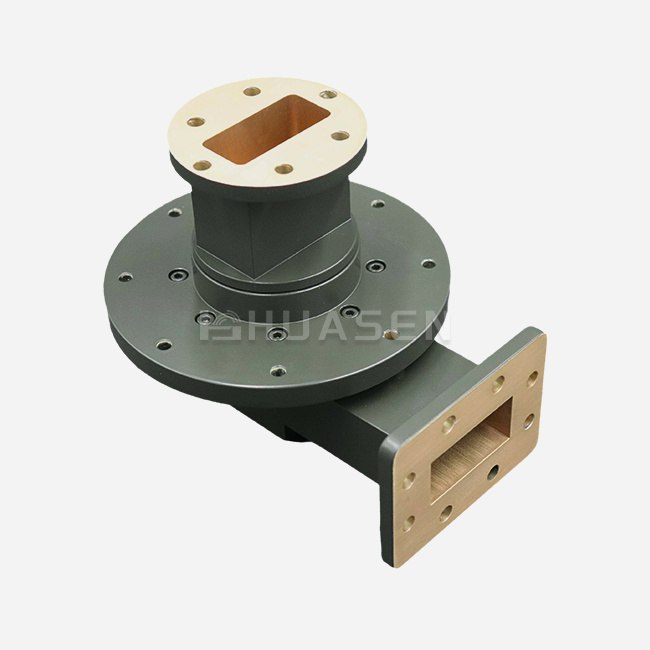
Specialized transmission line designs are often used by system builders to send microwave signals across multiple octaves without having to switch out hardware. By adding metallic ridges to its broad inner walls, the Double Ridged Straight Waveguide increases its operating frequency range from two to three frequency ratios, which usually cover 0.84 GHz to 40 GHz. By lowering the main mode's cutoff frequency and raising the cutoff frequency of higher-order modes at the same time, these bumps fix the bandwidth problem that comes with regular rectangular waveguides. This design lets makers of radar, electronic warfare, and test tools combine their RF architectures, which makes the systems simpler and cuts down on inventory needs while keeping the signal integrity very high across a wide range of frequencies.
Understanding the Frequency Range of Double Ridged Straight Waveguides
At Huasen Microwave, we've seen how hard it is for buying teams to find single parts that cover multiple bands without lowering performance standards. The key is to figure out how the shape of the ridges changes the way electromagnetic fields are spread inside the waveguide structure.
How Do Internal Ridges Expand Usable Bandwidth?
Standard rectangular waveguides usually work within a frequency range of 1.5:1 before higher-order modes cause crosstalk that is harmful. We make a capacitive loading effect by adding bumps to the middle of two broad walls that are opposite each other. This change lowers the cutoff frequency for the TE10 mode and raises the bar for the TE20 mode. This makes the single-mode operating window bigger. Our DRWAL line has bandwidth ratios of 2.4:1 to 3.6:1, which means it can cover frequencies from sub-GHz to millimeter waves in a single mechanical size.
The characteristic resistance profile changes as the electromagnetic field concentration moves toward the ridge gap. This function is useful for engineers working on 5G backhaul systems because it lets them switch easily to 50-ohm coaxial connections with little VSWR loss. We tried our units in a range of weather conditions and vibration levels that meet MIL-STD standards. The results show that the accuracy of the ridge placement is directly related to the frequency stability in difficult environments.
Common Frequency Bands and Their Applications
Our catalog has ridge shapes that are made to fit the needs of certain business bands. X-band versions (8–12 GHz) are used in marine radar systems that need metal housings that don't rust and have chromate conversion coatings to protect them from salt fog and temperature changes. Ku-band models (12-18 GHz) help satellite transfer sites that need low insertion loss—often less than 0.2 dB across the whole range—to keep signal budgets in long-distance space links.
Our broad units, which cover frequencies from 6.5 GHz to 18 GHz, get rid of the need for mechanical changes between threat frequency bands for defense companies making electronic countermeasure pods. A recent test with an airborne jamming system showed stable VSWR below 1.15:1 during high-G movements. This proved that our manufacturing tolerances on key ridge gap measurements were held to ±0.001 inches. Manufacturers of lab instruments like our Ka-band options (26.5-40 GHz) because they can achieve exact internal surface finishes through electroforming methods. These finishes reduce skin effect losses that would otherwise change vector network analyzer calibration data.
Key Design Parameters Affecting Frequency Range
There's more to choosing the right waveguide than just meeting the frequency specs on paper. We walk customers through three groups of parameters that affect success in the real world.
Ridge Geometry and Cross-Sectional Dimensions
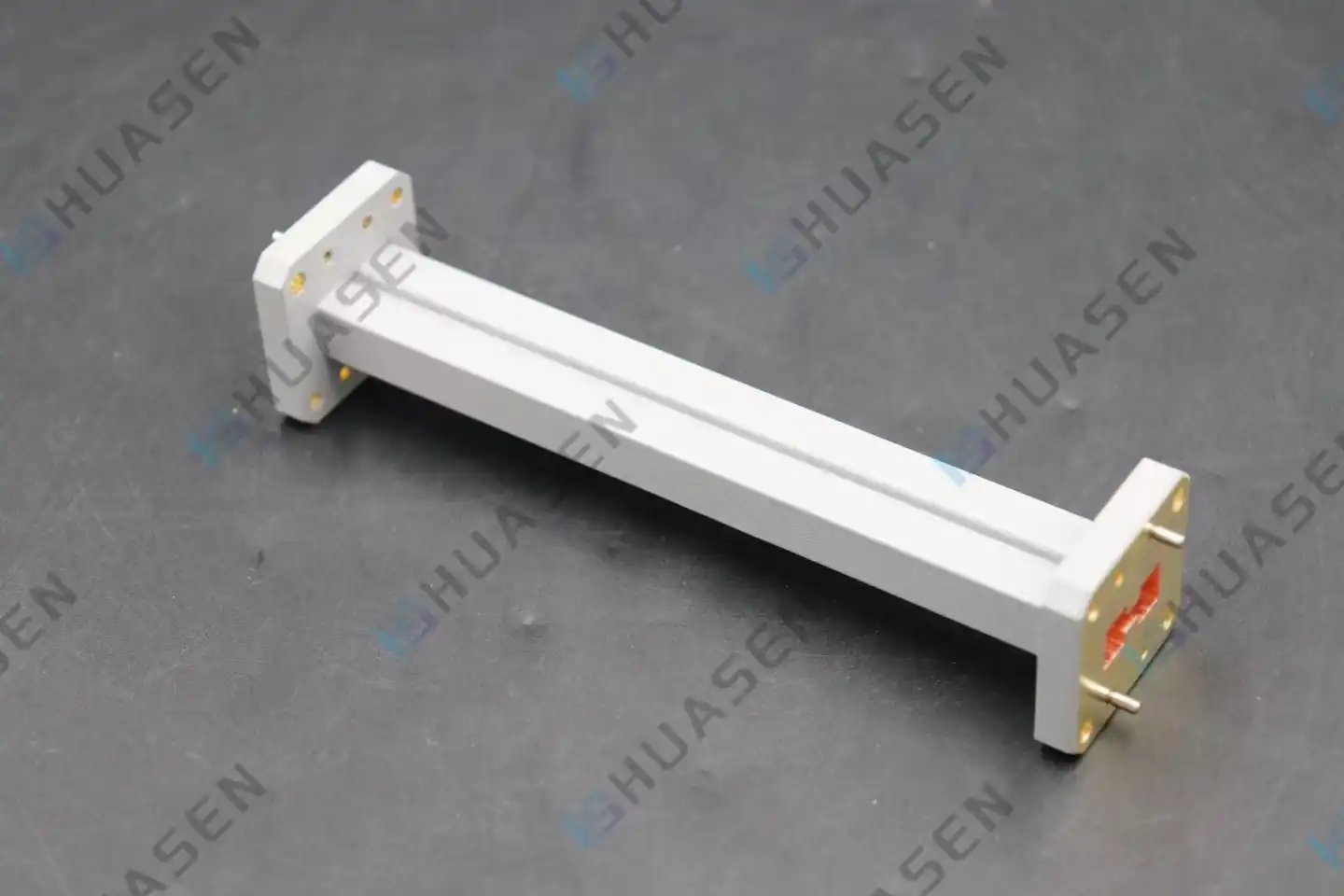
How quickly the cutoff frequency moves down is controlled by the height of the ridge. Taller lines make capacitance stronger, but they can't handle as much power because of the high current density at the sharp ends. Our engineering team balances these trade-offs by running finite element models that are checked against measurements made by a network monitor in our ISO-certified test lab.
Characteristic impedance matching is affected by ridge width in a double-ridged straight waveguide. In high-power radar uses, where we need to keep voltage standing wave ratios as low as possible when connecting to high-power amps, wider ridges lower impedance. The key measurement is the space between the two opposite ridges; changes greater than 0.025 mm lead to VSWR spikes that can be measured at the band edges. During production, we use coordinate measuring tools to make sure that every unit meets the size requirements before it is silver-plated.
The highest frequency limit before circular polarization modes show up is set by the waveguide's height and width. Higher frequencies can travel through smaller cross-sections, but ohmic losses rise because there is less surface area. When a satellite communications company needed a small 15 mm × 8 mm device that could cover frequencies from 17.7 GHz to 21.2 GHz, we made sure that the ridge sizes were just right to keep insertion loss below 0.15 dB while still fitting within their phased array spacing requirements.
Material Properties and Manufacturing Precision
Aluminum 6061-T6 is mostly used in aircraft, where extra weight has a direct effect on fuel use or payload capability. Because it can be machined, ridge edges can be made with very small tolerances. However, we use silver treatment to lower the surface resistance by about 40% compared to bare aluminum. Brass construction works well for desktop test equipment where thermal stability is more important than mass. This is because brass has lower thermal expansion coefficients, which keep the accuracy of the measurements even when the temperature in the lab changes.
When the frequency goes above 20 GHz, and the skin depth gets close to microns, surface roughness becomes very important. For millimeter-wave units, we recommend electropolishing to get Ra values below 0.4 micrometers. A defense lab recently checked our Ka-band waveguides against reference standards and found that the insertion loss was within 0.03 dB of what theorists predicted. This shows that our process controls for internal finish quality are working well.
If filler metal gets into the RF path, brazing joints at flange surfaces can cause impedance discontinuities. Our vacuum brazing processes keep the joints strong for pressure testing, which is needed for installations on high-altitude airplanes, and they also keep the active waveguide profile free of any protrusions. Temperature cycling tests from -55°C to +85°C show that the joint is reliable and doesn't lose performance, which eases customers' worries who are putting systems in arctic radar stations or tropical satellite ground stations.
Applications Leveraging Extended Frequency Range
Multi-octave bandwidth gives practical benefits in many areas where frequency agility is key to mission success or accurate measurements.
Radar and Electronic Warfare Systems
Frequency hopping is used in modern aerial radar systems to avoid jamming and make it easier to see targets. The rigid transmission backbone between traveling wave tube amplifiers and dual-polarized horn antennas is made up of our DRWAL parts. During a recent integration with a synthetic aperture radar platform, engineers got rid of three waveguide band modules and replaced them with a single 8-18 GHz double-ridged straight waveguide section. This cut the system's weight by 2.3 kilograms, which is a big savings for designs that have to fit inside an airframe.
Electronic defense systems need to be able to handle a lot of power across all danger bands. Our high-power versions can handle continuous wave sources of more than 500 watts and keep the VSWR below 1.2:1, even when pulses last less than 10 microseconds. The shape of the ridges successfully gets rid of heat by making more surface contact with the aluminum housings. For long-term high-duty-cycle operations, we can adapt the housings with cooling fins.
EMC Testing and Laboratory Instrumentation
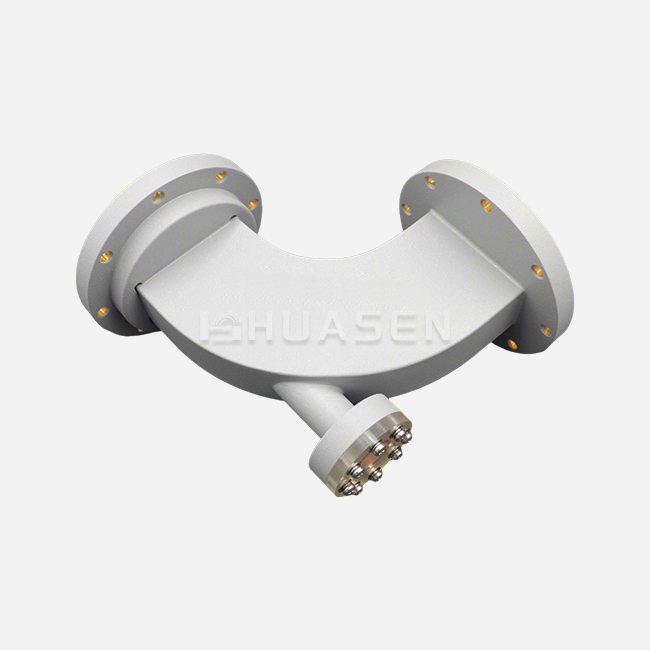
As per IEC 61000-4-3, immunity tests that are done in anechoic rooms need stable antenna feed devices from 80 MHz to 6 GHz. We made a special curved transition that connects our low-frequency DRWAL units to coaxial connections. This lets us sweep frequencies continuously without having to stop and recalibrate. Test houses say that chamber time is 30% shorter than it used to be when antenna swaps had to be done by hand at band borders.
Our precision calibration kits work well with vector network analyzers that are used to characterize double ridge waveguide sizes and parts. Metrology labs can directly use our devices in uncertainty budgets because each waveguide section comes with measured S-parameter files that can be traced back to NIST standards. The 26–40 GHz parts are used by a semiconductor research center to test prototype GaN amplifiers. The measurements are accurate to within 0.05 dB across multiple thermal cycles.
5G Infrastructure and Satellite Communications
Millimeter-wave 5G backup links that work in the 24-29 GHz pioneer bands need low-loss connections between antenna arrays and baseband units. Our small DRWAL assemblies can fit inside radio casings that are tightly fixed on towers. They also meet insertion loss requirements that keep link budgets safe over multi-kilometer paths. Corrosion-resistant coatings can handle seaside areas where salt spray speeds up oxidation on RF parts that aren't properly secured.
Satellite gateway stations that use multiplexed Ka-band uplinks need communication lines that don't change phases. We manage production factors, mainly how straight the ridges are along their length, to get phase uniformity within ±3 degrees across 6 GHz bandwidths. When a telecom company updated its ground station to handle high-throughput satellite service, our waveguides allowed data rates to go up to 400 Mbps per carrier without having to buy new antennas, which would have been expensive.
Comparing Double Ridged Straight Waveguides with Other Waveguide Types
Understanding the efficiency trade-offs between transmission line architectures is a key part of making choices about what to buy.
Frequency Range vs. Standard Rectangular Waveguides
In their intended band, standard WR-series waveguides have lower insertion loss—usually 0.05 dB per meter less than comparable double-ridged straight waveguide units—but only over a small range of frequencies. When systems work on more than one band, engineers have two options: use multiple waveguide runs with RF switches or combine them all into one double-ridged straight waveguide line.
We figured out how much this trade-off was worth for a radar maker looking at range at 10-15 GHz. A dual-waveguide system with WR-90 and WR-75 parts had four high-power switches added, which caused 0.8 dB of total loss and cost $12,000 in switching hardware. Our single WR-650 double-ridged straight waveguide option got rid of all switches, getting 0.6 dB total path loss while cutting costs by 40% and reducing weight by three kilograms. Reliability also got better; failing switches were their second most common field repair problem.
Bandwidth Capabilities Compared to Coaxial Cables
Coaxial wires are good for benchtop setups because they are mechanically flexible and easy to install. But when the frequency goes above 18 GHz, cable losses go up very quickly. For example, semi-rigid cables lose 2–4 dB per meter, while our double-ridged straight waveguides lose only 0.3 dB per meter. Waveguides also have better phase stability than coaxial wires, which can be a problem for phased array uses that need micron-level mechanical stability.
A university study group and I worked together to make a 35 GHz image radar. Their first coaxial version had phase noise from the cables, which made it hard to reassemble images clearly. When our rigid waveguide sections were used instead of coax runs, phase error went down by 15 degrees RMS, and their range precision went from 8 cm to 3 cm. The team released their findings and said that waveguide reliability made sub-wavelength imaging possible.
Power handling presents another distinction. Our normal stock items can handle steady loads of 1-2 kilowatts, but coaxial versions at these frequencies can't handle more than 100 watts before the dielectric breaks down or the connector arcs, including double ridge waveguide sizes. Waveguides are still the only good choice for defense uses that need to push power levels.
Conclusion
The frequency range of double-ridged straight waveguides solves some of the most important problems in designing wideband microwave systems. These parts cover more than one octave, which is something that regular waveguides can't do. They do this by changing the internal field patterns through a precise ridge shape. Engineers are able to combine gears, make them lighter, and make them more reliable, which are all very important benefits in aircraft, defense, and telecommunications. The DRWAL series from Huasen Microwave is an example of this technology. It has a range from 0.84 GHz to 40 GHz, VSWR performance below 1.15:1, and mechanical setups that can be changed from 0.1 mm to 500 mm in length. When picking the right waveguide, you have to weigh the bandwidth needs against the insertion loss limits, physical limitations, and weather needs.
FAQ
1. What frequency ranges do double ridged waveguides typically cover?
Depending on the shape of the ridges, double-ridged waveguides usually have bandwidth ratios between 2:1 and 4:1. 1-2 GHz, 2-4 GHz, 4-8 GHz, 6-18 GHz, and 18-40 GHz bands are common in the industry. Huasen Microwave has a collection that goes from 0.84 GHz to 40 GHz. At lower frequencies, VSWR stays below 1.15:1, and at millimeter-wave bands, it stays below 1.2:1. Frequency ranges can be made to fit the design of a certain device.
2. How do ridge dimensions affect frequency performance?
The lower cutoff frequency is mostly controlled by the height of the ridges. Higher ridges move the cutoff frequency down, which increases the low-frequency range. Ridge width changes characteristic impedance, which changes how transfers to coaxial connections work. The accuracy of impedance matching depends on the gap between two opposing ridges. Our production tolerances keep this size to ±0.025 mm to keep the required VSWR across all operating bands. The best designs balance these factors by using electromagnetic simulations that are confirmed by testing with a vector network tester.
3. Can double-ridged waveguides handle high power levels?
Ridge waveguides focus the flow of current along the sides of the ridges, which means they can hold a little less power than standard rectangular guides. Our high-power models can handle continuous wave sources of more than 500 watts and peak powers of more than 10 kilowatts for pulse lengths of less than 10 microseconds. Managing heat with metal housings and extra cooling fins makes it possible to increase the duty cycle. With the right tools, military radar and jamming systems regularly work at these settings.
Partner with a Trusted Double Ridged Straight Waveguide Supplier
Huasen Microwave can help you with your next system integration because they have been making microwave parts for 30 years, including the Double Ridged Straight Waveguide. Our DRWAL product line has a wide frequency band coverage, low VSWR specs, lengths that can be customized, and corrosion-resistant construction that makes it perfect for outdoor setups and tough working conditions. Our engineering team can help you with design from the prototype stage all the way through production, whether you're building 5G infrastructure, improving radar systems, or making precision test equipment. Email us at sales@huasenmicrowave.com to get full S-parameter data, dimensional models, or sample units. We can meet the deadlines for fast prototyping and large-scale production while maintaining uniform quality and providing detailed documentation of all tests.
References
1. Marcuvitz, Nathan. Waveguide Handbook. Institution of Engineering and Technology, 1986.
2. Ramo, Simon, John R. Whinnery, and Theodore Van Duzer. Fields and Waves in Communication Electronics. 3rd ed., John Wiley & Sons, 1994.
3. Saad, Theodore S. The Microwave Engineers' Handbook and Buyers' Guide. Horizon House Publications, 1971.
4. Chen, Y. and B. Beker. "Design and Analysis of Double-Ridged Rectangular Waveguide for Broadband Applications." IEEE Transactions on Microwave Theory and Techniques, vol. 47, no. 8, 1999, pp. 1485-1489.
5. Hopfer, S. "The Design of Ridged Waveguides." IRE Transactions on Microwave Theory and Techniques, vol. 3, no. 5, 1955, pp. 20-29.
6. Military Standard MIL-DTL-85, Waveguides, Rigid Rectangular, and Flexible, Electromagnetic, General Specification for. United States Department of Defense, 2005.
Send Inquiry