Coax Cable Selection Guide for High-Frequency Applications






2026-07-01 23:33:18
Choosing the right RF communication line is one of the most important but little-known parts of designing a high-frequency system. Radar sites, 5G base stations, and satellite ground ports all use a Coax Cable to send not only signals but also mission-critical data, and even a 0.5 dB loss can mean the difference between a stable link and a catastrophic failure. This guide specifically talks about the problems that procurement professionals, system integrators, and RF engineers face when they need to find coaxial solutions that balance electrical performance, material toughness, and the stability of the supply chain. We'll talk about how custom cable assemblies can help with problems like phase matching in phased arrays and environmental sealing in marine sites. This will help you make a smart technical choice about your next buy.
Understanding Coax Cable Basics for High-Frequency Use
Layered Structure and Signal Transmission Mechanisms
The concentric shape of coaxial cables makes them good at shielding. They have a core conductor (usually silver-plated copper), a dielectric insulator (PTFE or FEP for thermal stability), an outer shield (braid, foil, or both), and then a protective cover. This stacked structure keeps the electromagnetic field inside the center wire and shield, which stops radiation loss and interference from outside sources. At high frequencies, especially above 6 GHz, the skin-effect makes current flow only along the surface of the wire. This makes the choice of material and finish on the surface very important. Above 40 GHz, even small changes in temperature can change phase velocity and cause mistakes in time-domain measures, so PTFE's dielectric constant stability is very important.
Key Cable Types: RG6, RG59, and More
RG6 (75 Ohm) and RG59 (also 75 Ohm) are still used a lot in broadcast and CATV, but high-frequency uses need different types. RG6 shielding is better, and loss is lower at VHF and UHF frequencies, making it a good choice for outdoor antenna lines. RG59 is smaller and more flexible, so it can fit in tight areas better, but it loses more signal above 1 GHz. More and more modern systems use LMR-series (Low-Loss Microwave Rated) or semi-rigid wires for frequencies up to millimeter-wave bands. Solid outer wires are used in semi-rigid designs to stop shield leaking, but at the cost of flexibility. These designs are perfect for static installations, like changing from a radar waveguide to an antenna. This gap is filled by conformable wires, which can hold their shape without any tools and still provide great protection up to 18 GHz.
Critical Electrical Specifications
It is important to understand impedance matching. The characteristic impedance for telecommunications and data uses is 50 Ohm, while the characteristic impedance for video devices is 75 Ohm. Mismatch leads to echoes, which can be measured by the VSWR (Voltage Standing Wave Ratio). A VSWR of 1.5:1 means that 96% of the power is transferred, which is fine for most business uses but not for measurement, which needs a VSWR of less than 1.15:1. Insertion loss, which is recorded in decibels per meter, goes up with frequency and cable length. Attenuation doubles when the cable length is doubled. High-speed digital signal rise times are affected by capacitance per foot, and immunity to EMI/RFI is determined by shielding efficiency (measured in dB). This is very important in places with a lot of RF activity, like carrier hotels or shipboard electronic warfare rooms.
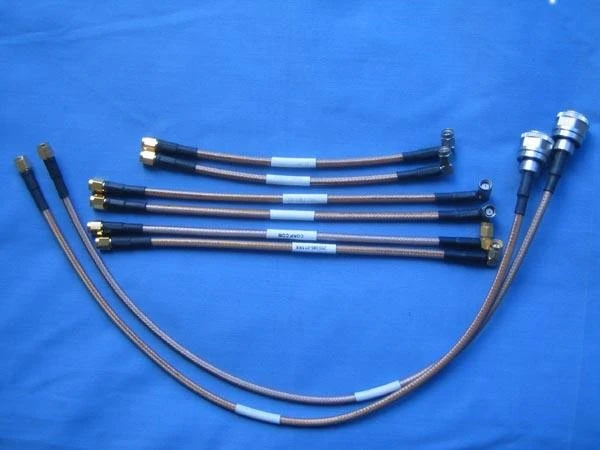
Criteria for Choosing the Best Coax Cable for High-Frequency Applications
Through organised criteria screening (Coax Cable), procurement teams have to find a balance between different goals. The following decision strategy talks about the most important measures that have a direct effect on the performance and total cost of ownership of a system.
Frequency Range Compatibility and Bandwidth
The cutoff frequency of your cable limits its useful bandwidth. This frequency is based on the cable's physical size and dielectric properties. A normal RG58 wire (50 Ohm) can handle messages up to about 1 GHz before it stops working because of too much loss. This range is greatly increased by high-performance assemblies that use low-loss dielectrics and precise connections. For example, custom cable assemblies from Huasen Microwave can work from DC to 60 GHz with an insertion loss of less than 6.5 dB at 40 GHz. Choosing the right connection is often the limiting factor. SMA connectors work successfully up to 18 GHz, 2.92mm (K-connector compatible) up to 40 GHz, and 1.85mm up to 67 GHz. When you match the specs of the wire and connection, the setup won't cause problems in wideband systems that cover many octaves.
Attenuation Rate and Power Handling
Attenuation lowers the power of a signal directly. This is a problem when there are long cables between radio heads that are far away and antennas. At 1 GHz, a 100-foot run of RG58 drops about 8 dB, which means that more than 80% of the power being sent is lost as heat. When you upgrade to LMR-400, this drops to 2.7 dB, which keeps the signal gaps. Power handling goes down as frequency goes up. For example, a wire that can handle 1 kW at 100 MHz might only be able to handle 50W at 2 GHz because of higher resistance losses and dielectric heating. For military radar and electronic defences, wires need to be able to handle high pulse power while keeping PIM (Passive Intermodulation) below -160 dBc so that they don't mess up sensitive sensors.
Shielding Effectiveness and Environmental Sealing
Triple-shielded wires (braid, foil, and braid) achieve >90 dB separation, which is very important in places where there is a lot of interference. When installed outside, they need to be rated IP67 or IP68. This is done with internal potting compounds and adhesive-lined heat shrink at the connection ports to keep moisture out, which would damage the dielectric properties. In maritime and aircraft uses, you need to make sure that the product can handle UV light, salt spray (ASTM B117 compliance), and vibrations (MIL-DTL-17 standards). Extreme temperatures can test jacket materials. For example, normal PVC jackets become rigid below -20°C, but special FEP or silicone jackets stay flexible from -55°C to +200°C, which is important for high-altitude UAVs and cryogenic lab sets.
Cost Optimization in Bulk Procurement
The unit price changes based on the shielding grade, wire diameter, and complexity of the connection. Standardising on fewer types of cables lowers the cost of keeping supplies and makes managing extras easier. Although they cost more per unit, pre-terminated kits with factory-installed connectors get rid of the need for field termination work and quality variation. This is worth it when installation labour rates are more than $75/hour or when projects involve hundreds of identical jumps. Most of the time, volume savings start at sales of 100 pieces, and prices level off after 500 units. Requesting samples before committing to production runs lets you check the VSWR and insertion loss against the datasheets, which saves you money on costly respins.
Comparing Coax Cable Types and Alternatives in High-Frequency Applications
RG6 vs. RG59: Performance Trade-Offs
Both wires can be used for 75 Ohm uses, but because of how they are built, they can be used for different things (Coax Cable). RG6 has a stronger dielectric and a bigger center wire (18 AWG vs. 20 AWG). This makes the attenuation 30% lower at UHF frequencies. Its quad-shield versions are great at blocking LTE cell signals, which is a problem that cable TV systems keep having. RG59 is better for short patch lines inside equipment racks because it is more bendable and cheaper. There is also almost no loss. Neither cable works well above 3 GHz; satellite IF distribution at L-band (950-2150 MHz) is the highest frequency that they can work at before switching to LMR or hardline options.
Coaxial vs. Fiber Optic and Ethernet Alternatives
Fiber optics are the most common type of long-distance and ultra-high-bandwidth links (>10 Gbps). They don't lose much signal over kilometers and are immune to electromagnetic interference. But coaxial lines still have some benefits: they can carry RF signals directly without modulating or demodulating them, which makes the design for analogue radar returns and broadband antenna arrays easier. Passive optical fibers can't handle DC power input, which is what bias tees for active antennas do. It's easier to install because you don't need any transceivers or media adapters. Ethernet over twisted pair doesn't work well beyond 100 meters and isn't transparent to RF. Coax is a better choice for medium-distance RF spread (10–100 meters) where fiber's high cost and difficulty aren't needed.
Shielding Performance: Braid, Foil, and Hybrid Designs
Single-braid shields (which usually cover 80–95% of the signal) are flexible and good at blocking signals below 1 GHz. 100% foil screens work great at HF and VHF, but they aren't very strong mechanically—flex cycles break the foil, making leakage routes. Hybrid designs use both foil (which blocks high frequencies) and outer braid (which blocks low frequencies and makes the design stronger), which makes it useful across a wide frequency range. Tri-shield and quad-shield designs raise the isolation level above 100 dB, which is needed when coax runs next to high-power emitters or in industrial plants with a lot of electrical noise. The best way to shield is with semi-rigid wires that have solid outer conductors, but because they are rigid, they can only be used in precise test sets and static microwave assemblies.
Practical Installation and Maintenance Guidelines for High-Frequency Coax Cable Systems
Proper Grounding and Connector Mating
Correct grounding prevents shield currents from connecting to the center wire, which is a main way that EMI can get in. At each opening in the box, use 360-degree contact backshells to bond cable shields to grounded bulkhead connections. Pigtail ground wires create inductance loops that weaken shielding above 10 MHz. Using calibrated torque tools, tighten connectors to the manufacturer's specs (8–12 in-lbs for SMA and 12–15 in-lbs for N-type). If you over-tighten, the dielectric insulators will be crushed, which will cause VSWR spikes. If you under-tighten, there will be intermittent contact resistance and intermodulation products. Using thread-locking compound stops threads from coming loose when they are vibrated, which is very important for mobile platforms and equipment that goes through a heat cycle.
Cable Routing and Bend Radius Management
When the minimum bend radius is exceeded, the dielectric material is compressed, which changes the resistance and raises the return loss. Most flexible cables say that the minimum bend radius is 10x the cable diameter. For example, a cable with a diameter of 0.5 inches needs a bend radius of 5 inches. Semi-rigid wires can only be bent once; any more turns could cause the outer conductor to crack. Keep a 6-inch space between wires and AC power lines to keep magnetic fields from connecting. Instead of sharp-edged hangers that wear down coats over time from years of temperature changes, use cable trays with rounded supports. In places with a lot of vibration, hold wires every 18 inches with cushioned clamps. This will keep them from wearing out at the connection ports, which is where flexure stress builds up.
Routine Testing and Preventive Maintenance
VSWR sweeps done once a year find a decline before crashes happen (Coax Cable). A VNA (Vector Network Analyser) or return loss bridge quickly shows the difference between physical damage (sharp resonance spikes at certain frequencies) and connection rust (gradual VSWR rise across frequencies). Time-domain reflectometry (TDR) can spot fault locations to within inches, which is very helpful for fixing faults that happen at random on long outdoor runs. Verdigris on the center pins of outdoor connectors is a sign that water has gotten in. Even a single drip of water can increase loss by several decibels and speed up rusting. As soon as the manufacturer's union cycle limits are reached (usually 500 cycles for SMA and 2000+ cycles for ruggedised quick-disconnect types), the parts should be replaced because the contact springs will lose tension and electrical performance will drop without warning.
Procurement Insights: Buying High-Quality Coax Cables and Supplier Selection
Balancing Price and Performance in Bulk Orders
High-frequency wire costs anywhere from $2 per foot (standard RG-series) to $50 or more per foot (phase-matched semi-rigid sections). When you order 500 feet instead of 100-foot spools, you save 15 to 20%. This is called economies of scale. Custom cable systems cost 50–100% more than the cost of raw cable, but they get rid of the need for field labour and quality problems. When comparing prices, you should add up the total cost of installation, which should include connectors, labour, and any possible repairs. When you add up the cost of the technician's time and the test tools over time, a $15 pre-terminated assembly often beats a $8 bulk wire plus a $12 field-installed connector. By making volume deals with approved sellers, prices are locked in for 12 to 24 months. This protects against changes in the prices of copper and other valuable metals.
Evaluating Suppliers: Certifications and Support Infrastructure
Reputable makers use ISO 9001 quality systems and give you paperwork with a certificate of conformance that links lot numbers to raw materials. Adhering to IEC standards or MIL-DTL-17 certification (for military-grade wires) shows a dedication to consistent performance. Check how much technical help the seller offers. For example, can engineers do a Smith chart analysis of custom parts or suggest phase-matching solutions for beamforming networks? Commodity sellers have lead times of two to four weeks, while turnkey developers have lead times of six to twelve weeks for complex custom builds. Different warranty terms show how confident you are in the company. For example, lifetime promises on workmanship and 90-day limited coverage show very different quality philosophies. Instead of just depending on specification sheets, ask for test data from a third party that shows VSWR and insertion loss over a range of temperatures.
Trusted Brands and Sourcing Channels
Belden and Times Microwave (LMR-series) control most of the North American market, and their large distribution networks make their products easy to get. Humax and Andrew (CommScope) still have strong places in the infrastructure for cell phones. Specialised companies like Huasen Microwave stand out by offering special engineering services such as phase-matched sets for phased arrays, ruggedised assemblies that meet MIL-STD-810 shock/vibration standards, and low-PIM solutions for co-sited emitters. For prototyping numbers, Digi-Key and Mouser are two distribution channels. Allied Electronics is a channel for industrial maintenance, repair, and operations (MRO), and direct maker involvement is a channel for project-specific assemblies over $10,000. Costs are 30–40% less when you buy directly from Asian makers, but wait times are 8–14 weeks longer, and guarantee claims are harder to make. This is fine for spare parts that aren't very important, but it's risky for line-down emergency replacements.
Conclusion
To choose the right coaxial options for high-frequency uses, you have to weigh the prices, electrical performance, and environmental resistance. Understanding basic specs like VSWR, insertion loss, and shielding efficiency helps procurement teams match cable properties to practical needs. This is true whether the need is for phased array radar that needs picosecond phase stability or cellular infrastructure that needs low-PIM performance. Best practices for installation and regular maintenance routines increase the return on investment by keeping the signal strong and extending the service life. Supply chain risks can be reduced by working with makers that offer custom engineering help and certified quality systems. This lets you create unique solutions that off-the-shelf goods can't do.
FAQ
1. How does coax cable signal loss impact high-frequency performance?
High-frequency speed is impacted by signal loss in coaxial cable. Due to skin effect and dielectric losses, signal loss in coaxial lines grows exponentially with frequency. A 10-foot run of normal RG58 drops 12 dB at 10 GHz, which means the signal power is only 6% of what it was before. This loss lowers the signal-to-noise ratio in listeners and the effective transmitter power, which makes wireless systems' coverage areas smaller. If you choose low-loss options like LMR-400 or semi-rigid wires, attenuation drops to 1.5 dB over the same distance. This protects link budgets, which are important for keeping data rates high in 5G backhaul and satellite uplinks.
2. Can RG59 cable support satellite signal transmission effectively?
In home setups with distances of less than 150 feet, RG59 can handle satellite IF bands between 950 and 2150 MHz. Its 75 Ohm impedance fits the inputs of a satellite detector, so there are no reflection losses. Attenuation becomes a problem after 200 feet—a 250-foot RG59 run loses 8 dB at 2 GHz, which means inline amplifiers are needed, which add noise and cost. Commercial satellite systems prefer RG6 quad-shield or hardline options because they have 40% less loss and better rejection of local LTE interference that can overwhelm sensitive LNB front-ends that are sensitive. When professional multi-satellite headend systems switch to fiber-optic distribution, RF loss goes away completely, and the system can handle dozens of transponders.
3. What is the expected lifespan of outdoor shielded coax cables?
Outdoor coaxial wires are exposed to UV light, changes in temperature, and water, all of which weaken the jacket's structure and dielectric qualities over time. Normal PVC-jacketed wires last 5 to 8 years before they crack and let water in. UV-resistant polyethylene makes this last 10 to 12 years longer. When placed correctly with drip loops and sealed connections, premium wires with FEP or silicone jackets can last for 15 to 20 years in temperate areas. Coastal sea settings cut these numbers in half because salt spray speeds up rusting. Unexpected power blackouts can be avoided by checking the jacket regularly for damage and replacing it before the VSWR starts to break down.
Partner with Huasen Microwave for Precision RF Cable Solutions
Huasen Microwave comes to the problems of high-frequency cables with 30 years of experience in RF engineering. Our special wire assemblies can work from DC to 60 GHz, have an insertion loss of less than 6.5 dB at 40 GHz, and have a VSWR of less than 1.5. They can be used with SMA, N, 2.92mm, and four other types of connectors. We are experts in making phase-matched sets for beamforming networks, designs that can withstand high temperatures and torsion for aircraft platforms, and stable-phase assemblies with low loss for measurement. Before it is shipped, every part goes through full two-port VNA characterisation and TDR testing. As a well-known company that makes Coax Cable for the defence, aircraft, and telecommunications industries, we offer design help, sample validation, and bulk prices that are tailored to the needs of each project. Email our engineering team at sales@huasenmicrowave.com to talk about the details of your application and to get detailed datasheets. Let us help you with your signal integrity problems by using tried-and-true radio interconnect options.
References
1. Rizzi, P. A. (1998). Microwave Engineering: Passive Circuits. Prentice Hall, Upper Saddle River, NJ.
2. Maloratsky, L. G. (2004). Passive RF and Microwave Integrated Circuits. Elsevier, Burlington, MA.
3. Straw, R. D., ed. (2007). The ARRL Antenna Book, 21st Edition. American Radio Relay League, Newington, CT.
4. Balanis, C. A. (2016). Antenna Theory: Analysis and Design, 4th Edition. John Wiley & Sons, Hoboken, NJ.
5. Johnson, H. W., & Graham, M. (2003). High-Speed Signal Propagation: Advanced Black Magic. Prentice Hall, Upper Saddle River, NJ.
6. Institute of Electrical and Electronics Engineers (2020). IEEE Standard for Coaxial Cable Specifications (IEEE Std 287-2007/R2020). IEEE, New York, NY.
Send Inquiry