Loss Mechanisms of Coplanar Waveguide






2026-05-08 21:40:35
Loss mechanisms in coplanar waveguide structures directly affect the quality of the signal and how well the system works in high-frequency situations. Attenuation in these transmission lines mostly happens because of conductor losses due to skin effect and surface roughness, dielectric losses from substrate materials, radiation losses due to electromagnetic leakage, and flaws in the way they were made. When engineers and procurement managers understand these processes, they can choose the right substrate materials, conductor geometries, and parts that meet performance needs while staying within budget. This is especially important in demanding applications like 5G infrastructure, satellite communications, and millimeter-wave radar systems, where even small losses in dB can have a big effect on how well the system works as a whole.
Introduction
Transmission lines that can reliably carry signals at frequencies from a few GHz to more than 100 GHz are needed for modern wireless communication systems. Coplanar waveguides have become important parts in microwave and millimeter-wave applications because they make circuit design more flexible and integration easier. Coplanar waveguide structures are different from traditional microstrip configurations because they put the signal conductor and ground planes on the same substrate surface. This makes it easier to mount components and reduces electromagnetic interference.
How well these transmission lines work depends on how well you understand the different ways that signals get lost. It's important to understand how conductor losses, dielectric attenuation, radiation leakage, and surface effects affect signal transmission whether you're a procurement manager evaluating suppliers, a design engineer optimizing circuit layouts, or an original equipment manufacturer (OEM) putting parts into bigger systems. These losses have a direct effect on the noise level of your system, how well it uses power, and, in the end, how cost-effective your solution is. When signal quality can't be compromised, like in 5G base station front-ends, satellite communication terminals, and aerospace radar modules, choosing low-loss components is a strategic choice that affects how competitive the product is and how reliable it is in use.
Overview of Coplanar Waveguide Loss Mechanisms
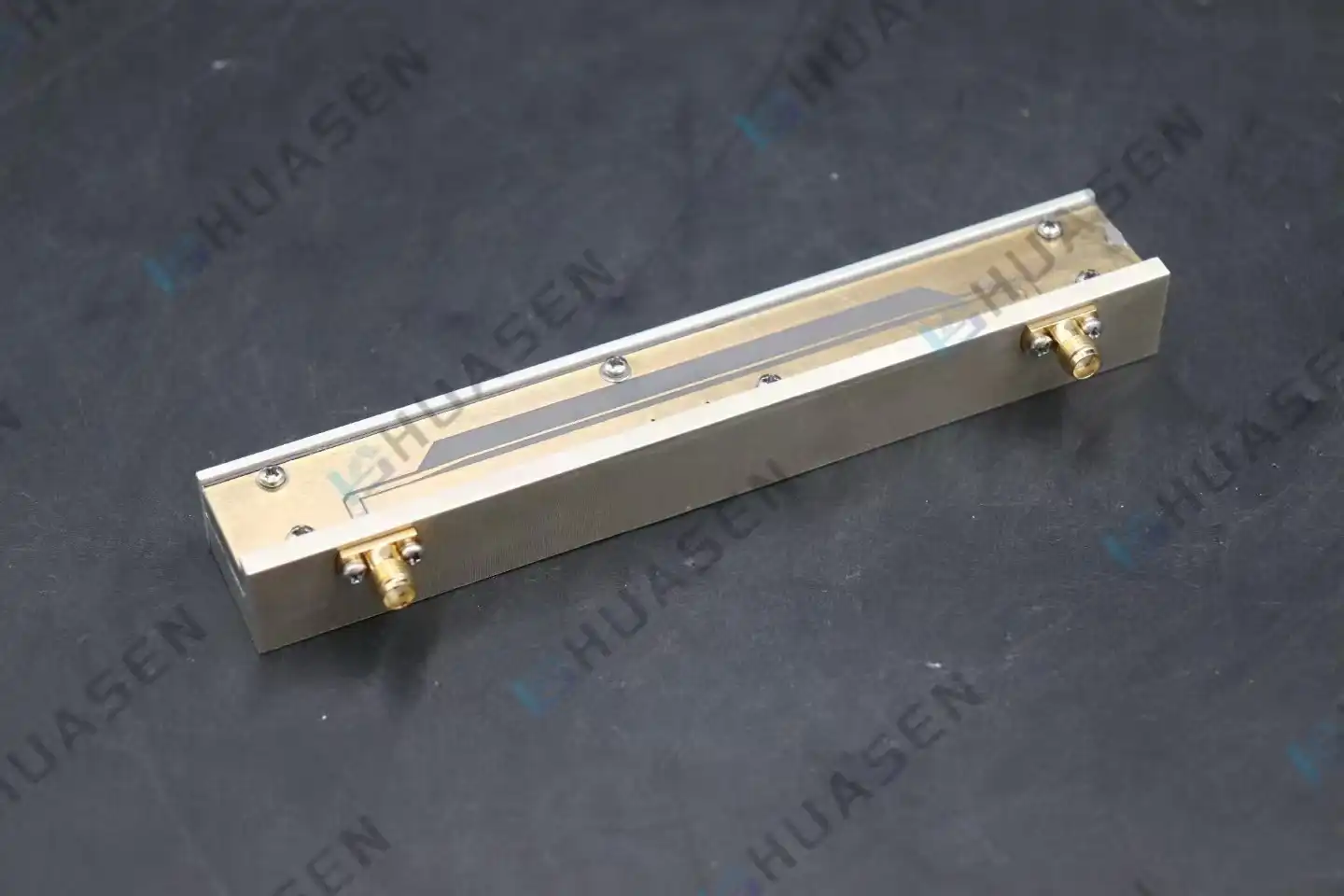
Coplanar waveguides are made up of a dielectric substrate, a center conductor, and two ground planes on either side. This creates a transmission line geometry that is widely used in modern RF systems. This arrangement is used a lot in 5G small cell antennas, phased array radar modules, and millimeter-wave test equipment, which needs to be small and work well at high frequencies.
Primary Loss Categories
Knowing the four main types of loss that affect coplanar waveguide performance helps people involved in the design and procurement phases make smart choices. Conductor loss is the amount of energy that is lost in metallic traces because of their limited conductivity and the skin effect, which keeps current flowing along the surface of the conductor at high frequencies. As the operating frequency goes up to the Ka-band and beyond, the skin's depth drops to micrometers. This makes surface quality even more important. The loss tangent parameter measures how much dielectric loss there is due to molecular polarization in the substrate material. When electromagnetic fields couple to empty space instead of staying in the mode they were meant to travel, this is called radiation loss. When it comes to millimeter-wave frequencies, where conductor surface irregularities get close to the skin depth dimension, surface roughness loss is big. This is something that is often overlooked in early designs.
The insertion loss specifications that procurement teams must look at when comparing component offerings are based on these loss mechanisms as a whole, including those in Coplanar Waveguide. You can ask suppliers the right questions about substrate materials, metallization processes, and testing methods if you fully understand them. Loss characteristics are linked to both production yield and long-term reliability. This is because parts that are working close to their limits tend to be less reliable and have more fluctuations. Cost effects go beyond unit prices and include all system costs, such as the amount of power needed for the amplifiers to make up for losses and ways to deal with heat that is lost.
Detailed Analysis of Major Loss Mechanisms
Conductor Loss Characteristics
The skin effect is the main cause of conductor loss in coplanar waveguide structures. This is when alternating current gathers near the conductor surface instead of spreading out evenly across the cross-section. This effect gets stronger as the frequency goes up, which makes the effective resistance go up by the same amount as the square root of the frequency. The choice of material is very important. Copper is better at conducting electricity than aluminum, but both need to have their surfaces treated to keep them from oxidizing. Gold and silver plating are common in high-reliability applications because they keep the electrical properties stable over long periods of time, but they make the parts more expensive to make.
Roughness on the surface adds an extra loss component that becomes very important above 10 GHz. Electroplating and chemical etching are two manufacturing processes that make conductor surfaces slightly uneven on a microscopic level. When the depth of the skin gets close to these roughness levels, current paths get twisted, which makes resistance higher. At millimeter-wave frequencies, research shows that surface roughness can cause 20–40% of all conductor loss. Chemical-mechanical polishing and specialized electroless plating are two advanced fabrication techniques that help lessen this effect. However, they make the manufacturing process more complicated and cost more.
Dielectric Substrate Considerations
Transmission line performance is largely determined by the dielectric material that supports the conductor pattern. Signal propagation is affected by the dielectric constant, loss tangent, thermal expansion coefficient, and moisture absorption of the substrate. Rogers RO3003, alumina ceramics, and quartz are some examples of low-loss tangent materials that lower dielectric attenuation but usually cost more. Even though standard FR-4 substrates are cheap, they have loss tangents greater than 0.02 at microwave frequencies, which means they can't be used in situations where low insertion loss is needed.
Temperature dependence is another important thing to think about when writing procurement specifications. When the temperature changes, the dielectric constant changes, which leads to impedance shifts that hurt VSWR performance. This is especially bad for outdoor base station installations that experience large temperature changes. The uniformity of the substrate thickness affects the consistency of the characteristic impedance across production batches, which has a direct effect on the yield in large-scale manufacturing. Requesting detailed material property documentation, such as frequency-dependent loss tangent measurements and thermal stability data, from suppliers during the evaluation process helps make more accurate performance predictions.
Radiation and Leakage Mechanisms
In coplanar waveguide transmission lines, radiation losses happen when electromagnetic energy doesn't travel in the way it was meant to and instead couples with the substrate or sends radiation into space. When there are breaks in the coplanar waveguide design, like bends, junctions, and changes between types of transmission lines, this mechanism gets stronger. As field containment gets weaker, radiation tends to get stronger when ground plane spacing is smaller compared to substrate thickness. Parasitic coupling between adjacent coplanar waveguide structures on different layers can create unintended signal paths, which makes it hard to use for applications that need to stack up multiple layers.
Tolerances in manufacturing have a direct effect on how radiation behaves. Changes in the ground plane geometry, gap spacing, and the width of the conductor can all change the electromagnetic field distribution. This could lead to mode conversion and more leakage. Millimeter-wave applications need precise lithography processes that can control dimensions better than 5 microns because feature sizes get smaller as the wavelength gets longer. Environmental factors, such as humidity, can change the properties of the substrate, causing loss of characteristics that change over time. This makes it harder to calibrate the system and predict its long-term performance.
Methods to Minimize Loss in Coplanar Waveguide Designs
Design Optimization Strategies
Careful choice of geometric parameters is the first step in effective loss reduction. The characteristic impedance is set by the conductor width and gap spacing, which also changes the loss per unit length. Wider conductors lower conductor loss but raise dielectric loss because the field can reach deeper into the substrate. Through electromagnetic simulation, the best designs find a balance between these different effects. Ground plane width and spacing affect field confinement. If the ground plane width is too small, the field can spread, which increases radiation loss. On the other hand, if the width is too large, it adds cost and substrate area that aren't needed.
High-performance coplanar waveguide designs start with choosing substrate materials with very low loss. For millimeter-wave uses, the best materials are liquid crystal polymers with loss tangents below 0.002, low-temperature co-fired ceramics that are very thermally stable, and thin-film substrates like polyimide for use in flexible circuits. When it comes to electrical performance, mechanical properties, thermal management, and cost, each material has its own unique trade-offs. When you buy in bulk, you can often get high-quality substrate materials at prices that are comparable to standard options. This is especially true when you sign a supply agreement for more than one year.
Advanced Fabrication Techniques
Modern ways of making things have a big effect on the achievable loss performance. Gold immersion plating and other surface treatments make conductor surfaces stable, low-resistance, and resistant to oxidation and corrosion. Electroless nickel immersion gold processes make it possible to reliably solder parts together while keeping the contact resistance low. Conformal coatings keep finished assemblies dry and clean in harsh conditions, but you need to think about the dielectric properties of the coatings because they change how well the substrate works.
Precision lithography techniques allow for better control of dimensions, which lowers differences in loss between batches of production. Laser direct imaging systems can get feature resolutions of less than 25 microns and make sure that the impedance stays the same by registering accurately. Chemical etching profiles change the cross-sectional geometry of a conductor. For example, isotropic etching creates sloped profiles, while vertical sidewalls make current crowding less likely. Aerosol jet printing and other forms of additive manufacturing show promise for rapid prototyping, but it's still hard to get a surface finish that's good enough for production.
Simulation-Driven Development
Before starting fabrication, electromagnetic simulation tools are now required to estimate how thecoplanar waveguide design loss will behave. Full-wave analysis, which records all loss mechanisms at the same time, can be done with software like ANSYS HFSS, CST Studio Suite, and Keysight ADS. It is very important to enter correct material property data, because the simulation results are only as reliable as the substrate parameters and conductor properties that were used. A lot of substrate makers now offer detailed material models that work with the most popular simulation programs. This makes the coplanar waveguide design process easier.
Simulation lowers the cost of development by finding performance problems before the prototype is made. Parametric sweeps that look at differences in material, substrate thickness, and conductor size help set manufacturing tolerances that keep performance at a good level. A big company that makes 5G infrastructure said that using simulation-driven development workflows cut design iteration cycles by 40%. This meant that they could get their products to market faster and spend less on engineering. To get a good correlation between simulated and measured results, you need to carefully design and calibrate your test fixtures. This is where experienced suppliers can help you with technical issues.
Comparisons: Coplanar Waveguide vs. Other Transmission Lines Regarding Loss
Performance Trade-offs Across Transmission Line Types
The most common alternative to coplanar waveguide configurations is microstrip transmission lines, which have a ground plane on the other side of the substrate and a conductor trace on one side. Because the field between the conductor and ground plane is stronger in microstrip, it usually has less radiation loss. But microstrip needs via holes for shunt component grounding, which makes fabrication harder and adds parasitic inductance. A coplanar waveguide gets rid of this need by putting ground planes on the same surface, which makes assembly easier and lets you mount flip-chip components.
Stripline configurations, with the signal conductor buried between two ground planes, offer superior isolation and less radiation loss. This benefit comes at the cost of more complicated manufacturing, slower cooling because of where the conductors are placed inside, and less easy access for tuning or making changes. For uses that need to keep signals separate, like multichannel test equipment or high dynamic range receivers, stripline is worth the extra work. Coplanar waveguide structures work great for applications that need to integrate surface-mount components, like integrated antenna modules and compact transceiver assemblies, where processing only one side of the structure saves money on production costs.
Cost Implications and Procurement Considerations
The price of a component is directly affected by how hard it is to make. Single-layer coplanar waveguide circuits need fewer processing steps than multilayer microstrip or stripline assemblies, which cuts down on the cost and time needed to make them. This benefit might not be as strong, though, if high-performance coplanar waveguide designs use premium low-loss substrates. To find ways to save money, procurement managers should ask for detailed cost breakdowns that separate material costs from processing fees.
Conclusion
Learning how loss works in coplanar waveguide structures helps you make better choices at all stages of a product's life, from the idea stage to mass production. Total insertion loss is a factor that affects system performance and cost. It is made up of conductor losses that depend on the material choice and surface finish, dielectric losses that depend on the properties of the substrate, and radiation losses that depend on the geometry of the design. When you compare the features of Coplanar Waveguide to those of other transmission line technologies, you can see when each one is the best value. Finding suppliers with the right manufacturing skills, quality systems, and technical support resources is key to successful procurement. As wireless communication systems get more complex and use higher frequencies, working with experienced component manufacturers can be very helpful. This is because it lets companies make competitive, reliable products that meet strict customer needs while keeping costs and development schedules in check.
FAQ
1. How does surface roughness impact coplanar waveguide loss at millimeter-wave frequencies?
Above 20 GHz, surface roughness becomes more important, and the skin depth shrinks to a level similar to the surface irregularities made by standard electroplating processes. Because the surface is rough, the current has to go through longer, more winding paths, which increases the resistance of the conductor in the coplanar waveguide. Surface roughness has been measured to be responsible for 30–50% of all conductor loss at Ka-band frequencies. Roughness can be reduced by choosing electroless plating or chemical-mechanical polishing, but it costs more to make. For millimeter-wave uses, suppliers should show RMS roughness data below 0.5 microns using surface profilometry.
2. Which substrate materials minimize dielectric loss in coplanar waveguide designs?
Rogers RO3003 has an ultra-low loss tangent of about 0.001 at 10 GHz for coplanar waveguide applications. Alumina ceramics are also very good at withstanding high temperatures, and liquid crystal polymers are both low-loss and mechanically flexible. For many business uses, PTFE-based materials are a good balance between cost and performance. You should choose a substrate based on more than just its loss tangent. You should also think about how well it matches the components' thermal expansion and how well it absorbs moisture, all of which affect the substrate's long-term reliability. Material data sheets that list properties across the frequency and temperature ranges you want to use allow for accurate performance prediction.
Partner with Huasen Microwave for High-Performance Transmission Line Solutions
To meet your tough RF transmission needs, you need a Coplanar Waveguide manufacturer with both technical know-how and proven production skills. Huasen Microwave makes custom solutions that meet your specific needs for impedance, bandwidth, power handling, and environmental factors while minimizing insertion loss. From the first discussions about an idea to the start of mass production, our application engineering team works together to make sure your project stays on schedule and on budget. They do this by helping with electromagnetic simulations, evaluating prototypes, and improving designs. Components that meet the strict needs of defense systems, aerospace platforms, and telecommunications infrastructure are made in advanced factories that have precise lithography, controlled metallization processes, and a full testing infrastructure. Our flexible capacity and quality management systems give you peace of mind, whether you need a few prototypes to test an idea or a lot of products on short notice. Email our technical sales team at sales@huasenmicrowave.com to talk about your needs and find out how Huasen Microwave's 30 years of experience with RF components can help you build your next-generation system. Ask for detailed specifications, a consultation on a custom design, or volume pricing that fits the needs of your project.
References
1. Gupta, K. C., Garg, R., Bahl, I., & Bhartia, P. (1996). Microstrip Lines and Slotlines (2nd ed.). Artech House Publishers.
2. Simons, R. N. (2001). Coplanar Waveguide Circuits, Components, and Systems. Wiley-IEEE Press.
3. Collin, R. E. (2001). Foundations for Microwave Engineering (2nd ed.). Wiley-IEEE Press.
4. Pozar, D. M. (2011). Microwave Engineering (4th ed.). John Wiley & Sons.
5. Edwards, T. C., & Steer, M. B. (2016). Foundations for Microstrip Circuit Design (4th ed.). John Wiley & Sons.
6. Heinrich, W. (1993). Quasi-TEM description of MMIC coplanar lines including conductor-loss effects. IEEE Transactions on Microwave Theory and Techniques, 41(1), 45-52.
Send Inquiry