Industrial Uses of Variable Waveguide Attenuator






2026-05-28 21:32:02
Variable waveguide attenuators serve as essential signal control components in high-frequency microwave and millimetre-wave systems, enabling precise amplitude adjustment without disrupting frequency integrity or phase stability. These devices allow engineers to dynamically manage signal strength in waveguide transmission lines, addressing critical challenges in sectors like satellite communications, radar calibration, and RF testing. By providing adjustable attenuation from 0 to 30 dB across frequencies spanning 0.96 GHz to 112 GHz, they solve specific pain points such as preventing receiver saturation, simulating environmental signal degradation, and protecting sensitive measurement instruments from high-power damage.
Understanding Variable Waveguide Attenuators
Microwave signal control with variable waveguide attenuators is complicated. These components offer continuous or stepwise attenuation adjustment, giving modern telecommunications and defence applications the flexibility they need.
Working Principles and Design Components
These attenuators use one of two main mechanisms. Rotary vane attenuators modify the electromagnetic wave's polarisation angle within the waveguide using a revolving dielectric element. This design ensures phase stability independent of attenuation, making it perfect for phase-sensitive measurements. Flap-type attenuators add a resistive vane to the waveguide electric field. More electromagnetic energy is absorbed when the vane penetrates the field, increasing attenuation. Signal control resolution and repeatability depend on these insertion mechanisms' mechanical accuracy.
Frequency Ranges and Performance Metrics
All the way from sub-GHz to 112 GHz, modern waveguide attenuators can handle everything from S-band satellite communications to W-band car radar tests. Performance assessment uses numerous key factors. Zero-attenuation insertion loss is usually below 0.5 dB, ensuring minimum signal deterioration during maximum transmission. High-quality devices have VSWR ≤ 1.3:1 over their attenuation range, indicating system impedance matching. Precision units with 0.01 dB resolution using calibrated micrometre drivers measure mechanical adjustment linearity to signal attenuation.
Industrial Applications Across Sectors
For satellite transponder pre-flight testing, engineers replicate space environment signal conditions in the lab using these attenuators. They are used in millimetre-wave material characterisation investigations when coaxial options would cause losses. When weather radar systems evaluate transmitter linearity, they shield costly spectrum analysers from kilowatt-level peak power while retaining measurement accuracy. High-power thermal measuring systems and base station front-end testing require these devices since they can take 10W to 4000W average power.
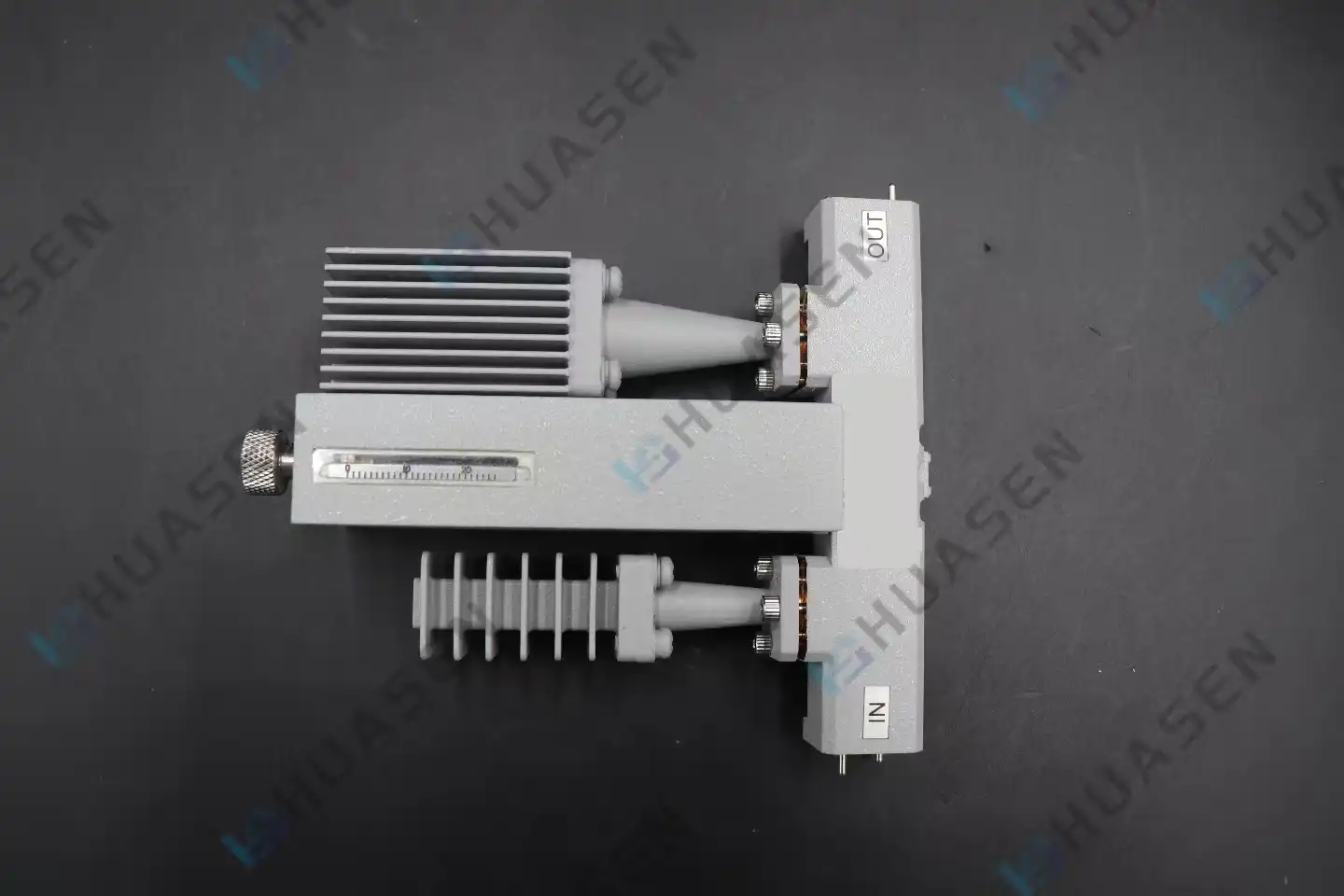
Key Advantages and Practical Benefits of Variable Waveguide Attenuators
Waveguide-based attenuators solve industrial problems better than coaxial or PIN diodes. Their structure offers improved power management without thermal breakdown issues encountered in coaxial configurations. Without a core conductor, the principal heat concentration point is eliminated, allowing continued operation at power levels that would damage conventional variable waveguide attenuators.
Here are the core advantages these devices provide to system integrators and testing facilities:
- Superior Precision Control: Micrometre-driven mechanisms allow precise modelling of progressive signal loss with 0.01 dB attenuation variations. When defining satellite modem dynamic range or identifying the threshold where bit error rates rise in communication channels, accuracy is crucial.
- Broad Frequency Adaptability: Single modules span all waveguide bands, eliminating frequency-specific components. A WR-28 variable attenuator from 26.5 to 40 GHz handles Ka-band satellite downlinks and 5G millimetre-wave backhaul tests, simplifying inventory and procurement.
- Enhanced Durability Under Industrial Conditions: In industrial settings, machined brass or aluminium housings with gold or silver coating resist corrosion and temperature extremes. MIL-DTL-3933 devices work reliably in vibration-prone aircraft and thermally difficult outdoor radar systems.
- Low Insertion Loss Characteristics: These components preserve system sensitivity by degrading signals minimally at zero attenuation. Receiver testing requires this since every tenth of a decibel influences noise figure measures and low noise amplifier characteristics.
B2B clients gain operationally from these advantages. Accurate measurements speed up product development by reducing design iterations. Single test configurations may accept different frequency bands and power levels, optimising laboratory equipment use. Reduced maintenance reduces downtime, especially for distant installations like marine communications systems, where technician access is difficult.
Calibration Procedures and Maintenance Best Practices
For measurement integrity, calibrate against traceable standards periodically. The mechanical drive unit should be backlash-inspected every six months to ensure the dial indication matches the vane position. Any surface contamination or physical damage to RF flange contacts generates impedance discontinuities that reduce return loss. Lint-free isopropyl alcohol swabs are recommended to avoid scratching precision-machined surfaces. The Variable Waveguide attenuator's flange screw torque parameters must be followed to avoid warping the mounting surface and producing RF leakage channels that impair insertion loss. Proper storage in regulated humidity settings avoids plated surface corrosion, increasing operating longevity and meeting manufacturer standards.
Choosing the Right Variable Waveguide Attenuator for Your Industrial Needs
Technical parameters must meet application requirements for procurement. For most testing circumstances, 0-30 dB is sufficient for dynamic control, although rain fade simulation may require higher ranges. A Variable Waveguide An attenuator designed for X-band (8.2-12.4 GHz) cannot support Ku-band satellite frequencies without severe performance reduction.
Technical Specifications and Selection Criteria
A key selection criterion is power handling capacity. Base station testing of high-power amplifiers requires attenuators with average power levels above 100W and peak power in the kilowatt range. Insertion loss requirements at zero attenuation affect the system noise figure; sub-0.3 dB devices sustain receiver sensitivity in low-noise situations. Bandwidth impacts frequency coverage: narrowband optimisation is achieved with ≤5% bandwidth, whereas ≤10% bandwidth versions allow greater flexibility with small performance adjustments. FDP (flush-mounted), FBP (broad-wall), and FUGP (universal grooved) flanges must match waveguide infrastructure for mechanical installation and RF performance.
Procurement Considerations for System Integrators
Manufacturer minimum order numbers affect project economics. Catalogue goods are shipped individually for prototype development and small-scale installations. Custom attenuators demand MOQs of 5-10 units due to engineering expenditure in customised specs. Standard waveguide bands are available immediately, whereas bespoke frequency ranges or power handling needs take 8-12 weeks. Bulk purchases of 50+ units can lower per-unit prices by 20-30%, although demand forecasting is needed to prevent inventory carrying costs.
Manufacturer Comparison and Selection
Several reliable and innovative manufacturers operate worldwide. Pasternack's broad library and same-day shipment on basic configurations enable speedy prototyping. Huber+Suhner provides solutions for severe environments and high-power applications that fulfil military standards. Attenuator design benefits from Keysight's precise calibration data and automated test equipment integration. Regional producers provide cheap prices and flexible customisation, but supply chain stability and certification compliance must be verified. ISO 9001 certifies process control, whereas MIL-STD conformance shows defence applicability. Long-term reliability statistics and warranty terms show manufacturer confidence in product durability, vital for maintenance-free equipment.
Standard Products Versus Custom Designs
In the context of waveguide variable attenuators, catalogue goods offer instant availability and proven performance for typical frequency bands and power levels. Standard attenuators are ideal for applications with conventional requirements due to procurement convenience and reduced unit prices. Custom designs meet specific needs like non-standard frequency coverage for 6G research, improved power management for particle accelerator RF systems, or reduced form factors for aircraft weight limitations. Customisation entails specifying electrical, mechanical envelope, and environmental criteria. Collaboration between engineers provides practical designs that balance performance, production, and cost. Custom development takes 6-8 weeks for electrical design, prototype manufacturing, qualification testing, and production ramp-up.
Procurement Insights: Pricing, Availability, and Ordering Tips
Budgeting and supplier negotiations are easier with market price knowledge. Rotary vane Variable Waveguide Attenuators with precision micrometre drives and phase stability cost $1,200 to $3,500, depending on frequency range and power rating. Standard flap-type designs cost $600–$1,800. Devices with ceramic absorption elements for high-power applications or exotic plating materials for corrosion resistance cost more due to their longer lifespans.
Pricing structures are greatly affected by customisation. Custom-machined housings and absorbent parts add 30-50% to the basic cost for frequencies beyond conventional waveguide bands. Enhanced power ratings require thermal management features like integrated heat sinks or forced-air cooling, increasing production complexity and component prices. Tier pricing with 15-25% per-unit discounts unlocks economies of scale for orders above 25 units. Manufacturers need accurate demand estimates and flexible delivery dates to negotiate bulk discounts and optimise production batching.
Price competitiveness and supply reliability should be considered while sourcing. Digi-Key and Mouser carry popular configurations for fast availability at larger margins. Direct manufacturer partnerships offer better prices and engineering support, but minimum orders may exceed current demands. Online B2B platforms provide price comparison and specification filtering from different suppliers, but product legitimacy and seller reliability must be verified. To reduce supply chain interruptions, qualify various suppliers, set framework agreements for recurrent purchases, and store long-lead or critical-path components.
Future Trends and Innovation in Variable Waveguide Attenuators
Technological advances change variables. Waveguide attenuator design and capability. Advanced carbon nanotube composite and metamaterial absorption materials increase linearity and bandwidth. These materials reduce frequency-specific calibration modifications by maintaining absorption properties throughout greater frequency ranges. Phased array radar modules and tiny satellite payloads can lower form factors without losing power management or accuracy using semiconductor packaging miniaturisation methods.
Closed-loop feedback systems using optical position sensors eliminate mechanical backlash and improve repeatability in precision control mechanisms. Digitised control interfaces replace manual adjustment dials, automating test sequences and remote operation in unmanned systems. These developments follow industry trends towards software-defined radio designs and automated production testing, where mechanical components must connect with digital control systems.
The development of 90-170 GHz attenuators is driven by millimetre-wave 5G and sub-terahertz 6G systems. These new bands require tighter production tolerances and newer absorbent material compositions for wavelengths around one millimetre. These capabilities help manufacturers meet demand from telecommunications infrastructure buildouts and automotive radar applications.
These technologies need procurement practices to change. Early supplier involvement in product development allows co-design of waveguide variable attenuator specs to meet system needs. Strategic connections with R&D-intensive firms offer access to next-generation capabilities. Monitoring industry frequency allocation and standardisation roadmaps helps predict component demands before they become critical path items, retaining competitive advantages in fast-changing markets.
Conclusion
Variable waveguide attenuators are essential for microwave and millimetre-wave signal management in telecommunications, aircraft, military, and research. Their accurate, repeatable attenuation control at high power levels solves system testing, calibration, and signal modelling problems. Success in procurement entails balancing technical standards against application needs, assessing manufacturer reliability and support, and devising sourcing strategies that maintain component availability without additional inventory costs. As wireless technologies increase in frequency and complexity, these components will incorporate advanced materials and digital control while maintaining the fundamental advantages that have made waveguide attenuators essential RF engineering tools.
FAQ
1. What distinguishes rotary vane from flap-type waveguide attenuators?
Polarisation rotation in a rotary vane variable waveguide Attenuators maintain phase stability independent of setting, which is important for phase-sensitive radar and interferometry studies. Flap-type designs use resistive elements in the waveguide, simplifying construction and reducing size but producing phase shift fluctuations with attenuation. Phase-critical systems need rotary vane designs, whereas amplitude-only testing may use flap-type economics.
2. How do frequency ranges affect attenuator performance?
Waveguide dimensions determine operating bandwidth and cutoff frequency. Standard waveguide sizes—WR-90 for X-band and WR-28 for Ka-band—cover certain bands optimally. Operating beyond ranges increases insertion loss and VSWR, degrading performance. System-frequency-matched attenuators guarantee that requirements are satisfied in all operational scenarios.
3. What maintenance extends attenuator's operational life?
As stated by manufacturers, mechanical drive assemblies need frequent backlash and lubrication inspections. Even tiny contamination causes impedance mismatches that affect return loss; thus, flanges must be clean. Storage in regulated conditions avoids precision-plated surface deterioration. Torque requirements during installation avoid RF performance-degrading warping. Regular calibration against traceable standards ensures measurement fidelity.
Partner with Huasen Microwave for Precision Signal Control Solutions.
Huasen Microwave Technology has developed high-performance variable waveguide attenuators for demanding industrial applications for 30 years. Our variable attenuation devices meet the most demanding satellite communications, weather radar, and defence system requirements from 0.96 GHz to 112 GHz with power handling from 10 W to 4000 W. Every attenuator fulfils strict insertion loss, return loss, and power handling criteria in CNC-machined and RF-tested factories. Engineering teams work directly with clients to optimise designs for specific applications, whether catalogue setups or entirely bespoke solutions with speciality flanges and environmental hardening.
As a renowned manufacturer, we meet MIL-STD, ISO, and RoHS quality requirements to satisfy system integrators and procurement managers. Flexible manufacturing accommodates prototypes to bulk orders with clear pricing and predictable lead times, simplifying procurement planning. Technical assistance includes calibration data, integration instructions, and proactive after-sales service to maintain performance throughout operating lifespans.
Discuss signal control needs with our technical team at sales@huasenmicrowave.com. We will collaborate with you to determine ideal configurations, give precise specs and test data, and produce solutions that improve system performance within budget and schedule constraints. Huasen Microwave provides accuracy, dependability, and value-driven components to help you succeed.
References
1. Pozar, D. M. (2012). Microwave Engineering (4th ed.). Hoboken: John Wiley & Sons, Inc.
2. Collin, R. E. (2001). Foundations for Microwave Engineering (2nd ed.). New York: IEEE Press.
3. Saad, T. S. (Ed.). (1971). Microwave Engineers' Handbook (Volume 1). Norwood: Artech House.
4. IEEE Standard 149-2021. IEEE Standard for Test Procedures for Antennas. New York: Institute of Electrical and Electronics Engineers.
5. Montgomery, C. G., Dicke, R. H., & Purcell, E. M. (1948). Principles of Microwave Circuits. New York: McGraw-Hill Book Company (MIT Radiation Laboratory Series, Volume 8).
6. Ginzton, E. L. (1957). Microwave Measurements. New York: McGraw-Hill Book Company.
Send Inquiry