How to Use a Coaxial Variable Attenuator in Signal Chains






2026-07-02 21:00:06
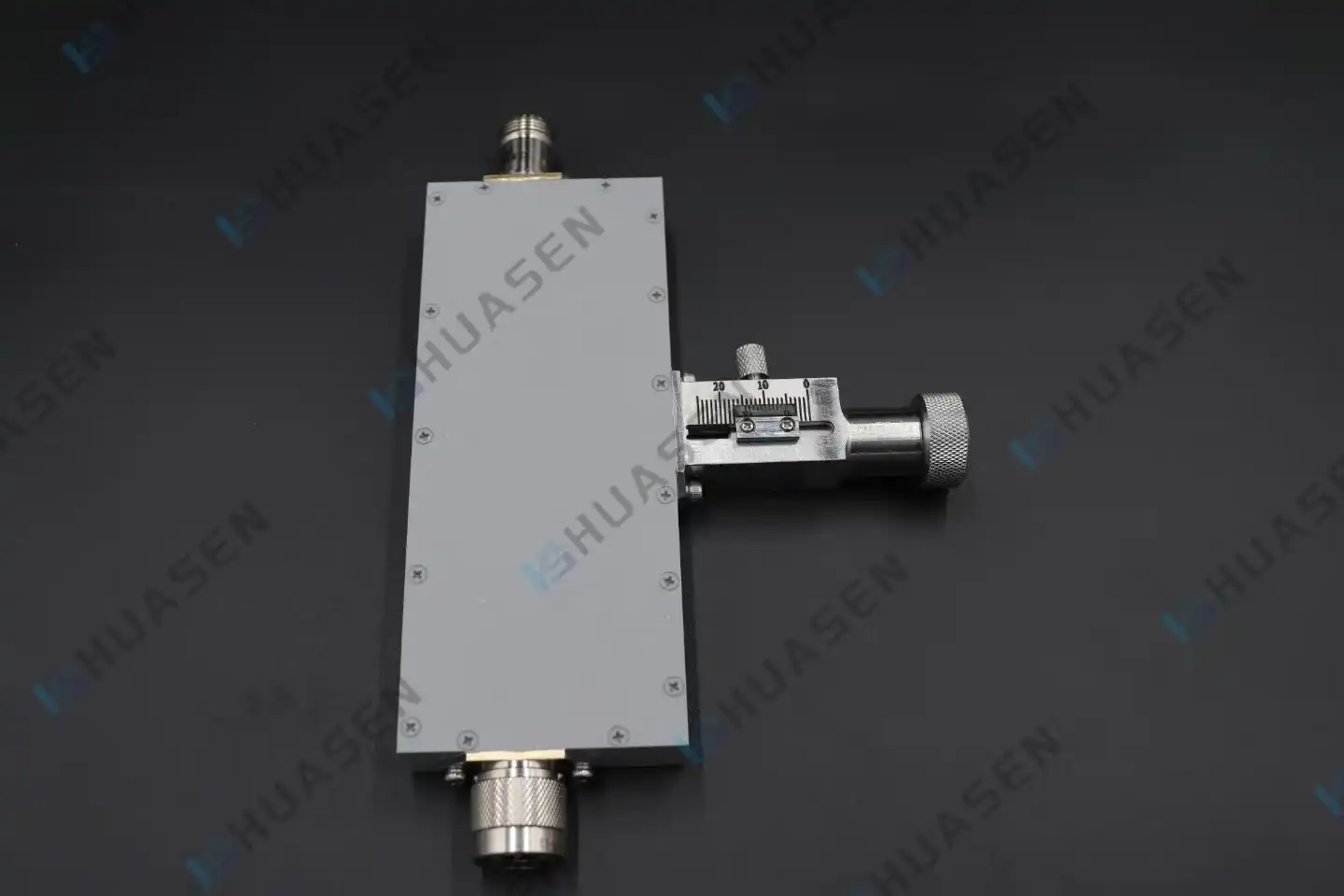
To use a coaxial variable attenuator in your RF signal chain, you need to connect it in-line between the parts you want to control the strength of the signal with. These devices change the power levels without stopping the circuit from working. This makes them essential for protecting receivers, setting gain levels, and calibrating them. Engineers can precisely attenuate signals from 0 to 30 dB by turning the helical mechanism or moving through set values. This ensures that the system works at its best in DC to 18 GHz environments for telecommunications, radar testing, and aerospace.
Understanding Coaxial Variable Attenuators and Their Role in Signal Chains
What Is a Variable RF Attenuator?
A coaxial variable attenuator is an inactive part that lowers the signal strength while keeping the waveform's structure. Variable attenuators let you change the loss value in real time using either manual knobs or motorised controls, while fixed attenuators keep the loss value the same. The internal resistive network takes in RF energy in a proportional way, which lets users set the exact level of reduction they need. This adaptability is very important for testing amps at different drive levels or keeping spectrum analysers from getting too hot while taking readings in the field.
Core Specifications That Define Performance
Three things are most important to look for in a variable attenuator: frequency range, attenuation spread, and insertion loss. It is not necessary to have more than one unit in wideband systems because Huasen Microwave's DC-18 GHz models cover cellular bands through Ku-band satellite links. The range of 0 to 30 dB can be used for both small changes and big power cuts. Insertion loss at 0 dB—often less than 0.8 dB in good designs—has a direct effect on your link budget. Reducing this parasitic loss keeps measurement sensitivity high in lab settings.
Manual Versus Electronic Control Mechanisms
Helical threads are used for fine-tuning in manual coaxial attenuators, which means they have an endless range of resolution. This mechanical method works well on a bench, where an engineer can change the settings by hand between tests. Electronic step attenuators, on the other hand, use PIN diodes to switch resistor networks, which lets automatic test equipment be controlled from a distance. Each type meets a different set of process requirements. Manual units offer better phase stability across adjustment cycles, while electronic versions allow millisecond switches for high-throughput production lines testing 5G base station components.
Step-by-Step Guide: How to Properly Use a Coaxial Variable Attenuator in Your Signal Chain
Assessing Your System Requirements
Write down your frequency band, resistance standard, and highest power level before you integrate. Almost all phone systems use 50 ohms, but some video distribution chains use 75-ohm systems. To avoid reflections caused by adapters, make sure that the coaxial variable attenuator connection type (SMA, N-type, or 2.92 mm) fits the ones you already have. Handling power is also very important. Sending 10 watts through a device designed for 2 watts will overheat the resistive elements, which will lead to lasting calibration drift that makes future tests less accurate.
Selecting Attenuation Range and Linearity
Make sure that the adjustment range of the item works with your needs. For example, to test receiver sensitivity curves, you might need to make small changes of 0.1 dB over a 10 dB range. To simulate path loss in marine communications, you might need the whole 30 dB range. Linearity specifications show how closely the real attenuation matches the setting on the dial. High-quality units stay accurate to within 0.5 dB, which stops the accumulation of mistakes that happen during multi-stage calibration processes when measuring radar cross-section.
Installation Best Practices for Signal Integrity
Mount the attenuator directly between the connectors using torque tools that have been measured. For SMA, 8 inch-pounds of torque keeps the centre pins from being overtightened, which can damage them. Before each link, check the threads for debris. Metal particles in the signal line cause impedance discontinuities that are hard to predict, which can be seen on a network analyser as VSWR spikes. When working in places that shake a lot, like drone tracking systems, use cable clamps to hold the attenuator body in place instead of just using the connecting grip, which can come loose during flight and cause signal fade.
Calibration Techniques for Dynamic Environments
Do a standard VSWR sweep after installation to make sure that the resistance matches across your frequency band. First, use a vector network analyser to find the insertion loss at 0 dB. Next, record S21 parameters as you step through the attenuation values. This information will help you figure out what's wrong with signal chains months from now. If the temperature changes often, like when satellite ground stations go from -40°C to +60°C, you should check the accuracy of the attenuation every three months because thermal expansion can change the values of resistive elements by 0.3 dB in sealed designs that aren't adjusted.
Comparing Coaxial Variable Attenuators to Other Attenuator Types for Procurement Decisions
Variable Versus Fixed Attenuator Applications
Fixed attenuators work best in fixed settings where the loss values don't change, like when the radio output needs to be padded to meet regulatory limits. Engineers can figure out what's wrong with gain compression by slowly raising input power while keeping an eye on third-order intercept points. This works best in research labs and field service. To keep inventory costs as low as possible without limiting options, procurement teams that help with both R&D and implementation often keep set units on hand for production builds and variable models on hand for validation testing.
Coaxial Compared to Pad and Step Designs
Pad attenuators (coaxial attenuators) have several fixed parts inside a single housing. They offer preset loss combinations that can be changed using mechanical buttons. They can be adjusted more quickly than continuous knobs, but they don't have any numbers in between. Software controls attenuation through RS-232 orders in the coaxial variable. Attenuators are used in automated settings. This lets scripted test routines check the receiver AGC reaction in fading channel conditions that are common in 6G development programmes.
Evaluating Supplier Reliability and Customisation
Ask for sample units and S-parameter files that cover your exact frequency band when you are comparing sources. Professional makers can be told apart from commodity suppliers by how clear their datasheets are. Look for VSWR plots at more than one attenuation setting, not just single-point specs. Huasen Microwave has been making RF components for 30 years, which means they have strong design gaps that keep performance even when temperatures change according to MIL-STD. This is very important when the components are going to be used in unmanned aerial vehicle tracking pods or offshore platform communication racks.
Procurement Considerations: How to Buy the Right Coaxial Variable Attenuator for Your Business Needs?
Price Ranges and Budget Planning
Coaxial variable attenuators by hand range from $200 for simple DC-6 GHz models to $1,500 for high-precision DC-40 GHz units with 0.1 dB sensitivity. Electronic models cost more because they have switching grids and control electronics built in. System integrators that are making 100-unit 5G test benches can often get 15-20% volume savings when they buy in bulk. This lowers the cost of the project and makes sure that all parallel measurement points have the same performance, which checks the beamforming algorithms.
Sourcing Channels and Wholesale Advantages
Direct ties with manufacturers give you access to engineering help that you can't get from distributors. Working with a Coaxial Variable An attenuator provider like Huasen lets you do collaborative design iterations that make the most of size, weight, and power limitations when you need to define custom frequency bands or ruggedised housings for shipboard radar systems. Online platforms are quick and easy for basic needs, but for more complicated military or aerospace projects, face-to-face quality reviews are better because they make sure the supply chain is stable over long production runs.
Technical Datasheet Evaluation Criteria
Pay close attention to the frequency flatness specs, which show how attenuation changes across the band. A flatness of ±1.0 dB at 18 GHz means that your real loss could change by 2 dB from peak to peak, which could hide amplifier gain noise during linearity tests. Ask for sample units to be tested in-house. Comparing real VSWR and insertion loss to what the datasheet says will help you find suppliers whose specs are too optimistic, which can lead to problems with integration when the parts arrive for production assembly.
Maximising the Value of Your Coaxial Variable Attenuators: Tips and Best Practices
Impedance Matching Strategies
Keeping your signal chain's resistance at 50 ohms reduces echoes that mess up measurement accuracy. Find impedance bumps that are greater than 1.2:1 VSWR using time-domain reflectometry. These bumps lower the effective dynamic range when you do spectrum analysis. The fully sealed design of Huasen keeps out moisture, which eats away at connection interfaces over time. This keeps impedance stable in humid coastal sites that support marine communication networks that connect offshore platforms to operations centres on the mainland.
Durability in Harsh Operational Environments
Outdoor base station components have to deal with changes in temperature, shaking, and salt spray. If you choose coaxial attenuators (variable coaxial attenuators) with airtight seals and passivated stainless steel housings, they will work without drift for years to come. Modern designs are small, which makes it easier to put racks in equipment sheds that are already crowded, where every cubic inch counts. This is especially true for retrofit projects that are improving old 4G infrastructure to support millimetre-wave 5G small cells.
Leveraging Engineering Support for Custom Solutions
Most uses can be met by off-the-shelf goods, but custom designs are better for systems with specific structures. Working together with companies like Huasen Microwave can help you find solutions like longer attenuation ranges for electronic warfare models or stronger connections for UAV packages that are subject to high vibration. With this partnership method, suppliers become long-term allies who know how your needs change over time and offer improvements that keep you ahead of the competition in the defence and aerospace markets.
Conclusion
Adding Coaxial Variable Attenuators in RF signal chains mean combining technical requirements with the best way to buy them. Engineering teams choose parts that improve system performance while keeping costs low by knowing things like frequency range, attenuation linearity, and weather stability. When devices are installed, calibrated, and impedance-matched correctly, they last longer and give more accurate readings in radar, satellite, and internet uses. Partnering with experienced makers gives you access to customisation options and expert support that can help you with difficult deployment issues, resulting in reliable signal control in settings that are essential to mission-critical operations.
FAQ
1. What differentiates continuously variable attenuators from step attenuators?
Through helical adjustment, continuously varying types offer endless resolution, making them perfect for analogue tuning while amplifier characterisation is being done. Step attenuators change loss in clear steps, like 1 dB or 10 dB. This makes them more reliable for automatic test scripts that need exact numbers to check receiver sensitivity at standard power levels.
2. How does frequency impact attenuation accuracy?
Frequency flatness is a way to measure how much accuracy is lost when higher frequencies add parasitic capacitance. When buying high-quality coaxial variable attenuators, this difference is kept to a minimum, but buyers must check the flatness specs, like 1.0 dB at 18 GHz, to make sure that mistakes stay within acceptable limits for millimetre-wave radar calibration or satellite uplink testing, where accuracy directly affects link margin calculations.
3. Can low-power attenuators handle transmitter lines?
When you use more power than the average or peak limit, the internal resistive elements get too hot and change their values forever or fail open. If the signals are stronger than the variable unit's rating, you should always put in a fixed power divider first. This will protect the adjustment mechanism and keep the freedom needed for gain staging downstream in multi-amplifier chains.
Partner with Huasen Microwave for Reliable RF Solutions
The DC-18 GHz portfolio from Huasen Microwave has the accuracy and durability that procurement teams and system designers are looking for in reliable Coaxial Variable Attenuators for 5G infrastructure, aircraft tests, and radar development. Our helical fine-tuning system lets you easily change the volume from 0 to 30 dB, and the fully sealed design means it can handle harsh industrial settings. We have been making Coaxial Variable Attenuators since 1993 and offer technical teamwork, custom frequency solutions, and quick help after the sale. Email our sales team at sales@huasenmicrowave.com to get datasheets, talk about bulk prices, or set up sample test units that show how our parts improve the performance of your signal chain.
References
1. Pozar, David M. Microwave Engineering, 4th Edition. Wiley, 2011.
2. Vendelin, George D., et al. Microwave Circuit Design Using Linear and Nonlinear Techniques, 2nd Edition. Wiley-Interscience, 2005.
3. Collin, Robert E. Foundations for Microwave Engineering, 2nd Edition. IEEE Press, 2001.
4. Institute of Electrical and Electronics Engineers. IEEE Standard for Precision Coaxial Connectors. IEEE Std 287-2007.
5. Ludwig, Reinhold, and Gene Bogdanov. RF Circuit Design: Theory and Applications, 2nd Edition. Pearson, 2009.
6. Rizzi, Peter A. Microwave Engineering: Passive Circuits. Prentice Hall, 1988.
Send Inquiry