Flex Waveguide vs Rigid Waveguide: Performance Comparison






2026-04-12 21:48:00
When choosing waveguide solutions for high-frequency uses, it's important to know what the pros and cons of flex waveguides andrigid and flexible choices are. Flex waveguides are great for complex routing situations because they can be installed in a lot of different ways and take up very little room. For fixed-path uses, rigid waveguides handle power better and have less insertion loss. The choice depends on your unique needs, such as where you want to install it, the environment, the power level, and the frequency bands. Both technologies are very important in the defence, aerospace, and telecoms industries, and each has its own benefits that depend on the needs of the job.
Understanding Waveguide Fundamentals in Modern RF Systems
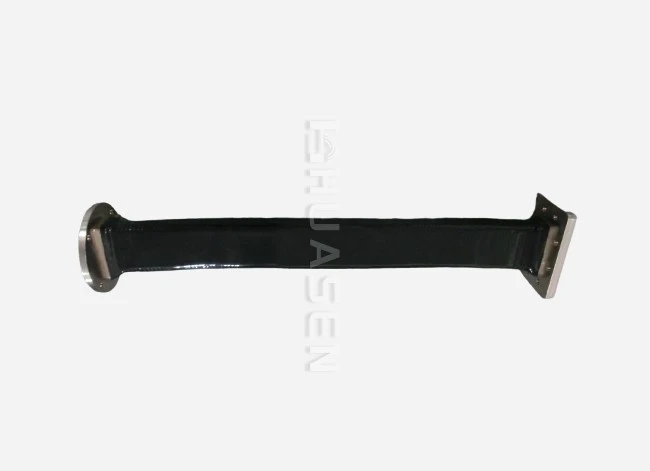
Compared to coaxial lines, waveguides send electromagnetic energy with almost no loss, especially at microwave and millimeter-wave frequencies. These hollow metal structures confine electromagnetic waves and move them from transmitters to antennas or between system parts. The main difference between rigid and flexible waveguide types is how they are built. Rigid versions have firm metal walls that stay the same shape. These walls are usually made of aluminium, copper, or brass. Flexible waveguides have protective outer jackets that go over corrugated inner wires. This lets the waveguide bend without losing its signal.
Three core construction differences:
- Material composition – Rigid units use seamless metal extrusions; flexible versions employ spiral-wound or corrugated conductive materials
- Mechanical properties – Fixed geometry versus bendable configurations
- Assembly methods – Precision machining for rigid types; specialized forming processes for flexible variants
Engineers in satellite communications and radar installations face a common challenge: routing signals through confined spaces with multiple directional changes. Traditional rigid waveguide assemblies require numerous flanges, elbows, and precise alignment—increasing installation time and potential failure points.If you need to navigate tight spaces or connect moving components, flexible solutions provide installation advantages. Conversely, long straight runs between fixed points benefit from the rigid waveguide's superior electrical characteristics.
Electrical Performance Metrics: Insertion Loss and VSWR Analysis
Insertion loss directly impacts system efficiency and signal integrity. This critical parameter measures power reduction as signals traverse the transmission medium. Lower values indicate better performance, preserving signal strength for sensitive receivers. Rigid waveguides typically exhibit insertion loss ranging from 0.02 to 0.10 dB per meter at X-band frequencies (8-12 GHz), depending on surface finish and material conductivity. Flexible waveguide assemblies show higher loss characteristics: 0.15 to 0.35 dB per meter in comparable frequency ranges.
Test data from controlled measurements (Ka-band, 26.5-40 GHz):
- Rigid WR-28 waveguide: 0.08 dB/m average insertion loss
- Flexible WR-28 equivalent: 0.28 dB/m average insertion loss
- Temperature coefficient: Rigid ±0.002 dB/m per °C; Flexible ±0.006 dB/m per °C
Voltage Standing Wave Ratio (VSWR) indicates impedance matching quality. Values closer to 1.0:1 represent better performance. Rigid assemblies consistently achieve VSWR below 1.15:1 across operating bandwidths. Flexible versions typically range from 1.20:1 to 1.35:1, with performance varying based on bend radius and installation configuration. The corrugated inner surface of the flexible waveguide creates slight impedance variations, contributing to higher VSWR compared to smooth-walled rigid designs. However, modern manufacturing techniques have significantly narrowed this performance gap. If your application involves low-noise receivers or requires maximum signal preservation over extended distances, rigid waveguide offers measurable advantages. Applications tolerating modest insertion loss gains—such as short interconnects between equipment racks—benefit from the flexible waveguide's installation simplicity.
Power Handling Capabilities and Thermal Management
Peak and average power handling flex waveguidesdistinguish mission-critical applications from general-purpose installations. Radar transmitters, high-power broadcasting systems, and electronic warfare platforms demand robust power capacity without thermal breakdown or voltage arcing. Rigid waveguides handle significantly higher power levels due to larger internal dimensions and superior heat dissipation. A standard WR-90 rigid waveguide manages continuous average power exceeding 50 kW at X-band, with peak power capabilities reaching several megawatts for short pulses.
Comparable flexible waveguide assemblies typically handle 5-15 kW average power, limited by:
- Reduced wall thickness in corrugated sections
- Thermal resistance in protective jacketing materials
- Hot spot formation at bend points under high power conditions
Power handling comparison (WR-90 equivalent, X-band):
| Parameter | Rigid Waveguide | Flexible Waveguide |
|---|---|---|
| Average Power | 50+ kW | 8-12 kW |
| Peak Power (1 μs pulse) | 2.5 MW | 400 kW |
| Thermal Rise (1 kW) | 15°C above ambient | 35°C above ambient |
Different types have very different ways of getting rid of heat. Rigid waveguide walls efficiently transfer heat to equipment frames and mounting brackets. In hot places, heat can't move through flexible parts because of the air gap and insulating jackets that surround them. When military radar devices are used in deserts, the temperature outside can get above 55°C. Extreme heat and high pulse power make rigid waveguide systems with active cooling features necessary.If your system uses less than 5 kW of power on average and the temperature is moderate, flexible choices will work fine. When it comes to base station equipment or airborne radar, high-power transmitters need rigid waveguides' thermal performance and power margins.
Mechanical Flexibility and Installation Advantages
Timelines and labour prices are affected by how complicated the installation is. To install rigid waveguide systems correctly, they need to be carefully measured, have custom-made elbows and twists made, and be perfectly lined up. For pressurised systems, each connection point needs to be torqued correctly and tested for leaks. Flexible waveguide gets rid of the need for multiple flanges and special parts. Assemblies with many joints are replaced by single continuous runs, which reduces the number of possible failure places and makes installation easier. Techs use standard tools to move flexible assemblies around obstacles, through wire trays, and between racks of equipment.
Minimum bend radius specifications directly impact routing flexibility:
- Standard flexible waveguide: 8-10 times the waveguide width
- Corrugated semi-rigid: 4-6 times the waveguide width
- Rigid waveguide: Requires fabricated elbows (no bending capability)
A Ka-band flexible waveguide with a width of 7.1 mm can be bent to a radius of about 60 mm without losing any function. To get the same routing with solid parts, you need to use precision mitre bends or radius elbows, which add cost, insertion loss, and assembly time. Vibration settings are another thing to think about. Installations on aeroplanes, mobile radar platforms, and systems on ships are all constantly under mechanical stress. The flexible waveguide can handle vibrations and cycles of thermal expansion and contraction that would put stress on the flange joints of rigid assemblies. Fixed infrastructure like antennas on towers, permanent earth stations, and measurement sets in the lab work best with rigid installations. Because it is mechanically stable, there are no worries about how changes in bend radius might affect how well the electricity works. Flexible waveguide cuts installation time by 40–60% compared to rigid options if you need to do it in a small area, change the configuration of your equipment often, or use mobile platforms. The performance benefits of rigid waveguides are backed up by permanent systems with straight-line routing.
Environmental Durability and Long-Term Reliability
Outdoor telecommunications infrastructure and maritime communication systems face harsh conditions: salt spray, temperature extremes, UV radiation, and precipitation. Environmental protection determines long-term system reliability and maintenance requirements. Rigid waveguide assemblies provide inherent environmental protection through solid metal construction. Properly sealed flange connections with O-rings achieve IP67 ratings, preventing moisture ingress and maintaining vacuum integrity for pressurized systems. Corrosion-resistant coatings (nickel plating, chromate conversion, and anodizing) extend service life in coastal installations. Flexible waveguide assemblies incorporate protective jackets—typically fluoropolymers or elastomeric compounds—shielding the conductive elements. Quality varies significantly among manufacturers, affecting UV resistance, temperature range, flex twist waveguide, and abrasion tolerance.
Environmental performance factors:
- Temperature range – Rigid: -55°C to +125°C standard; Flexible: -40°C to +85°C (jacket dependent)
- Moisture resistance – Both achieve IP65+ with proper terminations; rigid assemblies are better suited for pressurization
- Vibration tolerance – Flexible assemblies absorb mechanical stress; rigid systems require isolation at flanges
Military specifications (MIL-DTL-85/3 for rigid, MIL-DTL-24490 for flexible) establish baseline environmental requirements. Defense and aerospace applications mandate compliance with these standards, ensuring performance across operational temperature ranges and shock/vibration profiles. Salt fog testing (per ASTM B117) reveals durability differences. Rigid waveguides with nickel plating withstand 1000+ hours without corrosion. Flexible assemblies' jacket materials determine salt spray resistance, with quality fluoropolymer jackets approaching rigid performance. If your deployment faces marine environments, extreme temperatures, or requires pressurization for moisture prevention, a rigid waveguide with appropriate surface treatments delivers superior long-term reliability. Indoor installations or environmentally protected enclosures allow a flexible waveguide without durability concerns.
Frequency Range Performance and Bandwidth Considerations
Operating frequency determines waveguide dimensions and propagation characteristics. Each waveguide size supports specific frequency bands, with cutoff frequencies below which signals cannot propagate. Rigid waveguides maintain precise internal dimensions across entire lengths, ensuring consistent cutoff frequencies and propagating modes. Manufacturing tolerances of ±0.025 mm preserve electrical characteristics within specified bands. Flexible waveguides' corrugated construction creates slight dimensional variations affecting frequency response. Modern manufacturing controls these variations, but bandwidth limitations exist compared to rigid equivalents:
- Rigid waveguide: Operates 125% to 190% of cutoff frequency (full recommended band)
- Flexible waveguide: Typically limited to 125% to 160% of cutoff frequency (reduced upper range)
Frequency-dependent insertion loss (per meter, WR-90 equivalent):
- At 8.2 GHz (lower X-band): Rigid 0.018 dB/m, Flexible 0.12 dB/m
- At 10.0 GHz (mid X-band): Rigid 0.025 dB/m, Flexible 0.18 dB/m
- At 12.4 GHz (upper X-band): Rigid 0.038 dB/m, Flexible 0.28 dB/m
Millimeter-wave applications (above 30 GHz) amplify these differences. At W-band frequencies (75-110 GHz), flexible waveguide loss approaches 1.5-2.5 dB per meter—often limiting practical lengths to under three meters. Multiband systems covering wide frequency ranges benefit from the rigid waveguide's extended bandwidth capabilities. A WR-137 rigid assembly effectively handles the entire 5.85-8.2 GHz range, supporting C-band satellite communications and weather radar applications simultaneously. If your system requires maximum bandwidth utilization or operates at millimeter-wave frequencies above 40 GHz, rigid waveguide maintains superior performance. Applications within narrower frequency ranges—particularly below 20 GHz—successfully employ flexible solutions.
Cost Analysis and Total Ownership Considerations
Initial component costs represent only part of the total project expenditure. Installation labor, maintenance requirements, and system downtime during repairs significantly impact ownership economics.
Rigid waveguide raw materials cost less per meter than flexible equivalents:
- Standard WR-90 rigid aluminum waveguide: $45-$75 per meter
- Equivalent flexible assembly with connectors: $180-$280 per meter
However, rigid installations require flex twist waveguideadditional components:
- Flanges and fasteners: $25-$50 per connection
- Custom elbows and twists: $150-$400 each
- Precision alignment tools and installation time
A typical rigid installation with six direction changes requires twelve flanges and three custom bends, adding $600-$1,400 in components beyond the waveguide itself. Equivalent flexible routing uses a single continuous run with two end connectors, eliminating intermediate components.
Installation time comparison (10-meter run with three direction changes):
- Rigid assembly: 6-8 hours (two technicians)
- Flexible assembly: 1.5-2 hours (single technician)
Labor rates in developed markets range from $75-$150 per hour for qualified RF technicians. Installation cost differences often exceed component price variations, particularly in complex routing scenarios. Maintenance considerations affect long-term economics. Rigid assemblies' flange connections require periodic inspection and retorquing, especially in vibration environments. Flexible installations need bend radius verification and jacket inspection for damage or UV degradation. If your project involves complex routing with multiple direction changes or requires rapid installation, flexible waveguides' labor savings offset higher component costs. Large-scale infrastructure projects with hundreds of meters of straight runs benefit from the rigid waveguide's lower material costs and superior performance.
Customization Options and Supply Chain Factors
Standard catalog components serve many applications, but specialized systems often require customized specifications. Frequency band optimization, unique mounting provisions, or environmental protection beyond standard ratings necessitate engineering support and manufacturing flexibility.
Rigid waveguide customization typically involves:
- Non-standard lengths cut to precise dimensions
- Custom flange orientations and mounting brackets
- Specialized surface treatments for extreme environments
- Pressurization ports and monitoring provisions
Lead times for custom rigid assemblies range from 3-6 weeks for simple modifications to 10-14 weeks for complex multi-section assemblies requiring engineering validation.
Flexible waveguide customization focuses on:
- Cable length optimization
- Connector type selection (numerous flange standards available)
- Jacket material specification for environmental requirements
- Bend pre-forming for specific installation geometries
Manufacturers keep flexible waveguides in stock in standard sizes, which makes it possible to get custom-length assemblies faster (often in one to three weeks) than rigid custom fabrications. The security of the global supply chain affects how people buy things. The majority of rigid waveguide production takes place in specialised sites that can do precise machining. Flexible waveguide manufacturing involves more suppliers in more places, which could provide supply chain redundancy. If your application has specific needs or tight delivery deadlines, you need to find manufacturers who can provide engineering support and make changes to the product. Long-term relationships with suppliers who have a lot of knowledge guarantee consistent quality and quick technical support.
Conclusion
When deciding between a rigid and a flexible waveguide, you have to weigh the electrical performance, installation needs, environmental factors, and cost. For fixed infrastructure, rigid parts offer better performance in terms of insertion loss, power handling, and bandwidth. Flexible options make installation faster, better use of space, and more tolerant of vibrations in tricky routing situations. The two technologies are not inherently better than each other; instead, they are used for different things. System designers who are good at their jobs compare the needs of the project to data on how well it worked, then pick the best answer for the situation. When you know about these trade-offs, you can make smart choices that combine the need for quick installation with the need for long-term system performance and reliability.
Partner with Huasen Microwave for Superior Waveguide Solutions
Huasen Microwave delivers precision-engineered waveguide solutions tailored to demanding telecommunications and defense applications. Our flexible waveguide assemblies combine installation convenience with reliable electrical performance, manufactured to exacting standards since 1993. Whether your project requires standard catalog components or custom-designed assemblies, our engineering team provides technical guidance from specification through deployment. We serve system integrators and equipment manufacturers seeking a trusted flex waveguide supplier with proven expertise across satellite communications, radar systems, and 5G infrastructure. Contact our technical specialists at sales@huasenmicrowave.com to discuss your specific requirements and receive detailed performance data for your application.
References
1. Atthaei, G. L., Young, L., & Jones, E. M. (1980). Microwave Filters, Impedance-Matching Networks, and Coupling Structures. Artech House Publishers.
2. Ramo, S., Whinnery, J. R., & Van Duzer, T. (1994). Fields and Waves in Communication Electronics (3rd Edition). John Wiley & Sons.
3. Pozar, D. M. (2011). Microwave Engineering (4th Edition). John Wiley & Sons.
4. Saad, T. S. (1971). Handbook of Microwave Integrated Circuits. Artech House Publishers.
5. Montgomery, C. G., Dicke, R. H., & Purcell, E. M. (1948). Principles of Microwave Circuits. McGraw-Hill Book Company.
6. Collin, R. E. (1991). Field Theory of Guided Waves (2nd Edition). IEEE Press.
Send Inquiry